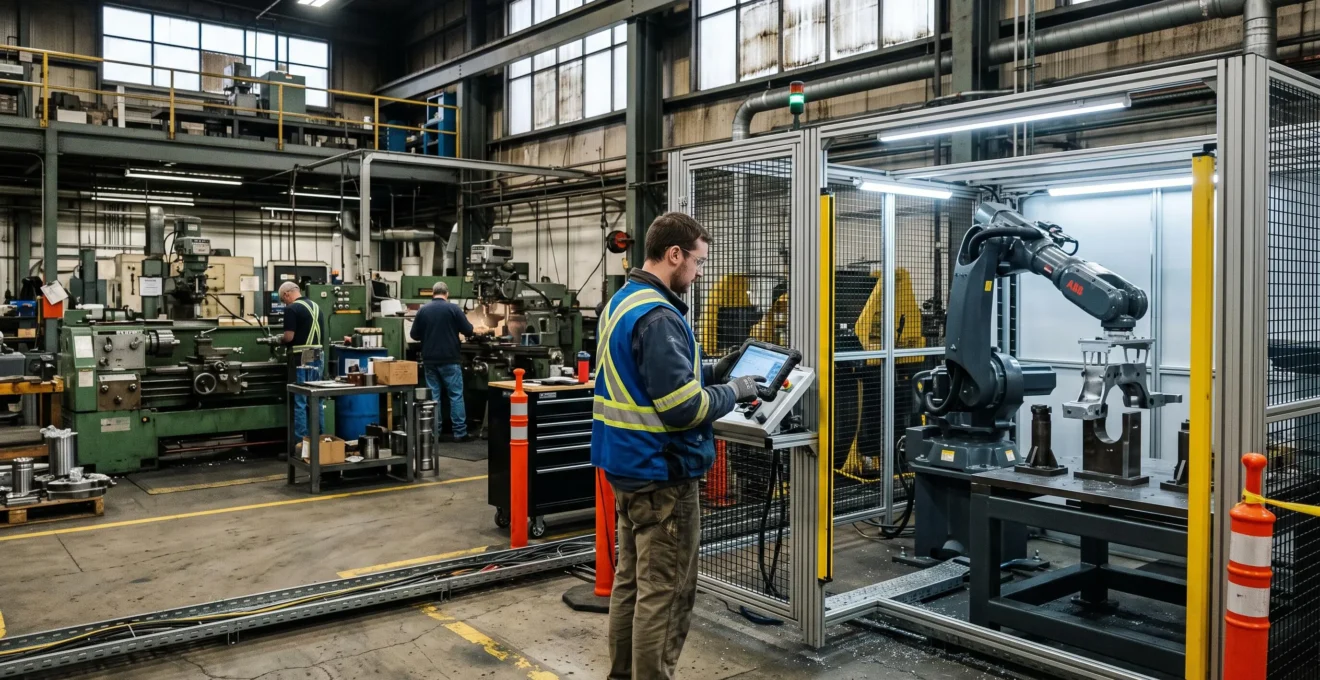
Canadian manufacturers and resource businesses face a difficult balancing act: improving productivity and production reliability while managing aging equipment, material costs, specialized labour needs and uneven access to industrial technology. For many facilities, modernization is not a single major investment. It involves a sequence of operational decisions about machinery, processes, digital systems and workforce capabilities.
Technological change can strengthen Canadian industrial competitiveness, but its value depends on where and how it is introduced. A robotic cell may improve consistency in a repetitive process while creating new maintenance requirements. Digital monitoring may support a remote mine without addressing the quality-control problems of a fixed manufacturing plant. Equipment upgrades may also underperform when workers lack sufficient preparation.
Industrial workers and regional business owners therefore need to assess modernization through practical outcomes: production continuity, lower material losses, safer operations, appropriate technology selection and sustainable technical skills. Regional operating conditions influence which improvements are feasible and how quickly they can be implemented.
Canadian industrial modernization: Key points
- Modernization opportunities differ across Canadian regions because suppliers, workforce capabilities, infrastructure and operating requirements vary.
- Equipment replacement, waste reduction and automation decisions should be based on measurable operational risks and benefits rather than technology trends alone.
- Workforce training and access to technical support are essential to sustaining productivity after industrial upgrades.
- Why Do Industrial Modernization Rates Vary Across Canadian Regions?
- How to Reduce Material Waste in Small Canadian Manufacturing Facilities
- Mining or Manufacturing: Which Digital Tools Address Different Operational Needs?
- How Deferred Equipment Replacement Can Threaten Production Continuity
- When Should Industrial Employers Retrain Workers Before Equipment Upgrades?
- How to Identify Repetitive Production Tasks Worth Automating
- How to Identify Skill Gaps Using Real Canadian Job Postings
- Where Can Robotics and Automated Systems Improve Canadian Industrial Operations?
Why Do Industrial Modernization Rates Vary Across Canadian Regions?
Industrial modernization progresses at different rates across Canada because businesses operate under different equipment, infrastructure, labour and supply-chain conditions. Proximity to automation providers, access to qualified technicians, machinery age and regional energy costs can influence investment feasibility. Comparing facilities without accounting for these conditions can obscure the practical reasons behind differences in technology adoption.
Statistics Canada’s analysis of the 2022 Survey of Advanced Technology illustrates the variation. Manufacturing enterprises reported an 8.4% robotics adoption rate, compared with 2.2% among enterprises in mining, quarrying, and oil and gas extraction. Across the industries covered by the survey, Ontario recorded 3.0% adoption, Quebec 2.2%, Atlantic Canada 1.4%, and the combined North and West regions 0.9%.
8.4%
Share of Canadian manufacturing enterprises reporting robotics technology adoption in the 2022 Survey of Advanced Technology. This measures robotics adoption, not overall industrial modernization, and does not represent the adoption rate in 2026.
These figures describe differences rather than establish their causes. A manufacturer near the Windsor–Quebec City industrial corridor may have more potential integrators within practical service distance than an isolated facility, but the advantage depends on the actual supplier network and equipment requirements. Businesses in British Columbia’s Lower Mainland may similarly benefit from proximity to industrial services, while still facing their own labour and operating constraints.
Long replacement-part lead times can change the economic case for automation. Equipment that is affordable to purchase may be expensive to maintain when specialized technicians must travel considerable distances. Electricity tariffs, connection capacity and local technical training opportunities can also affect project feasibility.
Statistics Canada‘s survey additionally identified regional differences in reported barriers among robotics adopters. Difficulty recruiting qualified staff was considered a significant obstacle by 48.2% of respondents in Atlantic Canada, compared with 19.5% in Ontario. These percentages should not be generalized to all industrial establishments.
A useful regional self-assessment should examine four conditions:
- Technical support: Identify available integrators and their typical response times.
- Parts availability: Compare delivery times for critical replacement components.
- Public support: Check currently available provincial modernization and workforce development programs.
- Labour capacity: Assess whether local technicians can install, operate and maintain the proposed technology.
Regional comparisons become more useful when they explain specific operational limitations rather than simply ranking technology adoption. Once those limitations are understood, facilities can identify achievable efficiency gains within their existing operations, including material waste reduction.
How to Reduce Material Waste in Small Canadian Manufacturing Facilities
Small Canadian manufacturers can reduce material waste by measuring losses, calculating their full costs and addressing the processes that generate the most avoidable expense. Better purchasing practices, grouped production runs, standardized material dimensions and recovery arrangements can help. Waste-handling changes must also account for the applicable provincial environmental requirements and the properties of each material.
The first step is distinguishing visible scrap from financially significant waste. A large volume of inexpensive packaging may attract attention, while smaller quantities of costly metal, specialty plastic or rejected finished components represent a greater financial loss.
For each waste stream, a facility can estimate the combined cost of discarded material, handling, transportation and disposal. Any recoverable resale value can be recorded separately. This provides a more useful basis for prioritization than waste volume alone.
Environment and Climate Change Canada identifies changes to equipment and processes, improved inventory management, material recovery and employee training as pollution-prevention measures in its pollution-prevention guidance for businesses.
These approaches are especially relevant to facilities operating short production runs. Frequent changeovers may generate setup scrap, trimming losses and additional rejected pieces while machines are recalibrated. Potential responses include grouping orders with compatible specifications, improving setup instructions and standardizing purchased input dimensions where product requirements permit.
Material recovery also deserves attention. Reusable offcuts may support other production orders, while suitable residual materials could potentially be exchanged with neighbouring industrial businesses. Such arrangements require verification of material quality, transportation costs and the receiving facility’s ability to use the recovered material.
However, not every waste stream can be managed through ordinary reuse or recycling. Hazardous residues, contaminated metals and certain technical materials may be subject to specific handling, storage, documentation or disposal requirements. Facilities should verify the rules applicable in their province and the classification of the material before modifying their practices.
Five actions for a practical material-waste audit
- Record the main material waste streams over a representative production period and produce a categorized waste inventory.
- Calculate material purchase losses and handling or disposal expenses for each stream, creating a ranked cost table.
- Document scrap generated during machine changeovers and prepare a changeover-loss worksheet.
- Test one feasible reduction measure, such as adjusted batch scheduling, and produce a before-and-after material balance.
- Verify applicable waste-management requirements and record the relevant compliance checks in a process review log.
Reducing waste improves resource efficiency, but the appropriate technique depends on the operation. That same principle applies to digital technology: a tool designed for one industrial environment may be unsuitable for another.
Mining or Manufacturing: Which Digital Tools Address Different Operational Needs?
Mining and manufacturing operations require different digital tools because their operating environments and sources of uncertainty differ. Mining businesses may prioritize remote equipment monitoring, geological information, fleet coordination and distributed-site communications. Manufacturers operating fixed production lines often focus on process repeatability, equipment utilization, quality control and production scheduling. Technology selection should follow the operational problem rather than the sector’s latest digital trends.
In mining, production activities may span geographically dispersed assets and changing geological conditions. Reliable access to equipment data and operational information can be important where physical inspections are difficult or costly.
Natural Resources Canada‘s 2022–2027 mining planning framework identifies connected sensors, real-time monitoring, analytics, dynamic scheduling, digital twins and integrated automation as potential applications for improving mining operations. These are technological opportunities identified in the planning document, not evidence that every deployment has delivered measurable benefits.
Manufacturing presents a different set of common requirements. A fixed facility may need to track individual production orders, identify quality deviations, record machine downtime and coordinate work across successive operations. Manufacturing execution systems, or MES platforms, can support these functions where their capabilities match the production process.
The distinction becomes clearer when comparing operational requirements.
| Decision criterion | Mining operations | Manufacturing facilities |
|---|---|---|
| Primary uncertainty | Geological, environmental and distributed operating conditions | Process variation, quality and production scheduling |
| Operating location | Potentially remote and geographically dispersed | Typically fixed production facilities |
| Important data | Equipment condition, location and remote telemetry | Cycle times, quality results and production status |
| Potential digital solutions | Remote monitoring, fleet systems and operational analytics | MES platforms, machine monitoring and inline inspection |
| Implementation constraint | Communications reliability and environmental conditions | Machine integration and process-data consistency |
These are typical distinctions, not absolute boundaries. Mines may operate processing plants with manufacturing-like requirements, while manufacturers may manage remote assets and complex material traceability.
The greater risk is transferring software between environments without verifying its intended function. A remote-maintenance platform may track mining equipment health effectively but lack the order-level information required to manage a factory’s production execution. Conversely, an MES may offer little value if remote-site communications cannot support its operating requirements.
Before procurement, employers should establish the required information, connectivity, cybersecurity controls, integration interfaces and worker competencies. Equipment safety obligations and applicable provincial requirements must also be reviewed, particularly when digital tools affect machinery control or remote operations.
Digital systems can improve visibility, but they cannot compensate for every physical limitation. Where aging equipment threatens production continuity, machinery reliability may need attention before additional software investment.
How Deferred Equipment Replacement Can Threaten Production Continuity
Deferring industrial equipment replacement can threaten production continuity when aging machinery becomes unreliable, difficult to repair or incompatible with newer systems. The risk extends beyond the individual machine if it is a critical production bottleneck. Businesses should evaluate downtime, replacement-part availability, repair costs and safety obligations before deciding whether continued operation remains economically defensible.
Consider a production line in which several machines depend on one specialized finishing station. If that station fails, work may accumulate upstream while downstream operations run out of material. The financial consequences can therefore exceed the maintenance expense associated with the failing machine.
Repeated temporary repairs can make this dependency harder to recognize. A maintenance team may successfully restart the equipment after each incident while the frequency of failures and time required for recovery gradually increase.
Two indicators deserve particular attention: more frequent provisional repairs and longer restoration times. Both suggest that short-term maintenance decisions may be accumulating into a larger production risk.
A transparent replacement decision should compare the projected cost of continued operation with the capital and transition costs of a replacement. The analysis can combine historical unplanned downtime, the estimated cost per hour of interrupted production, maintenance spending and the probability and consequences of future failures.
For a clearly hypothetical example, assume a machine has experienced 12 hours of unplanned downtime over a representative period and the facility estimates an incremental production interruption cost of $1,500 per hour. The estimated interruption cost would be $18,000 before repair expenses. Those figures illustrate the calculation only; they are not industry benchmarks or a forecast of future failures.
Canadian facilities relying on imported components should also investigate actual spare-part lead times, including any delays associated with overseas supply and specialized service availability. A low purchase price offers limited reassurance if an essential component cannot be replaced promptly.
Equipment compatibility creates another risk. Older machinery may lack interfaces required by modern monitoring systems or need substantial modifications to meet integration and safety requirements. As successive upgrades are postponed, the cost and complexity of connecting legacy and modern equipment may increase.
Replacement is not always the best immediate option. A reliable machine with available parts and manageable integration requirements may remain useful through preventive maintenance or a carefully scoped retrofit. The decision should reflect measured condition and operational criticality rather than equipment age alone.
Once an equipment replacement is justified, the next challenge is preparing the workforce to operate and maintain it without extending the disruption associated with installation.
When Should Industrial Employers Retrain Workers Before Equipment Upgrades?
Industrial employers should begin foundational training early enough to address safety, digital literacy and general operating concepts before installation. Machine-specific instruction is usually more useful closer to commissioning, when workers can apply what they learn. The appropriate schedule depends on equipment complexity, similarities with existing machines, training availability and the competencies required for safe operation.
Training after installation can create a costly gap between technical readiness and workforce readiness. A machine may be mechanically operational while production remains limited because operators are still learning its controls, setup procedures or troubleshooting requirements.
Training too early can also create challenges. Workers who learn detailed machine procedures months before the equipment arrives may have few opportunities to practise, particularly when the replacement technology differs substantially from existing systems.
A phased approach can help employers align learning with the upgrade:
- Early planning: Assess existing skills, introduce relevant digital concepts and identify safety-related learning needs.
- Before installation: Arrange supplier instruction, practical demonstrations and maintenance familiarization where suitable.
- During commissioning: Provide supervised, machine-specific practice and verify worker competence before assigning independent duties.
- After deployment: Monitor recurring errors, changeover performance and support requests to determine whether additional instruction is needed.
Canadian employers can also investigate applicable provincial workforce training assistance, apprenticeship arrangements and partnerships with community colleges or technical institutions. Eligibility, funding availability and administrative requirements vary, so these opportunities should be confirmed for the relevant jurisdiction and project.
The Canadian Centre for Occupational Health and Safety emphasizes that workers involved with industrial robots should understand relevant hazards, procedures and safe operating requirements. Its guidance on industrial robots and cobots supports integrating competency development and risk assessment into deployment planning.
For employers, training is also a workforce allocation problem. When only a few experienced operators can keep older machines running, removing them from those roles for training may temporarily weaken existing production. Waiting until new machinery is installed can intensify this conflict.
Cross-training, staggered instruction and temporary operating coverage may help maintain continuity. Supervisors should distinguish between attendance at a training session and demonstrated ability to perform the relevant duties safely and consistently.
Prepared workers make equipment upgrades easier to implement, but technology investment should still be directed toward tasks where automation addresses a clearly identified operational need.
How to Identify Repetitive Production Tasks Worth Automating
Production tasks are promising automation candidates when they combine measurable workload, consistent operating conditions and meaningful opportunities to improve quality, safety or production capacity. Repetition alone is insufficient. Employers must also examine variation, exceptions, surrounding workflows and maintenance requirements to determine whether automation would solve the problem or simply relocate it.
The first assessment should identify operations with frequent cycles, predictable movements and limited product variation. Examples may include transferring identical components, performing standardized inspections or arranging finished items for packaging.
A second assessment should examine what happens before and after the proposed automated task. A fast automated station offers limited production benefit if upstream material preparation cannot supply it consistently or downstream operations cannot accept its output.
Some tasks that appear repetitive contain exceptions that become apparent only through direct observation. Components may arrive in different orientations, surfaces may vary, or operators may make small adjustments that are not documented in standard work instructions.
Before committing to equipment, supervisors should observe representative operating cycles and record their durations, variations, manual adjustments and interruptions.
Task selection must also account for factors beyond frequency. An operation performed relatively infrequently may still deserve automation if it exposes workers to physical strain or frequently produces costly quality defects. Conversely, a highly repetitive manual operation may not justify substantial equipment spending when it is inexpensive, safe and easily staffed.
For small-batch Canadian facilities, flexibility is especially important. Changes in product dimensions, order sizes and handling requirements can reduce the usefulness of a fixed automation solution. Modular tooling, programmable handling systems or partial automation may be more appropriate than replacing the entire workstation.
A practical decision matrix can compare candidate tasks using observed cycle time, exception frequency, defect cost, physical demands, staffing requirements, integration complexity and expected maintenance support.
The resulting priority should reflect overall system performance. A task should not receive a favourable assessment simply because its movements are easy to automate.
Automation priorities become more realistic when matched with the workers available to operate, maintain and improve the proposed systems. Canadian job-market information can provide another perspective on those skill requirements.
How to Identify Skill Gaps Using Real Canadian Job Postings
Canadian industrial employers can identify potential skill gaps by comparing competencies repeatedly requested in relevant job postings with the capabilities of their existing teams. The strongest approach considers similar occupations, technologies and regions, then validates the results against actual production needs. Job advertisements provide useful market signals, but they do not independently prove a local shortage or justify every listed requirement.
Begin with postings from employers operating comparable equipment or production processes. Relevant sources may include Canada’s Job Bank, employer career pages and other recruitment platforms. The objective is to identify recurring technical requirements, not merely collect job titles.
For example, advertisements for industrial maintenance positions may mention programmable logic controllers, industrial electrical troubleshooting, preventive maintenance, automation diagnostics or equipment safety procedures. These are illustrative competency categories, not results from a newly conducted analysis of current postings.
Employers can group extracted skills into a common framework and compare them against demonstrated employee capabilities. Evidence might include practical assessments, documented maintenance experience, completed training and supervisor observations.
It is important to distinguish three situations:
- Internal capability gap: A required competency is absent or insufficient within the current workforce.
- Local recruitment constraint: The business has difficulty attracting qualified candidates under its actual employment conditions.
- Overstated job requirements: Advertisements combine preferred qualifications that may not all be necessary for successful job performance.
These situations call for different responses. An existing worker may learn a specific diagnostic technique through targeted instruction, while a specialized engineering need may require recruitment or an external service partnership.
A simple prioritization framework considers how frequently a skill appears in relevant postings, how essential it is to planned operations and how difficult recruitment has been locally. Competencies that are essential, repeatedly requested and difficult to source deserve closer attention, although this does not automatically make internal training the best solution.
Job postings also contain a timing bias. They reflect hiring intentions at publication and may include technologies nearing replacement or skills associated with a temporary investment cycle. Employers should compare multiple sources and consult equipment suppliers, technical educators and operational specialists before committing to a long-term training strategy.
Regional colleges and provincial apprenticeship arrangements may offer ways to address certain gaps. Their relevance depends on the occupational requirements, available programs and the facility’s ability to provide practical experience.
Once employers understand operational requirements and available workforce capabilities, they can make more informed decisions about where robotic systems offer meaningful improvements.
What to establish before investing in industrial automation
- Identify the production problem first and distinguish capacity, quality, safety and continuity objectives.
- Confirm that equipment integration, technical support and maintenance capabilities are realistic for the facility’s location.
- Prepare workers and verify operational safety requirements before committing to full-scale deployment.
Where Can Robotics and Automated Systems Improve Canadian Industrial Operations?
Robotics and automated systems can improve Canadian industrial operations in material handling, repetitive inspection, packaging, palletizing and tasks performed under difficult physical conditions. Their value may come from increasing capacity, reducing exposure to hazards or improving consistency. The strongest applications depend on task variability, workforce availability, integration costs and reliable access to maintenance expertise.
Heavy material handling is one potential application. Automated lifting, positioning and transfer equipment can reduce the amount of demanding manual movement involved in selected processes, provided the system is designed around the actual loads, work environment and required safeguards.
Industrial environments involving dust, noise, cold conditions or other hazards may offer additional opportunities. Automation can limit certain forms of worker exposure, although it may introduce mechanical, electrical and maintenance risks that need separate assessment.
Repetitive inspection is another candidate where products and acceptance criteria are sufficiently consistent. Machine vision or automated measurement can help identify deviations, but employers must evaluate detection accuracy, false rejects, lighting conditions and the handling of exceptional cases.
Packaging and palletizing may also be suitable when product dimensions, load patterns and throughput are predictable. For changing product mixes, the required reprogramming and tooling changes can significantly affect the business case.
Three investment objectives should be kept distinct:
- Replace a physical action: Automate a repetitive movement while preserving the broader production process.
- Increase capacity: Reduce an identified bottleneck when other operations can support the resulting throughput.
- Improve safety: Reduce worker exposure to specific hazards while controlling risks introduced by the automated system.
In some Canadian regions, production continuity may be an important part of the investment rationale. Where qualified workers are difficult to recruit, automated systems may help maintain certain operations. However, labour scarcity does not remove the need for trained personnel to oversee, maintain and troubleshoot the equipment.
Small-batch production requires particular caution. Traditional fixed automation can be poorly suited to frequent changes in part geometry and production sequences. Collaborative robotic applications, rapid-change tooling or partial automation may offer greater flexibility, but none is automatically the most economical choice.
Collaborative systems also require application-specific safety assessment. Their ability to operate near workers does not eliminate hazards associated with moving components, sharp workpieces, unexpected motion or surrounding equipment. The Canadian Centre for Occupational Health and Safety highlights these considerations in its robotics safety guidance.
For Canadian industrial employers, the feasibility of robotic automation ultimately depends on the supporting ecosystem. Spare parts, qualified integrators, programming capabilities and local maintenance resources influence the operational sustainability of any installation.
A practical next step is to select one measurable operational problem, document its current performance, assess the available workforce and technical support, and evaluate a limited automation or process-improvement proposal before scaling the investment.
Can small Canadian manufacturers modernize without replacing every machine?
Yes. Modernization can include improved maintenance practices, better production scheduling, process monitoring, targeted equipment retrofits and material-waste reduction. The most appropriate investments depend on the condition of existing machinery, production constraints and the compatibility of proposed upgrades. Complete replacement is not always necessary.
How should an industrial business assess automation costs beyond the purchase price?
The assessment should include installation, integration, tooling, worker training, maintenance, energy requirements, production interruption and eventual equipment support. Expected improvements in throughput, quality, worker safety or continuity should be evaluated separately. Estimates should reflect the facility’s actual operating conditions rather than assumed industry-wide savings.
What should employers do when local automation technicians are difficult to recruit?
Employers can assess whether existing workers can develop the required capabilities through targeted training, whether qualified service providers can offer appropriate support, or whether partnerships with technical colleges and apprenticeship programs are feasible. Supplier response times and remote support arrangements should be evaluated before choosing equipment that depends on scarce expertise.
Are robotics adoption rates a reliable measure of industrial competitiveness?
Not by themselves. Robotics adoption provides information about the use of one technology category, but competitiveness also depends on productivity, product quality, resource efficiency, reliability, operating costs and market requirements. The Statistics Canada figures cited here describe adoption reported in the 2022 survey and should not be interpreted as current overall modernization rankings.
How can employers evaluate whether modernization has actually improved production?
They should define baseline measures before the change and compare them with representative results after implementation. Suitable indicators may include unplanned downtime, material losses, first-pass quality, cycle time, production throughput, safety-related observations and maintenance demand. Results should account for changes in product mix, operating hours and production volume so that unrelated variation is not mistaken for a technology benefit.