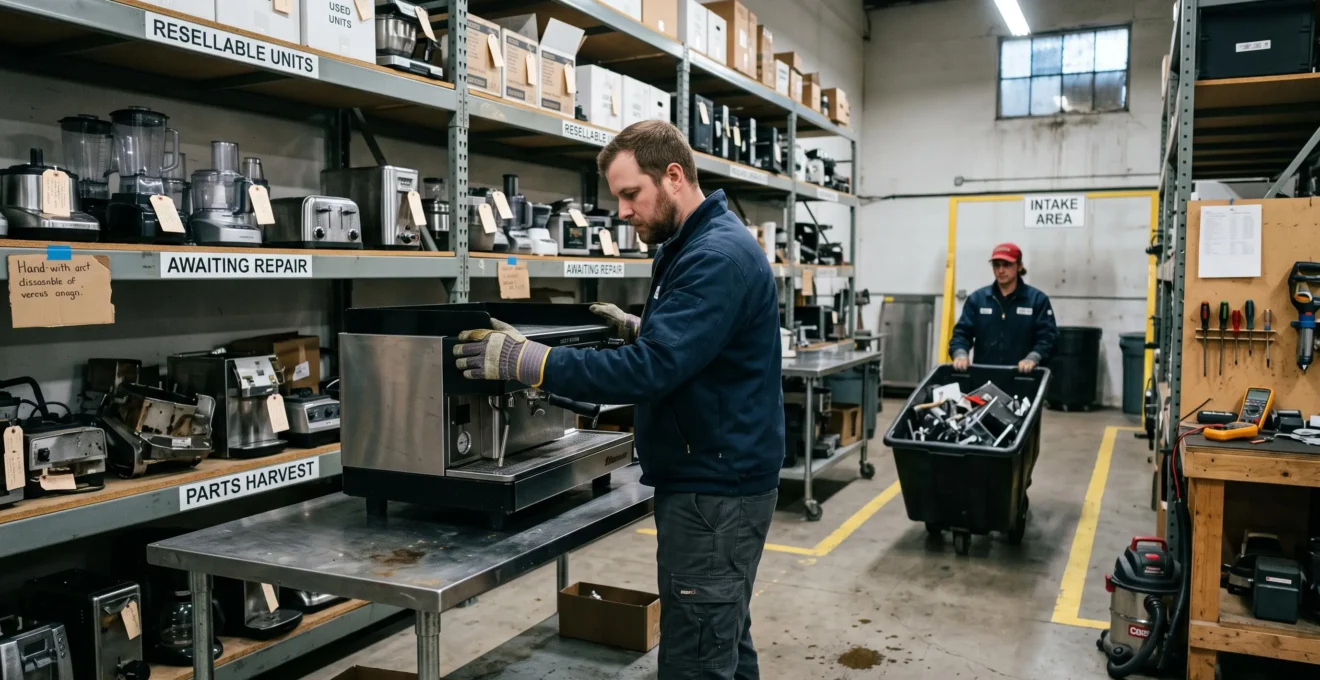
Canadian businesses can move beyond traditional recycling by designing operations that keep products, components and materials useful for as long as their condition and economics allow. For small and medium-sized enterprises (SMEs), this means treating returned products as potential assets rather than automatically classifying them as waste. Reuse, repair, refurbishment and remanufacturing can preserve more of a product’s existing functionality than material recovery alone, while creating opportunities for service revenue, lower procurement costs and more resilient supply chains.
The practical challenge is choosing the right circular model for each product category. A take-back program may work when collection can be integrated into existing delivery routes. Repair may be more appropriate when products are durable but customers are geographically dispersed. Remanufacturing may justify investment when products have standardized components, predictable demand and sufficient residual value.
Canadian companies must also account for provincial differences in extended producer responsibility requirements, regional logistics, material availability and environmental marketing rules. Circularity is therefore not a single recycling initiative. It is an operational strategy that connects product design, procurement, customer relationships, reverse logistics and financial measurement.
Key principles for a practical circular economy
- Prioritize reuse, repair, refurbishment and remanufacturing when they preserve more product value than material recovery.
- Build take-back and recovery operations around existing logistics, clear acceptance criteria and viable destinations for returned products.
- Measure products actually returned to service, procurement costs avoided and residual value captured, rather than relying on collection volumes alone.
- Why Is Recycling Insufficient for Building a Truly Circular Business?
- How to Build a Product Take-Back Program Without Disrupting Daily Operations
- Repair Services or Product Leasing: Which Better Supports Long-Term Resource Use?
- Reverse Logistics Mistakes That Can Make Material Recovery Unprofitable
- How to Track Reuse Rates and Material Savings in a Circular Business
- Local or Imported Materials: Which Offer Better Total Procurement Value?
- Common Greenwashing Claims That Can Distort Everyday Shopping Decisions
- How Can Canadian Businesses Build More Reliable Local Supply Chains?
Why Is Recycling Insufficient for Building a Truly Circular Business?
Recycling alone is insufficient because recovering material at the end of a product’s life does not necessarily preserve the functionality, components, labour or energy already invested in manufacturing it. A circular business seeks to keep products useful for longer, choosing the highest-value recovery option that remains technically feasible, commercially viable and appropriate for the material concerned. Recycling remains important, but it should not automatically be the first option.
The distinction between closed-loop recycling and downcycling helps clarify the issue. Closed-loop recycling returns a material to an application with comparable performance, where the process permits. Downcycling produces a material with reduced performance or fewer suitable applications. Neither outcome is inevitable for every material: the result depends on contamination, composition, processing technology and the quality requirements of the next application.
For most products that remain functional, preserving the product itself can retain more value than recovering its constituent materials. The circular strategy hierarchy therefore places reuse, repair, refurbishment and remanufacturing ahead of recycling and, where appropriate, other lower-value recovery routes.
Environment and Climate Change Canada‘s overview of product value retention explains how these processes can extend useful life and reduce waste and demand for resource extraction.
Extended producer responsibility (EPR) adds another dimension. Canadian EPR programs assign producers financial responsibility for managing specified products at end of life, but paying program fees does not itself establish a system for capturing the commercial value of returned goods. Requirements differ across jurisdictions and product categories, so companies should verify their applicable obligations rather than assume one national rule applies everywhere. The Government of Canada‘s overview of extended producer responsibility explains the underlying distinction between producer responsibility and product stewardship.
The practical objective is to select the best available loop for each product line, rather than eliminate recycling or assume that every item can be reused indefinitely.
A useful first step is to compare the condition, repairability, remaining service life and recovery costs of the products already passing through the business. That assessment provides the foundation for a take-back model that protects both resource value and operating margins.
How to Build a Product Take-Back Program Without Disrupting Daily Operations
A product take-back program works best when returns follow existing business processes instead of creating a separate collection network from the outset. Canadian SMEs can begin by accepting a limited range of products, defining clear eligibility rules and arranging a destination for every accepted item before collection begins. This approach limits operational disruption and reduces the risk of accumulating returned goods that have no practical recovery route.
Start by mapping existing customer-facing activities. Deliveries, installations, maintenance appointments and equipment replacements may already bring employees or transport vehicles close to customers who have used products to return. Adding a collection step to these journeys can reduce incremental handling and transport requirements, provided the additional work fits vehicle capacity, route timing and staff responsibilities.
Next, define which products the program will accept. Criteria can include model, age, condition, completeness, proof of purchase and the presence of hazardous or restricted components. The business should also specify how employees record returns, who authorizes exceptions and where items are stored while awaiting assessment.
Crucially, establish recovery channels before launch. A returned product might be suitable for resale, refurbishment, repair, parts harvesting or material recycling. Each destination needs an accountable owner, acceptance criteria and a realistic estimate of handling and processing costs.
Incentives should reflect the value of the returned product and the administrative burden of the offer. A refundable deposit may encourage customers to return reusable assets; a trade-in credit may connect the return to a replacement purchase; and a discount on a future transaction may suit an established customer relationship. None guarantees profitability. The incentive should be tested against the residual value actually recovered.
A controlled pilot allows the company to measure return volumes, condition, staff time and recovery outcomes before extending the program to additional products or regions.
Five actions to launch a controlled take-back pilot
- Choose a limited product range and produce a written eligibility sheet listing accepted models, condition requirements and exclusions.
- Map existing delivery, installation and service routes, then document the proposed collection points and responsible teams.
- Identify a destination for each accepted condition category and obtain written acceptance criteria from relevant recovery partners.
- Prepare a cost model listing collection, inspection, storage, incentives, processing and disposal costs alongside estimated recovery value.
- Run a pilot with a defined review date and create a results sheet tracking returns received, processing outcomes, labour time and net value recovered.
The strongest initial program is not necessarily the one that collects the most products. It is the one that establishes a repeatable process, demonstrates a viable recovery route and gives employees a clear procedure without compromising existing customer service.
Repair Services or Product Leasing: Which Better Supports Long-Term Resource Use?
Repair services and product leasing can both extend useful product life, but they require different capabilities and customer relationships. Leasing is generally more suitable for standardized, frequently used assets that a business can track and maintain throughout their service life. Repair services suit durable products whose ownership remains with customers and whose condition varies with use. The better model depends on product characteristics, logistics, technical skills and the company’s ability to manage assets or repairs profitably.
Under a repair model, the business sells a product or supports an existing installed base, then provides diagnosis, maintenance and replacement parts. Revenue may come from individual repairs, service agreements or maintenance packages. The operational challenge is ensuring that technicians have the necessary diagnostic skills and that replacement components remain available at a commercially reasonable cost.
Leasing changes the relationship from selling an asset to providing access to its use. The provider retains ownership and takes responsibility for tracking, maintenance and eventual return or redeployment. This can improve control over asset condition and end-of-life decisions, but it also introduces fleet-management requirements, capital commitments and reverse-logistics costs.
| Decision factor | Repair services | Product leasing |
|—|—|—|
| Asset ownership | Usually remains with the customer | Usually remains with the provider |
| Core capabilities | Diagnosis, repair skills and parts availability | Asset tracking, fleet management and reverse logistics |
| Product suitability | Durable products used under varied conditions | Standardized assets with predictable use and maintenance |
| Revenue structure | Repair fees and service contracts | Recurring access or rental payments |
| Main operational challenge | Repair time, parts supply and service coverage | Utilization, returns, maintenance and asset recovery |
Canadian geography can materially change the comparison. Customers in rural and remote communities may be expensive to serve through centralized leasing returns. A network of local repair partners or regional leasing depots may reduce travel and improve service availability, depending on product density and demand.
The Circular North America discussion paper identifies low population density, uneven infrastructure and cost pressures as barriers to circular business models. This makes regional feasibility a necessary part of the business case rather than a secondary implementation detail.
Hybrid models can reduce uncertainty. A company might introduce service contracts alongside product sales, lease one standardized product category while repairing another, or pilot leasing in a compact service area before extending it geographically.
A staged transition is often more manageable than replacing an established sales model at once. Customer willingness to pay, utilization and the actual cost of maintaining and recovering assets should determine whether the business expands, adapts or abandons the initial approach.
Reverse Logistics Mistakes That Can Make Material Recovery Unprofitable
Reverse logistics becomes unprofitable when the cost of collecting, transporting, sorting, disassembling and processing returned products exceeds the value recovered. Canadian businesses should evaluate the entire reverse flow before scaling collection, particularly when products are heavy, geographically dispersed or difficult to dismantle. A material’s resale or recycling price is only one part of the calculation; transport distance, labour time, contamination and the availability of local recovery partners can determine the outcome.
One common mistake is transporting low-value materials over long distances without evaluating the economics. A national collection program may appear efficient at the marketing level but become expensive when individual returns are scattered across remote locations. Map expected return volumes, destination capacity and transport costs, then compare direct shipment with regional consolidation. A break-even transport radius should be calculated from the company’s own costs and recovery values rather than borrowed from another business.
Another mistake is failing to grade products at intake. If every returned item enters the same queue without a condition assessment, employees may spend time inspecting or handling products that have already lost their recovery value. Establish clear categories for resale, repair, parts harvesting and recycling, with a corresponding valuation and handling route for each.
Design for disassembly also matters. A product containing valuable materials can still be uneconomic to recover if dismantling takes too long or requires specialist labour. Measure actual disassembly time per unit and account for tools, worker training, safety requirements and the condition of fasteners and components.
Finally, mixing incompatible return streams can contaminate otherwise recoverable materials. Keep product categories or material types separate where composition and processing requirements differ. Document intake conditions, storage arrangements and quality checks so that downstream partners can assess batches consistently.
These measures make recovery economics visible before investment scales. If a product cannot be recovered profitably through the intended route, the business can evaluate another destination, improve product design or narrow the program rather than repeatedly absorbing avoidable losses.
How to Track Reuse Rates and Material Savings in a Circular Business
A circular business should distinguish the materials collected from the products actually returned to productive use. A recovery rate describes what enters the recovery system, while a reuse rate focuses on products that return to service. Neither metric alone establishes financial or environmental performance. Combining return volumes, refurbishment outcomes, avoided procurement spending and residual value captured provides a more useful view of whether a circular initiative is delivering operational results.
Start by establishing a baseline before the program begins. Record purchasing volumes, expenditure on relevant products and components, waste-disposal costs, existing repair activity and the quantities already recovered through established channels. Without this reference point, later claims about savings can be difficult to substantiate because the business cannot distinguish program effects from changes in demand, prices or operating conditions.
A small set of indicators can support routine management:
| Metric | What it measures | Operational decision it supports |
|—|—|—|
| Return rate | Eligible products returned relative to the relevant population or sales cohort | Whether collection arrangements and incentives are working |
| Refurbishment success rate | Returned products successfully restored relative to those assessed for refurbishment | Whether acceptance criteria and refurbishment processes are effective |
| Reuse rate | Products actually returned to service relative to the defined eligible or returned population | Whether recovered products find a productive destination |
| Avoided procurement spend | Purchases avoided because recovered products or components replace new purchases | Whether recovery reduces purchasing requirements |
| Residual value captured per returned unit | Value realized from resale, redeployment, parts or other recovery routes, measured consistently | Which product categories and recovery channels warrant investment |
Define the denominator for each rate and keep it consistent across reporting periods. For example, a reuse rate calculated against all eligible products is not directly comparable with one calculated only against returned products. Report the definition alongside the result.
Connect the measurements to financial records and operational systems wherever possible. Purchasing data can substantiate avoided expenditure; work orders can document repair and refurbishment outcomes; and waste invoices can help track disposal costs. Existing reporting systems used for EPR or corporate emissions management may provide useful input data, although their coverage and definitions may not align with the company’s circularity metrics.
Avoid treating collected weight as proof that resources have been preserved. A large quantity of material can be collected but ultimately discarded, downgraded or processed at a loss. Likewise, a high reuse rate does not automatically prove an environmental benefit if recovery requires disproportionate transport, energy or additional materials.
A reliable reporting framework gives management a basis for comparing product categories, revising incentives and prioritizing investment. It also creates a defensible record of what the business achieved, what it spent and which assumptions still need testing.
Local or Imported Materials: Which Offer Better Total Procurement Value?
Local materials do not automatically provide better procurement value than imported alternatives. The decision should account for purchase price, supply reliability, lead time, transportation, quality consistency, traceability and the cost of recovering products after use. Local sourcing can offer an advantage when nearby suppliers support shorter delivery routes, repair networks or efficient reverse logistics. Imported materials may remain preferable when local capacity is limited, volumes are small or recovery opportunities are negligible.
A useful starting point is to classify inputs by volume, supply criticality and remanufacturing potential. High-volume, critical materials with valuable recovery opportunities deserve particular attention because the company may benefit from coordinating procurement, product design and return flows. Low-volume components or inputs that cannot reasonably be recovered may not justify the cost of changing suppliers solely to achieve geographical proximity.
Total procurement value should also include the consequences of disruption. A lower unit price can be offset by long lead times, larger inventory requirements, expedited shipping or a lack of alternative suppliers. Conversely, a nearby supplier may charge more but offer shorter replenishment times or more flexible technical support. These advantages must be verified against actual service levels and commercial terms.
Traceability is another consideration. When a business makes claims about recycled content, material origin or product recovery, it needs records that support the specific claim being made. A shorter supply chain may simplify communication and documentation, but local origin alone does not establish recycled content, environmental superiority or responsible production.
The decision should therefore combine supplier evidence with operational performance rather than assume that domestic procurement is inherently more sustainable. For recovered materials, establish specifications for composition, tolerances, contamination and testing. Include provisions for inconsistent supply, substitute materials and contingency volumes before making secondary inputs essential to production.
A regional supplier network can also improve circularity when partners exchange by-products, supply recovered components or support repair and refurbishment. These opportunities are most valuable when there is sufficient volume, consistent quality and a practical commercial arrangement.
The best sourcing strategy may combine local and imported inputs, with different rules for critical components, recoverable materials and non-critical purchases. This approach preserves flexibility while allowing the company to invest in local circular capacity where the operational case is strongest.
Common Greenwashing Claims That Can Distort Everyday Shopping Decisions
Canadian businesses should make environmental claims that accurately describe measurable product or business characteristics and that can be supported by appropriate evidence. Terms such as “eco-friendly,” “recyclable” and “carbon-neutral” can create misleading impressions when their scope, conditions or supporting data are unclear. Circular economy initiatives need transparent measurement and documentation so that sustainability communications reflect actual outcomes rather than intentions, collection targets or unverified supplier statements.
The distinction between a process claim and an outcome claim is important. Saying that a company operates a take-back program describes an activity. Claiming that a product contains a specified share of recovered material describes a product characteristic that requires evidence appropriate to that representation. A collection program, by itself, does not prove that collected products have been reused or that recovered material has entered a new product.
The legal framework also requires attention to developments over time. Canada’s Competition Act prohibits false or misleading representations used to promote a product, service or business interest. The Competition Bureau assesses environmental representations in light of both their literal meaning and the general impression they create. Following amendments that received Royal Assent on March 26, 2026, the requirement for environmental claims to use an internationally recognized methodology was removed. That change did not eliminate the applicable requirements for adequate testing, proper substantiation or truthful representations.
Competition Bureau guidance on environmental claims and greenwashing explains the relevant legal framework and the importance of supporting environmental representations. Because the requirements can depend on the nature of the claim, companies should review current legislation and guidance before publishing or renewing environmental marketing.
For an SME, an evidence register can connect each public claim to its scope, calculation method, source records, responsible owner and review date. Supporting evidence may include supplier documentation, material specifications, purchasing records, verified measurements or appropriate test results. The evidence must match the claim rather than merely demonstrate that the company has undertaken some environmental activity.
Accurate communication also improves commercial credibility. Procurement teams, customers and business partners can distinguish documented performance from broad sustainability language, allowing the company to explain what has been achieved, what remains a target and which limitations still apply.
Key considerations for stronger local supply chains
- Build redundancy around critical inputs instead of relying on a single supplier simply because it is nearby.
- Treat recovered products, by-products and industrial exchanges as potential secondary sourcing channels.
- Specify material quality, grading, traceability and contingency arrangements before increasing dependence on recovered or locally sourced inputs.
How Can Canadian Businesses Build More Reliable Local Supply Chains?
Canadian businesses can build more reliable local supply chains by combining regional supplier relationships with diversified sourcing, clear quality specifications and planned access to recovered materials. Local procurement can shorten some transport routes and strengthen relationships, but geographical proximity alone does not guarantee resilience. A critical input supplied by one nearby company may remain vulnerable to production interruptions, capacity constraints or regional disruption. Reliability depends on how well the entire supply network responds to failure.
Start by identifying inputs whose absence would interrupt production, delay customer orders or prevent essential repairs. Assess each input against supply criticality, available alternatives, lead time, quality consistency and the consequences of disruption. For critical materials, a combination of suppliers across different regions may provide more resilience than complete dependence on one local source. The appropriate balance depends on cost, technical compatibility and the practical availability of alternatives.
Circularity expands the range of potential supply channels. Returned products can supply refurbished equipment or reusable components. Manufacturing by-products may serve as inputs for another industrial process. Regional recovery facilities, municipal programs, provincial initiatives and manufacturing clusters can provide useful contacts, collection infrastructure or partnership opportunities where suitable programs and materials exist.
These opportunities require active relationship management. A business should establish material specifications, estimated volumes, collection arrangements, acceptance procedures and responsibilities before relying on recovered inputs for essential operations. Secondary materials can vary more in composition, condition and consistency than standardized virgin materials, so incoming inspection and contingency planning are particularly important.
Canadian geography must also shape the operating model. Dispersed populations and uneven recovery infrastructure can make transport expensive, especially when products are bulky or return volumes are unpredictable. Regional consolidation, partnerships with existing service providers and shared recovery arrangements may help, but the financial case must be established for each material stream.
A resilient circular supply chain therefore combines forward procurement with reverse flows. Suppliers provide new inputs, customers return used products, recovery partners restore useful components and manufacturers incorporate suitable secondary materials. Each connection needs clear specifications, traceability and a viable commercial purpose.
Canadian SMEs can turn this assessment into a practical sourcing plan by identifying critical inputs, validating alternative suppliers, documenting recovery opportunities and agreeing on quality and contingency requirements. The resulting plan should be reviewed as demand, supplier performance and regional recovery capacity change, keeping resource efficiency aligned with dependable operations.
What is the difference between recycling and a circular economy?
Recycling recovers materials from products at the end of their useful life. A circular economy takes a broader approach by seeking to preserve product functionality and material value through reuse, repair, refurbishment, remanufacturing and other suitable recovery strategies. Recycling remains an important option when higher-value loops are technically impractical or economically unviable.
Can a small Canadian business introduce a circular model without major capital investment?
Yes. A business can begin by documenting existing material flows, offering repair services, arranging take-back during scheduled deliveries or testing resale of returned products. The appropriate starting point depends on product condition, staff capabilities, logistics and available recovery partners. A limited pilot helps establish costs and outcomes before larger investments are considered.
How should a business decide whether a returned product should be repaired or recycled?
Assess the product’s condition, remaining service life, repair requirements, parts availability, safety, expected resale or reuse value and total processing costs. Repair is more attractive when the product can return to service at a viable cost. Recycling may be preferable when repair is unsafe, technically impractical or uneconomic, provided an appropriate recovery route is available.
Which circular economy metrics should an SME track first?
Begin with return rate, refurbishment success rate, reuse rate, avoided procurement spending and residual value captured per returned unit. Record the definitions and denominators for each metric, establish a pre-program baseline and connect results to purchasing, work-order and waste-management records wherever possible. These measures reveal whether returned products actually create operational and financial value.
Does sourcing materials locally automatically reduce environmental impact?
No. Local sourcing can reduce some transport requirements and simplify supplier coordination, but environmental performance also depends on production methods, material composition, energy use, transport arrangements and end-of-life management. Compare credible evidence about the complete supply chain rather than treating geographical origin as proof of environmental superiority.