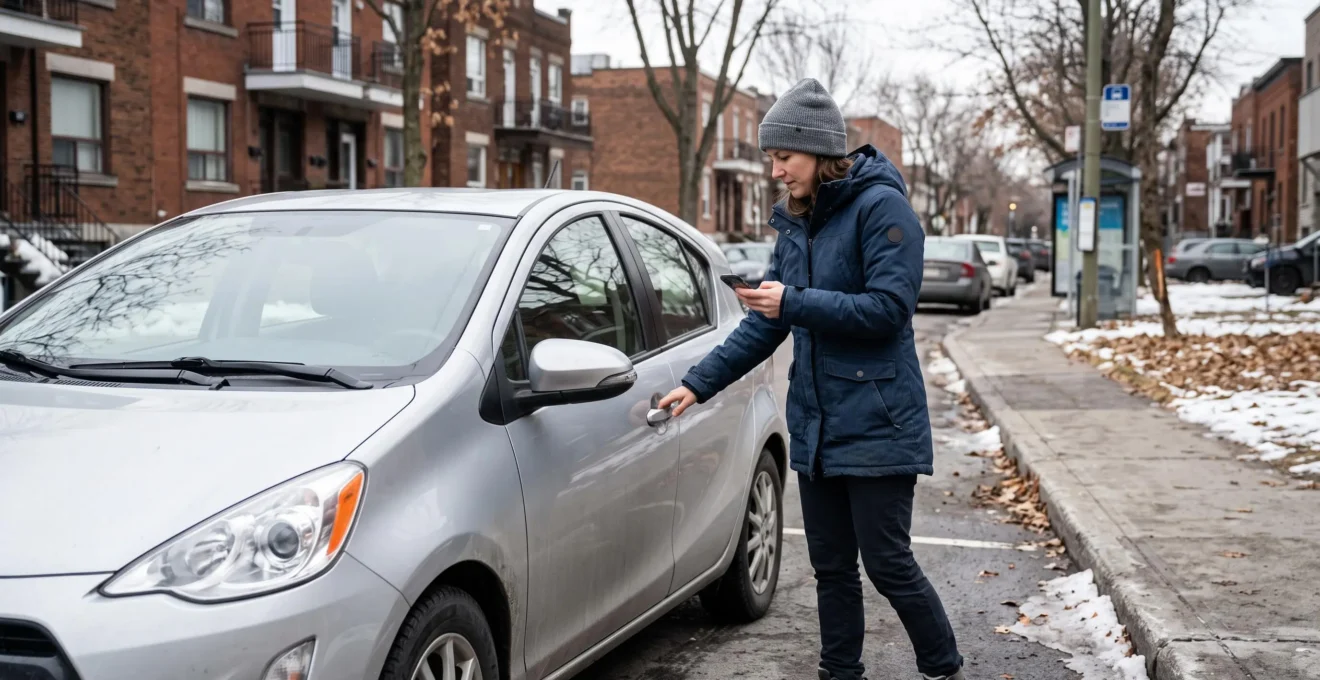
Car-sharing makes more sense than owning a vehicle in Canada when driving needs are occasional, suitable vehicles are reliably available nearby, and the total cost of bookings is lower than the fixed and variable costs of ownership. For urban residents who mainly walk, cycle or use public transit, paying for a car only when needed can avoid ongoing expenses such as insurance, depreciation, maintenance and residential parking.
However, a low advertised hourly rate does not automatically make car-sharing the better choice. Membership fees, trip duration, distance charges, parking restrictions, late returns and insurance deductibles all influence the final cost. Access matters just as much: a service that is unavailable in the neighbourhood, or cannot accommodate a planned return journey, may not be a practical substitute for a private vehicle.
The Canadian context also varies considerably between dense metropolitan neighbourhoods, suburbs and smaller communities. The most reliable decision combines three tests: whether a suitable service is available, whether its full cost compares favourably with ownership, and whether it fits the household’s actual travel routine. A two-car household may benefit from replacing one underused vehicle, while someone who drives daily may still need a car of their own.
Car-sharing versus ownership: the essentials
- Check real vehicle availability and permitted parking locations before comparing prices.
- Calculate complete trip costs and compare them with the fixed and variable costs of owning a vehicle.
- Consider car-sharing for occasional trips or as a replacement for an underused second car, provided availability and timing are dependable.
- Why Are Car-Sharing Options Limited Outside Major Canadian Cities?
- How to Calculate Car-Sharing Costs for Occasional Weekend Trips
- Free-Floating or Station-Based Car-Sharing: Which Fits Your Routine?
- Damage Reporting and Late-Return Mistakes That Can Trigger Extra Fees
- When Should a Two-Car Household Replace One Vehicle with Car-Sharing?
- Rent, Groceries or Transportation: Which Costs Matter Most When Relocating?
- How to Coordinate Transit Connections When Commuting Across Municipal Boundaries
- How Can Canadian Cities Improve Daily Transport Efficiency Without Major Road Expansion?
Why Are Car-Sharing Options Limited Outside Major Canadian Cities?
Car-sharing options are often less practical outside major Canadian urban centres because reliable access depends on where vehicles are placed, whether local parking rules permit their use, and whether enough members use the fleet to support its operation. The presence of an operator in a region does not guarantee that a resident can find a vehicle near home or return it conveniently after a trip.
Density is an important consideration because the distribution of potential users influences where a shared fleet may be practical. Yet the relationship is not determined by population alone. Municipal parking permissions, street restrictions, seasonal rules and vehicle circulation also shape the areas an operator can serve. Communauto, for example, identifies these operational factors in its vehicle-access and FLEX service-area FAQ. Its documented rules are specific to its services and should not be treated as a complete inventory of Canadian car-sharing coverage.
Residents should therefore assess access at neighbourhood level rather than relying on a city’s name appearing on a service website. Check the operator’s map, identify the actual pickup and return zones, and examine the app at the times when trips are likely to occur. A service area may cover a neighbourhood without ensuring that a vehicle will be available when required. Flexible one-way services and station-based round trips can also impose different return conditions.
In smaller communities, a local vehicle-sharing arrangement or peer-to-peer platform may be worth investigating, but its operating hours, insurance arrangements and vehicle availability need separate verification. Such arrangements should not automatically be assumed to offer the same protections or convenience as a professionally managed fleet.
If no suitable service offers dependable access for essential journeys, private ownership or conventional rental may be the more practical solution. Cost comparisons become meaningful only after the availability test has been passed.
How to Calculate Car-Sharing Costs for Occasional Weekend Trips
Car-sharing is financially attractive for occasional weekend trips when the complete cost of each booking is lower than the cost of owning and maintaining a vehicle for the same travel needs. The comparison must include membership fees, hourly or daily charges, distance charges, taxes and applicable extras, alongside the fixed costs of private ownership that continue even when a car is parked.
Start by identifying the relevant pricing model. An operator may charge a membership or subscription fee, an hourly rate, a daily maximum and a separate amount for kilometres beyond an allowance. These components can change the result considerably: a longer booking may reach a daily cap, while a distant destination may incur extra distance charges. Compare the actual terms of the plan available in the relevant service area rather than using a national average.
Communauto’s published rates illustrate this structure. The displayed Ontario Open round-trip plan lists $12 per hour, a $55 first-day maximum, 75 kilometres included per trip and $0.25 per additional kilometre. Its displayed Open Plus plan lists a $5 monthly subscription, $6.75 per hour, a $50 first day, $35 for each additional day and $0.21 per kilometre; the subscription plan specifies a minimum 12-month commitment. These are operator-published examples, not guaranteed current quotations for every location or trip. Check the published car-sharing rates before booking.
For an explicitly hypothetical eight-hour booking under the displayed Ontario Open hourly structure, eight hours at $12 would total $96 before the daily maximum is applied. If the stated $55 first-day cap applies to that booking, the time charge would be capped at $55. A 60-kilometre trip would remain within the stated 75-kilometre allowance. Taxes and any applicable extra charges would still need to be considered. This illustration shows why the pricing formula matters as much as the headline hourly rate.
Ownership requires a different calculation. Include insurance, registration, depreciation, financing costs if applicable, maintenance, repairs and parking, then add fuel and other usage-related expenses. Do not count only fuel and maintenance: a privately owned vehicle continues to generate fixed costs even during months with little driving. Compare costs over the same period and include only expenses that would genuinely disappear if the vehicle were sold.
Build a weekend-trip cost comparison
- Record the expected number of bookings and total hours per month; save a monthly usage estimate.
- Record the planned kilometres for a representative trip; save a distance estimate.
- Calculate the booking using the applicable membership, hourly, daily-cap and kilometre rules; save an itemised trip quotation.
- List annual vehicle ownership expenses, including insurance, depreciation, maintenance, registration and parking; save a fixed-cost worksheet.
- Compare both options over the same month and year, including taxes and applicable extras; save a break-even comparison with its assumptions.
Also verify who pays for fuel or charging, whether cleaning charges apply, what happens if a trip crosses a provincial boundary or ends outside the permitted area, and what insurance deductible may apply following damage. These conditions vary by operator and booking. A conventional rental may be worth comparing when a trip requires a full weekend or several consecutive days.
The practical threshold depends on both monthly hours and annual kilometres, not on a universal number of trips. If repeated bookings become expensive or difficult to secure, compare them with conventional rental and ownership using the same assumptions rather than relying on a single advertised rate.
Free-Floating or Station-Based Car-Sharing: Which Fits Your Routine?
Free-floating car-sharing is generally more suitable for short urban journeys when vehicles can be picked up and left within a permitted service area. Station-based car-sharing is generally more suitable for planned journeys when a vehicle is reserved for a period and must be returned to a designated location. The right model depends on the trip, local coverage and pricing rules, not simply on which service advertises the lowest rate.
With free-floating services, the vehicle may be found on the street or through an app, and the trip can often end at a different permitted location within the service zone. This flexibility can help with one-way journeys or trips that would otherwise require returning to the starting point. However, the destination must satisfy the operator’s parking rules. Some journeys cannot end in a neighbouring city or outside the authorised zone, even when the operator also serves that city.
Station-based services are better suited to a planned round trip when a specific vehicle can be reserved for the required period. A designated pickup and return point can make longer bookings easier to organise, particularly when the trip involves shopping, carrying equipment or visiting destinations poorly served by transit. The trade-off is that reaching the station and returning the vehicle may add walking time or require another connection.
| Criterion | Free-floating | Station-based |
|---|---|---|
| Typical use | Short urban trips and some one-way journeys | Planned round trips and longer bookings |
| Pickup and return | Within authorised service and parking zones | At the designated station or return location |
| Main constraint | Vehicle availability and permitted end locations | Reservation availability and access to the station |
| Cost comparison | Check time-based rates and any distance charges | Check hourly rates, daily caps and distance charges |
Before choosing, consider how often journeys are spontaneous, whether the vehicle must be close to home, and whether the booking needs to accommodate groceries, bulky items or a full day away. Then verify actual availability for the times and locations involved. The same operator may offer more than one model, but the rules and prices can differ by service.
A free-floating service may suit short, flexible journeys, while a station-based booking may be more predictable for a weekend away. Neither is automatically cheaper: the appropriate comparison begins only after the travel pattern and the applicable tariff are established.
Damage Reporting and Late-Return Mistakes That Can Trigger Extra Fees
Shared-car users can reduce the risk of avoidable disputes by checking the vehicle before departure, reporting relevant existing damage through the operator’s designated channels, and returning the vehicle within the reserved period and permitted zone. The precise reporting procedure, late-return charges and insurance responsibilities depend on the provider’s terms. A quick inspection and a clear record are practical safeguards, but they do not replace the applicable booking agreement.
Before starting a trip, inspect the exterior and interior for damage that may be relevant to the vehicle’s condition. Check whether a defect is already recorded in the vehicle status information. If a problem is not recorded, follow the operator’s reporting instructions before driving away. Communauto’s collision and damage-reporting FAQ instructs members to report relevant existing damage and contact the operator promptly when a collision or new damage occurs, including incidents without visible damage. These procedures apply to Communauto and should not be assumed to describe every provider’s requirements.
For useful documentation, take photographs when appropriate, note the condition of the vehicle and retain any confirmation generated by the app or support channel. If an incident occurs during a trip, report it using the operator’s prescribed process and provide the requested details. Do not assume that an unreported defect automatically establishes liability; responsibility depends on the circumstances, the records and the applicable terms.
Late-return policies also vary. Depending on the service, an extension may not be possible if another member has reserved the vehicle, and additional charges may apply under the operator’s rules. Leave a realistic time margin for traffic, parking and the return procedure instead of planning to arrive at the exact end of the booking.
Insurance deserves a separate check. Review the deductible or excess that could apply after a claim, any optional protection offered during booking, and the exclusions in the operator’s terms. Personal auto insurance and credit-card coverage should not be assumed to cover a shared vehicle; ask the relevant insurer or card provider to confirm the actual policy wording and eligibility conditions.
These precautions make occasional car-sharing more predictable, especially when a household depends on the booking for an important appointment or return journey. Keeping the operator’s instructions accessible and allowing time for a proper return is a simple way to limit avoidable uncertainty.
When Should a Two-Car Household Replace One Vehicle with Car-Sharing?
A two-car household should consider replacing one vehicle with car-sharing when the second car is underused, the remaining vehicle can cover essential journeys, and a shared vehicle is reliably available for the trips that would otherwise require the second car. The decision should follow a review of actual use, not a general assumption that two vehicles are unnecessary or that sharing will always be cheaper.
Start with each vehicle’s real usage pattern. Record annual kilometres, the days each car is used, the purposes of those trips and the occasions when both vehicles are needed simultaneously. A second car used only for occasional errands or weekend outings is a stronger candidate for replacement than one relied upon every weekday for work, school or essential appointments.
Next, compare the costs that would disappear if the vehicle were sold with the cost of covering its journeys through shared vehicles, transit, cycling, walking or conventional rentals. Insurance, parking, maintenance and depreciation may represent significant ownership expenses, but the relevant savings depend on the household’s actual arrangements. If a vehicle is financed or has other ongoing obligations, those terms also need to be considered before assuming that selling it immediately eliminates every cost.
Availability is equally important. Check whether a suitable vehicle can be reserved during commuting peaks, weekends and other high-demand periods. Consider whether one adult might need the shared vehicle while the other needs the remaining private car. A household can have a favourable cost estimate on paper and still find the arrangement unworkable if bookings overlap or the service area does not cover important destinations.
A trial period can expose problems that a spreadsheet misses. Where feasible, temporarily avoid using the second vehicle while keeping it available, and track the shared bookings, missed trips, extra travel time and actual expenses. The test should cover the household’s normal routine rather than only a quiet week with few commitments.
Replacing a second car works best when the household has a dependable alternative for occasional trips and agrees on how bookings will be coordinated. If the trial repeatedly reveals unavailable vehicles, conflicting schedules or expensive long bookings, keeping both vehicles may remain the more practical choice.
Key takeaways
- Evaluate housing and transport together: a lower rent can be offset by higher travel costs or poor car-sharing access.
- Test public-transit connections and shared-car availability for actual journeys, including trips outside peak hours.
- Consider municipal transport and parking policies as part of the long-term mobility outlook, but base any decision to sell a vehicle on current local access.
Rent, Groceries or Transportation: Which Costs Matter Most When Relocating?
When relocating within Canada, housing, food and transportation should be evaluated together because the new address can change both the need for a private car and the feasibility of using car-sharing. A more central neighbourhood may offer better access to transit and shared vehicles, while a less expensive property farther from services may create additional travel needs. Neither outcome should be assumed without comparing actual locations and expenses.
Statistics Canada’s 2023 Survey of Household Spending reported average annual household expenditures of $24,671 on shelter, $12,090 on transportation and $12,046 on food. These figures describe historical national averages for 2023, not current prices for a particular city, rental property or private vehicle. Transportation expenditure includes more than car ownership, so it cannot be used directly as an estimate of the savings available from car-sharing. The 2023 household spending survey provides useful context for considering these budget categories together.
For a relocation decision, compare realistic housing options rather than isolated headline rents. For each neighbourhood, record the expected rent, access to grocery stores, public-transit routes and schedules, availability of shared vehicles, parking costs and the likely frequency of driving. Include the cost and time of reaching a shared vehicle, especially if a booking requires returning it to a designated station.
Consider the time horizon as well. Rent and location influence everyday travel for the duration of the tenancy, while car-sharing usage can be adjusted as needs change. A central property with a higher rent might be worthwhile if it reduces other expenses, but the difference must be demonstrated by the household’s own budget rather than assumed from general urban trends.
In contrast, a cheaper home may be a poor fit if public transit is infrequent, essential destinations are distant or no dependable shared-car service operates nearby. In that situation, the apparent housing saving may be accompanied by the cost of owning a vehicle or using conventional rentals more often.
The most useful relocation comparison is a side-by-side budget for specific neighbourhoods, including both money and travel time. Choose the location that meets the household’s practical needs, then determine whether shared vehicles can reliably cover the journeys that remain.
How to Coordinate Transit Connections When Commuting Across Municipal Boundaries
Cross-municipal commuting in Canada can make car-sharing useful when transit connections do not cover the entire journey conveniently, but the combination works only if the relevant services, schedules and vehicle-return rules fit together. A shared car may help with a first- or last-mile connection or a journey beyond a transit station, yet it is not automatically cheaper or more reliable than completing the trip by transit.
Begin by mapping the complete commute rather than comparing only the fastest individual leg. In regions served by different transit agencies, such as GO Transit, exo, TransLink or municipal systems, check the applicable fares, transfer arrangements, operating hours and service frequency. Use the relevant agencies’ current information to confirm whether a transfer is accepted, whether separate tickets are required and how much time should be allowed between connections.
Then identify the section where a shared vehicle could provide a meaningful advantage. For example, a hypothetical commuter might take transit for the main part of a journey and use a shared car to reach a workplace that is poorly served by a connecting route. The comparison should include the transit fare, the shared-car booking, the time required to reach and return the vehicle, and any additional parking or transfer expenses. This is a planning scenario, not evidence of a particular route’s actual cost or availability.
Reliability matters alongside price. A connection that works during the morning peak may be impractical for a late shift or a return journey after transit service becomes less frequent. Check the actual operating hours and booking availability for both directions, including the return trip. For a station-based vehicle, verify that the reservation can cover the complete journey; for a free-floating vehicle, check whether the intended destination is inside the authorised service area.
A useful comparison records total door-to-door time, waiting time, transfer time, fare and booking cost, together with the consequences of a missed connection. Where schedules are unreliable or shared vehicles are scarce, a private car may offer greater practical flexibility despite its higher fixed costs.
The strongest multimodal arrangement is one that works consistently at the times the commuter actually travels. If transit alone already meets the journey’s needs, adding a shared car may create unnecessary expense; if a connection is missing, compare the full combined journey with the marginal cost of keeping a vehicle.
How Can Canadian Cities Improve Daily Transport Efficiency Without Major Road Expansion?
Canadian cities can improve everyday transport efficiency without major road expansion by making public transit, walking, cycling and car-sharing work together, while managing curb space and parking more effectively. These measures can reduce the need for every household to own a vehicle, but their impact depends on local density, reliable connections and whether residents can access the alternatives when they need them.
Car-sharing can make more efficient use of existing vehicles when multiple members rely on the same fleet at different times. It may also reduce the number of privately owned vehicles that households need to keep for occasional journeys. The extent of any reduction depends on actual local usage and cannot be inferred from the existence of a car-sharing programme alone.
Municipal decisions can influence whether shared mobility is practical. Where local authorities permit suitable shared-vehicle parking, manage residential parking demand and coordinate street access with transit services, operators may have more opportunities to provide convenient pickup and return locations. Conversely, parking restrictions, seasonal rules or a lack of legal parking spaces can constrain service coverage. Such policies do not guarantee that a fleet will be available in every neighbourhood.
Transit and active-transport infrastructure are equally important. Convenient walking routes to transit, connected cycling infrastructure and dependable service can reduce the number of trips for which a private car is necessary. Car-sharing then serves as a complement for occasional journeys that are difficult to complete by other modes, rather than as a replacement for every form of transport.
Residents can use local transport plans and parking policies to assess whether their neighbourhood is likely to become more convenient for car-free or car-light living. However, future policy intentions should not be treated as current service availability. Before selling a vehicle, confirm that the alternatives already work for essential journeys and assess planned improvements separately.
For an individual household, the next step is practical rather than speculative: compare its real travel needs with the services currently available, calculate the full cost of each option and test the arrangement before making an irreversible decision about vehicle ownership.
Is car-sharing cheaper than owning a car in Canada?
It can be cheaper for occasional drivers when the total cost of bookings is lower than the ownership expenses avoided. Compare membership fees, hourly or daily charges, kilometres, taxes and extras with insurance, depreciation, maintenance, registration and parking. The result depends on local rates, annual mileage and the availability of suitable vehicles.
Can car-sharing replace a second family car?
Yes, if the second vehicle is underused, the remaining car covers essential journeys, and shared vehicles are available when both adults need transport. Review actual usage records and test the arrangement before selling the vehicle. Repeated booking conflicts, unavailable cars or expensive long trips may make retaining the second vehicle more practical.
What should be checked before booking a shared vehicle?
Check the pickup and return rules, service-area boundaries, pricing structure, included kilometres, taxes, possible extra charges and insurance deductible. Inspect the vehicle and report relevant existing damage through the operator’s designated channels. Allow enough time to complete the trip and return the vehicle according to the booking terms.
Is free-floating car-sharing better than station-based car-sharing?
Free-floating services may suit short urban journeys that benefit from flexible pickup and drop-off locations. Station-based services may suit planned round trips and longer bookings. Compare the actual coverage, return restrictions, reservation availability and pricing for the trips you make rather than assuming one model is always more economical.
What if car-sharing is unavailable in my neighbourhood?
Check the operator’s actual service map and vehicle availability, then investigate whether local community-based arrangements or conventional rentals can cover occasional trips. If no dependable option meets essential travel needs, private ownership may remain the more practical choice. Reassess only when a suitable alternative is demonstrably available.