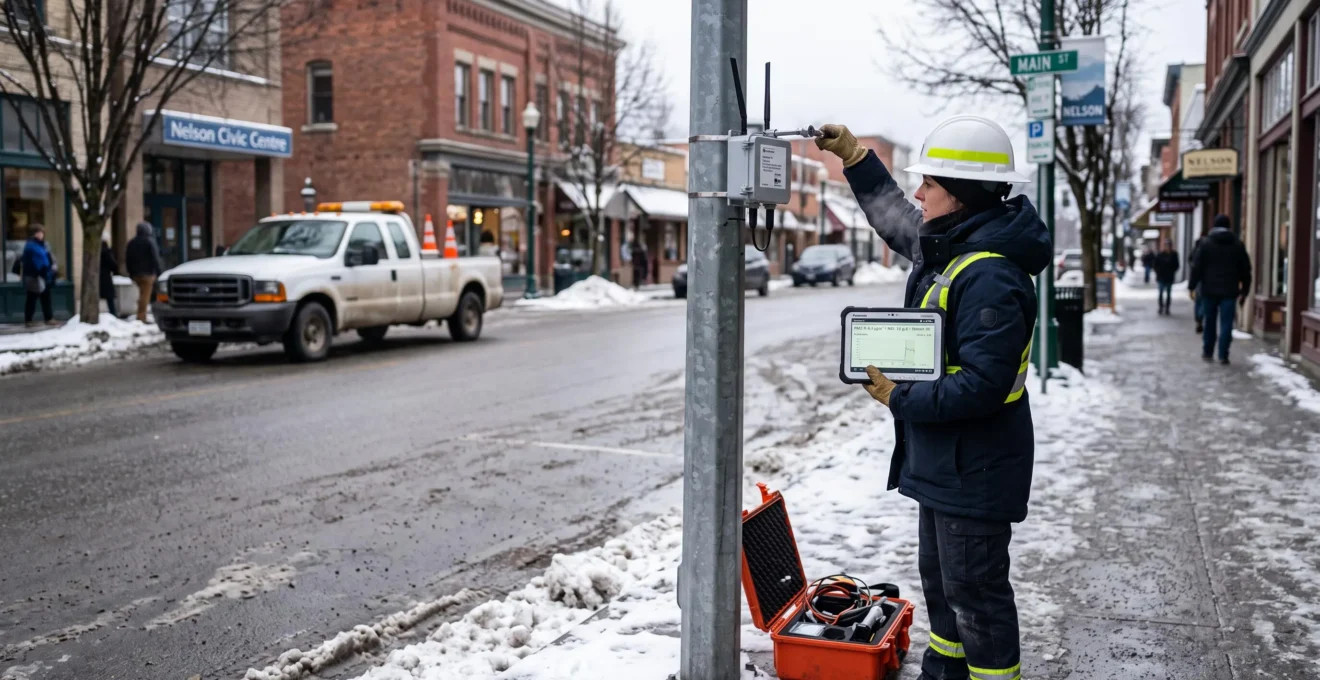
Canadian municipalities can improve infrastructure management by turning connected sensor readings into verified, actionable information about asset condition, service performance and emerging faults. The value does not come from collecting more data alone. It comes from knowing whether measurements are trustworthy, whether they answer a defined operational question and whether the responsible team can act on the results.
For infrastructure teams managing water networks, roads, public lighting, environmental monitoring and municipal equipment, a reliable approach combines sensor selection, data validation, privacy safeguards and clear maintenance procedures. These controls matter particularly in Canadian conditions, where freeze-thaw cycles, extreme cold, remote service areas and uneven network coverage can complicate long-term monitoring.
Every deployment should begin with a measurable service problem, such as unexplained water losses, recurring equipment failures or insufficient information about road conditions. The municipality can then select appropriate sensors, establish a baseline, define data-quality rules and connect validated readings to existing operational workflows. Privacy and vendor accountability should be built into the design from the outset, especially when infrastructure monitoring could reveal individual movements or behaviour.
Key principles for municipal sensor programmes
- Validate sensor readings against reference measurements, physical limits and time-series continuity before using them for consequential decisions.
- Select wired or wireless technology according to asset accessibility, Canadian operating conditions, communications coverage and lifecycle costs.
- Connect verified data to documented maintenance and response procedures while limiting personal information and measuring operational outcomes.
- Why Can Environmental Sensors Produce Misleading Urban Measurements?
- How to Check Sensor Data Quality Before Using It for Municipal Decisions
- Wireless or Wired Sensors: Which Suit Long-Term Infrastructure Monitoring?
- Privacy Risks of Collecting Location Data Through Connected City Infrastructure
- How Predictive Alerts Can Help Detect Water Infrastructure Problems Earlier
- How to Identify Public Service Problems Worth Solving with Smart Technology
- How Condition-Based Maintenance Can Reduce Equipment Downtime
- How Can Canadian Smart Cities Use Technology to Improve Everyday Public Services?
Why Can Environmental Sensors Produce Misleading Urban Measurements?
Environmental sensors can produce misleading urban measurements because their readings depend on calibration, local conditions, installation and instrument performance. A sensor installed beside a busy intersection may record a pollution concentration that differs substantially from the surrounding neighbourhood, while a sensor exposed to unusual heat or airflow may report conditions that are not representative of the wider area. Municipalities should therefore establish measurement quality and site suitability before using readings to direct public services or infrastructure spending.
Three mechanisms deserve particular attention. First, sensor drift occurs when an instrument’s response changes over time, potentially introducing a persistent bias. Second, random measurement noise creates unpredictable variation that cannot necessarily be removed by applying a single correction. Third, the urban microclimate influences what a sensor actually measures: reflected solar radiation, heat retained by pavement, street-canyon wind patterns, nearby exhaust outlets and building geometry can all affect local observations.
These effects also explain why a low-cost sensor should not automatically be treated as equivalent to a reference-grade instrument. Where appropriate, readings can be compared with nearby Environment and Climate Change Canada weather observations or another suitable reference. However, differences in location, exposure, measurement method and averaging period must be considered before interpreting a discrepancy as instrument error.
Before generalising a reading, the team should ask whether the location represents the intended area, whether the sensor is protected from avoidable interference, whether its calibration is current and whether the measured variable matches the intended decision. A roadside air-quality sensor, for example, may be useful for identifying a local exposure hotspot without accurately describing average neighbourhood conditions.
The operational consequence is significant. A false high reading can trigger unnecessary inspections or interventions, while a false low reading can conceal a genuine environmental or infrastructure problem. Reliable decisions therefore require an explicit distinction between systematic errors that may be corrected and random errors or unexplained anomalies that may make individual readings unsuitable for use.
This establishes the foundation for the next step: a repeatable validation process that identifies questionable measurements before they enter municipal reporting, prioritisation or maintenance decisions.
How to Check Sensor Data Quality Before Using It for Municipal Decisions
Municipalities can check sensor data quality by comparing readings with an appropriate reference, detecting implausible or frozen values, measuring transmission completeness and documenting how questionable observations are handled. The objective is not to declare every measurement accurate. It is to identify which data are sufficiently reliable for a particular decision, which require further investigation and which should be excluded from automated actions.
Begin with cross-validation. Compare a suspect sensor with a reference instrument or a nearby sensor measuring the same variable under sufficiently comparable conditions. Differences should be assessed against the instruments’ known characteristics, calibration status and measurement intervals. For water-quality applications, the US Environmental Protection Agency‘s technical report on water-distribution sensor evaluation discusses installation requirements, calibration, maintenance, data acquisition and performance evaluation. Its methods provide useful technical context, but they are not a universal Canadian acceptance standard for every sensor type.
Next, examine time-series behaviour. Repeated identical readings over an implausibly long period may indicate a frozen sensor, failed connection or stale value. Missing timestamps can reveal transmission gaps, while sudden changes outside physically credible ranges may indicate faults, configuration errors or genuine events requiring confirmation.
Municipalities should track three practical indicators: the percentage of expected readings received, the percentage of readings outside defined plausible ranges and the frequency of suspiciously unchanged values. Each indicator needs an agreed calculation method and a threshold appropriate to the application. A missing reading in a non-critical environmental dashboard does not carry the same operational consequences as missing pressure data on a critical water main.
Quality control also requires an accountable decision process. The responsible team should record who reviews anomalies, who authorises corrections and when uncertain data must be excluded from automated decisions. Ontario’s municipal infrastructure asset-management regulation, discussed later in this article, supports a structured approach to asset condition, risks and lifecycle planning; it does not prescribe universal sensor-quality thresholds or require connected monitoring.
Five actions to establish a verifiable data-quality process
- Document each sensor’s purpose, location, measured variable and reference instrument in a sensor register.
- Define the expected reporting interval and calculate a baseline transmission-completeness rate from the monitoring logs.
- Record physically plausible ranges and a rule for identifying repeated unchanged values in a written validation specification.
- Compare suspect readings against a suitable reference and retain the comparison results, calibration status and investigation notes.
- Approve a data-handling procedure that identifies the reviewer, correction authority, exclusion criteria and treatment of unresolved anomalies.
When a sensor is the only source available at a critical site, the safest response is not to accept or silently discard its reading. Compare it with neighbouring measurements, operating records or an independent field test where feasible. If uncertainty remains, flag the observation, delay an irreversible decision where operationally safe and use an explicitly documented contingency procedure.
Once the municipality knows how it will evaluate incoming readings, it can select the communications and sensor architecture that delivers those readings reliably over the asset’s expected service life.
Wireless or Wired Sensors: Which Suit Long-Term Infrastructure Monitoring?
Wired and wireless sensors can both support long-term municipal infrastructure monitoring, but the appropriate choice depends on the asset, access conditions, power availability, communications coverage and lifecycle cost. Wired systems can provide dependable power and communications at suitable fixed sites, while wireless devices can reduce installation complexity and make monitoring practical where cabling is difficult. Neither option is universally superior, especially in Canadian environments with severe winters and widely dispersed infrastructure.
Start by assessing how difficult the sensor will be to reach after installation. Devices embedded in roads, attached to bridges or installed near buried water infrastructure may be expensive or disruptive to service. A replaceable battery is not necessarily a low-cost solution if reaching the unit requires excavation, traffic management or a specialist crew. Where physical access is difficult, a wired connection or a carefully engineered long-life power solution may be preferable.
Surface-mounted sensors on accessible street furniture, waste containers or some environmental monitoring stations may be more suitable for wireless operation. However, battery performance must be assessed under the expected operating temperature, including cold-weather exposure and the effects of frequent communications. A nominal battery-life estimate under laboratory conditions is not sufficient evidence of service life at a Canadian outdoor installation operating near -30 °C.
Communications coverage creates another trade-off. LoRaWAN may be appropriate for low-bandwidth telemetry where gateways and network coverage are available. Cellular IoT can suit sites with compatible network service, but rural and northern locations may have limited coverage or depend on a single provider. A radio survey and an outage-response plan should therefore precede procurement for critical installations.
| Decision factor | Wired monitoring | Wireless monitoring |
|---|---|---|
| Installation | May require cabling, conduit and civil works. | Can reduce cabling, but requires suitable power and network coverage. |
| Maintenance access | Can be attractive where fixed infrastructure is accessible. | Battery replacement and device servicing can dominate costs at difficult sites. |
| Remote locations | May require expensive communications infrastructure. | Depends on gateway reach, radio conditions or available cellular service. |
| Lifecycle risk | Includes cable damage, repair access and component obsolescence. | Includes battery degradation, radio coverage and protocol or platform changes. |
Procurement should compare the total cost of ownership over the asset’s expected monitoring period, including installation, power, communications, battery replacement, repairs, software, cybersecurity and eventual decommissioning. For a monitoring programme intended to last 10–20 years, the municipality should also examine whether devices can be replaced independently of the platform and whether data can be exported in documented formats.
Open interfaces and clearly defined data ownership reduce dependence on a single supplier. Contracts should specify data access, interoperability, security updates, support arrangements and transition assistance if a supplier discontinues a product or changes its service model.
Hardware and network design determine how reliably information reaches municipal systems; privacy design determines whether that information can be collected and used responsibly.
Privacy Risks of Collecting Location Data Through Connected City Infrastructure
Connected city infrastructure can create privacy risks when location measurements or movement patterns make individuals identifiable, even when names and other direct identifiers are absent. Vehicle trajectories, repeated visits and detailed timestamps can sometimes be linked with other information to infer a person’s home, workplace or routine. Municipalities should therefore evaluate what their sensors can reveal, restrict collection to a legitimate operational purpose and establish appropriate safeguards before deployment.
Not every infrastructure measurement is personal information. A streetlight reporting its own power consumption, for example, is different from a camera or network of sensors tracking individual movements. The risk depends on the granularity of the data, the ability to link records, the purpose of processing and the context in which information is collected and shared.
Canadian privacy requirements also vary by jurisdiction and activity. Municipal public-sector information is not automatically governed by the same legislation as a private-sector technology supplier. Federal and provincial or territorial rules may apply differently depending on the organisation, the information and the processing arrangement. Legal review should identify the applicable public-sector privacy requirements and any relevant obligations imposed on private-sector service providers.
The joint findings published by Canadian privacy authorities in their investigation into location tracking by the Tim Hortons App illustrate how granular location information can reveal individual movements and why purpose limitation, meaningful consent, proportionality and service-provider accountability matter. The investigation concerned a specific commercial application; it should inform privacy risk assessment without being treated as a blanket legal ruling on municipal sensor deployments.
Practical safeguards begin with data minimisation. Collect the least detailed information needed to operate the service, aggregate observations spatially and temporally where that still supports the intended decision, remove unnecessary identifiers and establish documented retention and deletion schedules. Hashing identifiers alone is not a guarantee of anonymity if records can still be linked or traced to individuals.
Supplier contracts should prohibit unauthorised reuse, sale or onward disclosure of raw data and define access controls, security responsibilities, incident notification, retention and deletion. A privacy impact assessment before deployment can identify risks early, support accountable decisions and document the reasons for the chosen safeguards.
Public-space collection does not automatically remove privacy concerns. Even where observations are made in publicly accessible locations, the scale, persistence and granularity of monitoring may create risks that would not arise from an isolated observation. Transparency about what is measured, why it is necessary and how long records are retained helps establish public trust.
With suitable governance in place, municipalities can use sensor information to identify operational anomalies while ensuring that the drive for better services does not justify unnecessary surveillance.
How Predictive Alerts Can Help Detect Water Infrastructure Problems Earlier
Predictive alerts can help municipal water teams identify developing problems by analysing patterns in pressure, flow and other relevant measurements before a fault reaches a critical threshold. A gradual change in overnight pressure or a persistent increase in baseline flow may justify investigating a possible leak, but neither observation proves that a leak exists. Useful alerts combine historical context, measurements from relevant network locations and a defined procedure for confirming the suspected problem.
A conventional threshold alarm activates when a measurement crosses a predefined limit. Predictive monitoring instead looks for changes in behaviour, combinations of signals or trends that may precede a failure. For example, a monitoring system could flag an unusual flow pattern that persists during periods when demand would normally be low. Whether that pattern indicates a leak depends on the network configuration, legitimate consumption, pressure conditions and the quality of the measurements.
The technical foundation is a credible baseline. Teams need sufficient historical observations to understand normal operation across relevant periods, including seasonal demand and operational changes. Data from multiple points can help distinguish a local anomaly from a wider system event, provided the readings are time-aligned and their reliability is understood.
The US Environmental Protection Agency’s manual on drinking-water distribution-system loss control describes complementary approaches to water-loss management, including audits, performance indicators, flow measurements, pressure-related methods and field leak detection. These approaches support a structured investigation process; they do not establish a universal predictive-alert threshold or guarantee that analytics will outperform every conventional alarm.
False positives are an operational risk. If alerts fire too frequently without identifying actionable faults, staff can become desensitised, investigations consume limited capacity and important signals may be missed. Before activating automatic dispatch or other consequential responses, run the system in observation mode, review alerts against known operating events, and adjust sensitivity using documented evidence.
Every alert should enter an operational workflow that identifies who receives it, the required response time, the evidence needed for confirmation and the person authorised to prioritise an intervention. Depending on the situation, confirmation may involve checking nearby sensors, reviewing network records, performing a field pressure test or using acoustic leak-detection equipment.
Performance should be measured through operational outcomes rather than alert volume. Relevant indicators include the proportion of alerts confirmed as actionable, time from detection to investigation, time to confirmed fault and the cost of unnecessary callouts. These indicators should be interpreted against a documented baseline and the limitations of the monitoring system.
Once the monitoring workflow is defined, the next question is whether water infrastructure is the right problem to prioritise—or whether another municipal service would offer a more measurable benefit.
How to Identify Public Service Problems Worth Solving with Smart Technology
Municipalities should select smart-technology projects by identifying a measurable service problem, determining why it occurs and confirming that better information can change the response. Technology is most useful when uncertainty about conditions prevents a good decision. It is less likely to solve a problem caused primarily by a broken process, insufficient staffing or a lack of resources unless the project also addresses those underlying constraints.
Three problem categories help establish the distinction. A measurement problem exists when the team lacks reliable information about what is happening, such as not knowing when a pump begins to operate abnormally. A process problem exists when the relevant information is already available but requests, approvals or maintenance handoffs are failing. A resource problem exists when the municipality understands the situation but lacks the people, equipment or budget to respond.
Before selecting a pilot, assess four factors:
- Incident frequency: How often does the problem occur, and is its pattern documented?
- Current operational cost: What staff time, repairs, service disruption or avoidable expenditure does the problem generate?
- Baseline evidence: Which existing records can establish performance before the intervention?
- Decision readiness: Is there a responsible team with the authority and capacity to act on the information produced?
A pilot should have an explicit success criterion before procurement begins. For example, a municipality investigating repeated pump faults could measure the time required to identify a fault and the number of unplanned interruptions during a defined baseline and evaluation period. The target should be set using local records and operational priorities rather than a vendor’s unverified performance claim.
Project selection should also reflect municipal scale and geography. A large urban municipality may prioritise congestion, asset condition or coordinated maintenance across many sites. A smaller or remote municipality may gain more from monitoring drinking-water systems, street lighting or dispersed infrastructure where routine inspection involves long travel times.
Technology-first procurement reverses this logic: it starts with a sensor platform and then searches for a use case. This approach can create dashboards without clear ownership, measurable benefits or a reliable way to change operational decisions. A defined baseline and a documented decision process make it possible to test whether a technology addresses the actual problem.
Once a use case has been selected and its expected benefit can be measured, condition-based maintenance offers a way to connect reliable monitoring with the timing of inspections and repairs.
How Condition-Based Maintenance Can Reduce Equipment Downtime
Condition-based maintenance can reduce equipment downtime by scheduling work according to measured asset condition rather than relying exclusively on fixed intervals or waiting for a failure. The approach is useful when indicators such as vibration, temperature, pressure or operating cycles provide meaningful evidence of deterioration. It does not eliminate preventive maintenance or guarantee fewer failures: success depends on data quality, appropriate thresholds, staff capability and integration with existing maintenance procedures.
Calendar-based preventive maintenance schedules inspections or servicing at predetermined intervals. Corrective maintenance responds after a fault occurs. Condition-based maintenance uses current evidence to decide when inspection or intervention is justified, allowing teams to identify deterioration earlier in suitable applications while avoiding some unnecessary scheduled work.
Municipal examples include monitoring pump vibration for changes associated with mechanical wear, tracking temperatures in equipment cabinets and analysing the operating cycles of treatment-plant machinery. Vehicle and infrastructure applications may also benefit where the chosen indicators correlate with the failure modes being managed. A measurement is useful only if its relationship to asset condition is understood and validated.
The data requirements vary by equipment. Historical measurements, work orders, inspection findings and failure records can help teams distinguish normal operating variation from developing faults. If historical evidence is sparse, a threshold based on a short observation period may be unreliable, particularly where equipment experiences seasonal demand or changing operating conditions.
Maintenance integration is equally important. A sensor dashboard that is separate from the municipality’s maintenance-management system can create duplicate work, missed handoffs and uncertainty about whether an alert has been addressed. Where practical, validated alerts should create traceable work requests or inspection tasks in the existing system, with an assigned owner, priority and closure record.
There is also a risk of under-maintenance. If a municipality replaces established preventive intervals with condition-based rules before the monitoring system is proven, it may delay work that remains necessary. A safer transition begins with a limited group of critical assets, preserves appropriate preventive activities as a safety net and compares the new approach with recorded equipment outcomes.
Success measures should include unplanned downtime, failure frequency, emergency work, unnecessary maintenance visits and total maintenance cost. Results need to be interpreted in context because changes in equipment utilisation, workload or operating conditions may also influence these indicators.
This approach turns monitoring into a repeatable management capability and provides a practical foundation for extending connected technology to other public services.
Key takeaways before expanding municipal smart services
- Prioritise services where reliable new measurements can change a specific operational decision, supported by a baseline and an accountable owner.
- Build data-quality controls, privacy safeguards, lifecycle planning and maintenance workflows into each deployment instead of adding them after installation.
- Expand only when a pilot demonstrates measurable service value and the municipality can sustain the equipment, processes and governance over time.
How Can Canadian Smart Cities Use Technology to Improve Everyday Public Services?
Canadian smart cities can improve everyday public services by connecting reliable measurements to specific operational actions, such as adjusting street lighting, prioritising road repairs, coordinating waste collection or informing residents about snow-clearing progress. The benefit depends on the service problem, the quality of the underlying data and the municipality’s ability to respond. A connected platform by itself does not establish that service quality has improved.
For adaptive public lighting, occupancy or ambient-light measurements can inform lighting adjustments where equipment, safety requirements and local policies permit. The municipality should assess lighting performance, energy use, maintenance needs and relevant safety constraints rather than assuming that every sensor-controlled reduction is appropriate.
For roads and sidewalks, condition sensors, inspection records and other relevant observations can help maintenance teams prioritise inspections and repairs. Measurements need to be interpreted alongside road classification, weather, asset condition and field reports. For waste services, fill-level sensors may help identify collection needs and support route planning, but only where collection schedules, vehicle capacity and service obligations can accommodate dynamic routing.
Winter operations offer another potential application. Vehicle-location information and operational records can help dispatchers understand where snow-clearing vehicles have travelled and communicate service progress. However, equipment tracking must be designed for the operational purpose, with suitable access controls and retention limits, rather than creating an unnecessarily detailed record of individual workers’ movements.
These examples follow the same operational chain: define the service issue, identify the information required, validate the measurements, connect the result to a decision and evaluate the outcome. Municipal asset-management planning can provide a governance framework for relating those decisions to asset condition, service levels, lifecycle activities, costs and risks.
In Ontario, Ontario Regulation 588/17 on municipal infrastructure asset management planning sets out requirements for covered municipalities, including asset-management planning and relevant lifecycle and financial strategies. Its requirements are jurisdiction-specific; they should not be presented as uniform legislation for all Canadian municipalities. The regulation also does not require municipalities to install connected sensors or use predictive analytics.
For municipal leaders, the practical implication is to align technology investment with existing service and asset-management priorities. A sensor deployment should clarify which asset or service outcome it supports, what evidence is required to assess success and who is accountable for the resulting operational decision.
Public trust is part of that operating model. Municipalities should explain what information is collected, why it is necessary, who can access it and how long it is retained. Publishing appropriate project objectives and performance measures helps residents understand the public benefit while making it easier to scrutinise costs, privacy protections and actual results.
The practical next step is to select one or two priority services, document their current performance, assign operational and privacy responsibilities, and test whether verified sensor information improves the decisions that matter. Expand the programme only when the evidence, workflows and long-term operating model justify it.
What sensor data should a Canadian municipality monitor first?
The best starting point depends on a documented service problem. A municipality facing unexplained water losses might begin with pressure and flow measurements, while a team managing recurring equipment faults might monitor vibration, temperature or operating cycles. Select variables that are relevant to the problem, establish a baseline and confirm that the responsible team can act on the results.
How can a municipality determine whether its sensor readings are reliable?
Compare readings with a suitable reference, check calibration and installation conditions, detect missing or implausible values, and identify suspiciously unchanged readings. Track transmission completeness and other application-specific indicators. Document who investigates anomalies and how uncertain measurements are treated before they influence consequential decisions.
Which privacy rules apply to connected municipal infrastructure in Canada?
The applicable rules depend on the province or territory, the organisation collecting the information, the type of data and the processing activity. Municipal public-sector requirements and private-sector rules governing a technology supplier may differ. Before deployment, obtain jurisdiction-specific privacy advice, assess whether location records could identify individuals and establish appropriate collection, access, retention and contractual safeguards.
Should municipalities choose wired or wireless infrastructure sensors?
Choose according to the asset’s accessibility, power requirements, operating temperature, network coverage, maintenance costs and expected service life. Wireless sensors can simplify installation where cabling is impractical, while wired systems may suit fixed installations with reliable power and communications. Compare total lifecycle cost and interoperability rather than purchase price alone.
How should a municipality measure the success of a smart-infrastructure pilot?
Define a baseline before deployment and select measures that reflect the original service problem. Depending on the use case, these might include unplanned downtime, time to investigate faults, unnecessary field visits, water-loss indicators or service response times. Record the evaluation period, account for relevant operating changes and expand only when the results justify the cost and ongoing responsibilities.