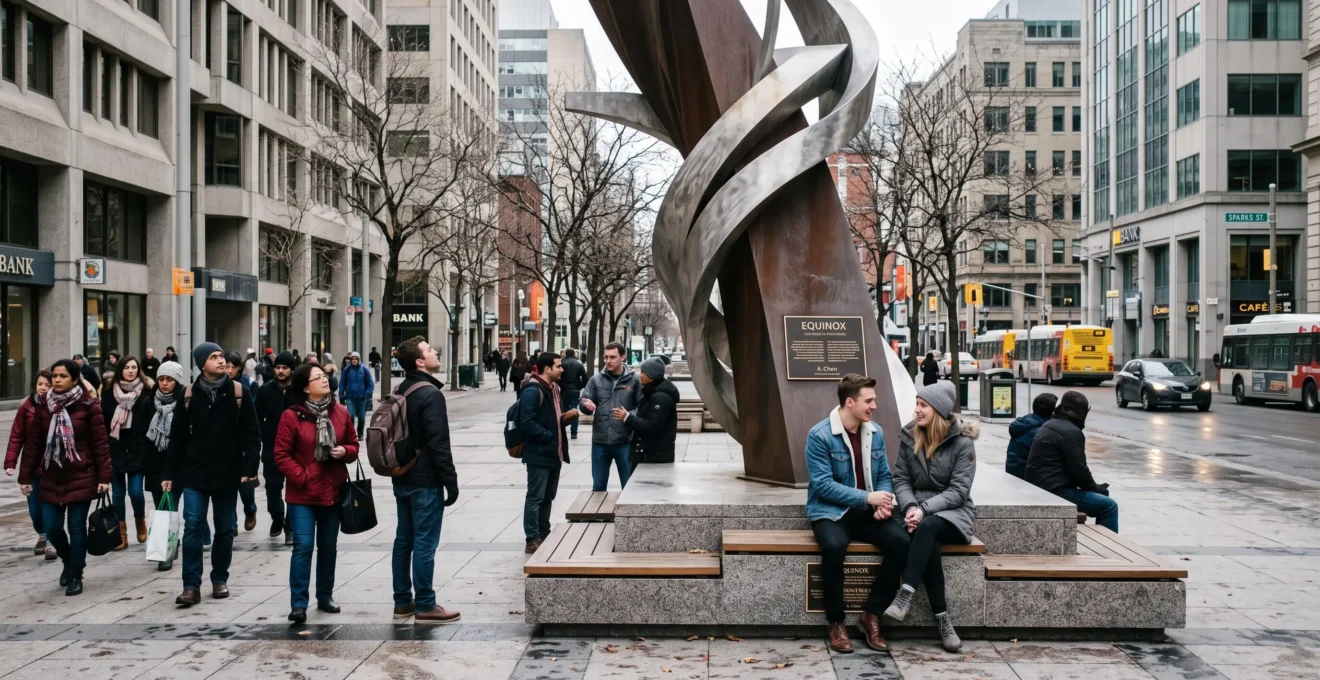
A sculpture in a downtown plaza can become a meeting point, a source of neighbourhood pride or the centre of a heated disagreement. A mural can transform a familiar wall into a record of local experiences. A temporary installation can invite residents to reconsider a public space they normally pass without noticing.
Across Canadian cities, public art influences more than visual appearance. It shapes how people navigate streets, interpret history, recognize their communities and interact with one another. Unlike artworks displayed in galleries, outdoor installations become part of everyday urban environments, including for people who never intended to encounter art.
These effects are not automatically positive. Decisions about commissioning, accessibility, cultural representation and maintenance determine whether an installation strengthens a sense of belonging or exposes unresolved tensions. Understanding those decisions helps residents and cultural planners assess public art as an ongoing part of civic life rather than simply an aesthetic addition.
Public art and urban life: the essentials
- Public installations influence community identity by making particular histories, perspectives and values visible in shared spaces.
- Meaningful participation, accessible design and year-round maintenance help determine who can experience and identify with an artwork.
- Temporary projects, permanent landmarks and evolving heritage interpretation offer different ways to keep civic spaces culturally relevant.
- Why Do Some Public Sculptures Spark Debate in Canadian Communities?
- How Can Residents Participate in Planning a Neighbourhood Mural?
- Temporary Art or Permanent Landmarks: Which Better Activates Public Spaces?
- Accessibility Oversights That Can Exclude Visitors from Public Art
- How Lighting and Seasonal Conditions Transform Outdoor Art Experiences
- The Cultural Assumptions That Can Exclude Canadians from National Conversations
- Common Interpretation Mistakes That Can Distort Local Heritage Stories
- How Can Canadian Communities Preserve Cultural Heritage as Their Populations Change?
Why Do Some Public Sculptures Spark Debate in Canadian Communities?
Public sculptures can spark controversy because they place cultural messages in spaces everyone shares, regardless of whether residents agree with those messages. Unlike gallery exhibitions, which visitors choose to enter, civic monuments and installations become unavoidable parts of streets and plazas. Disagreements therefore concern not only artistic taste but also public recognition, historical responsibility and decision-making authority.
A sculpture commissioned for a public square makes a claim about what deserves collective attention. For some residents, that claim may represent a valued tradition. For others, the same object may symbolize exclusion, an incomplete historical narrative or an institutional decision made without their participation.
Canada’s debates about colonial-era monuments and commemorative figures belong within wider conversations about historical accountability, including those advanced by the Truth and Reconciliation Commission. However, individual monument disputes have different histories, participants and circumstances. They cannot all be explained by a single national cause.
Three questions help distinguish the issues behind a local controversy:
- Commissioning and funding: Who proposed the work, paid for it and approved its location?
- Representation: Whose experiences does the artwork acknowledge, and whose perspectives are absent?
- Decision-making power: Who can influence its interpretation, alteration, relocation or removal?
These questions separate artistic expression from the public institutions responsible for allocating space and resources. Residents may defend an artist’s freedom while still questioning the municipality’s commissioning process.
Disagreements often intensify because participants understand the stakes differently. Supporters may see criticism as an attempt to restrict expression or erase heritage. Opponents may interpret continued public display as official endorsement of the message they contest. Neither interpretation, by itself, resolves the question of who should control shared civic ground.
Vancouver’s interpretation of The Hollow Man illustrates another approach to commemoration. Jon Sasaki‘s temporary sculpture at Hastings Park represents Ian Alistair Mackenzie and confronts political responsibility for the forced removal, incarceration and dispossession of Japanese Canadians during the Second World War.
Its location near a building used to detain Japanese Canadians in 1942 makes the surrounding landscape part of the artwork’s meaning. Rather than celebrating a historical figure, the sculpture asks why certain responsibilities have received limited public attention.
Canadian example: The Hollow Man at Hastings Park
The City of Vancouver identifies The Hollow Man as an anti-monument. Its hollow aluminium construction challenges conventional commemorative sculpture, while its placement connects the work directly to the history of Japanese Canadian incarceration.
The municipality states that more than 8,000 Japanese Canadians were detained at the Hastings Park site. The sculpture is intended to remain for 2,593 days before its planned dismantling, making eventual removal part of its artistic concept. These documented intentions do not, on their own, demonstrate how visitors respond to the work.
Public-art controversies reveal that urban identity is not fixed. The challenge is creating processes through which residents can disagree about civic symbols without treating disagreement itself as a failure of public culture.
How Can Residents Participate in Planning a Neighbourhood Mural?
Residents can participate in neighbourhood mural projects through consultations, design workshops, community juries and artist-selection processes, depending on the municipality and funding program. Participation is most influential before the artwork’s concept and artist have been finalized. Early involvement can shape what the mural represents, while later consultation may offer only limited changes to an established design.
A neighbourhood mural commonly involves several groups: artists, property owners, local organizations, municipal administrators and residents. Their responsibilities overlap, but their decision-making powers are not necessarily equal.
An online survey can reveal preferences without transferring design authority. A co-design workshop allows participants to contribute ideas more directly. Serving on a selection panel, where a program permits it, may provide influence over which proposal proceeds.
Residents should therefore ask not simply whether consultation will happen, but which decisions remain open when consultation begins.
Toronto offers a useful municipal example. According to Toronto’s StreetARToronto Partnership Program guidelines, the 2026 funding stream supports eligible large-scale community-engaged projects with funding of up to 70,000 CAD.
The program requires at least two community engagement sessions, including one in-person workshop. Its two-stage structure separates community consultation beginning in fall or winter 2026 from planned mural production in 2027. This creates an opportunity to gather local input before painting begins.
These conditions apply to that specific Toronto program, not to every Canadian mural. The guidelines establish consultation requirements but do not give neighbourhood residents automatic final approval or veto rights. The published program currently states that applications are closed until further notice.
Participation also operates within practical constraints. A project may require written permission from the wall’s owner, municipal approvals, insurance arrangements and safe working conditions. Depending on the location and installation method, scaffolding, structural or building-related requirements may also apply.
These conditions should be clarified before residents invest time in discussing concepts that cannot be implemented. Property authorization is explicitly required under Toronto’s Partnership Program, while other requirements depend on the project and jurisdiction.
Community-led programs can distribute influence differently from projects commissioned entirely by a property owner or municipality. Residents considering programs in Toronto, Montréal or Vancouver should examine each program’s current rules rather than assume that consultation, community endorsement and final design approval mean the same thing.
The most productive conversations are often about local meaning. A mural representing neighbourhood life should be recognizable to people with different relationships to that neighbourhood, including those who are frequently overlooked in official accounts.
Five practical steps for residents proposing a mural
- Identify the proposed wall and owner. Prepare a location sheet containing the address, photographs and property ownership information.
- Check local program requirements. Produce a short summary of applicable permissions, eligibility conditions and funding opportunities.
- Map community participants. Create an outreach list that includes residents, local organizations and groups whose perspectives are often missed.
- Organize an early design conversation. Record participants’ themes, concerns and preferred visual references in a workshop summary.
- Clarify who decides what. Create a decision record showing which suggestions can influence the design, who approves it and how feedback will be communicated.
A neighbourhood mural becomes a more credible expression of shared identity when residents can recognize their contributions and understand how competing perspectives informed the outcome. That principle also matters when cities decide whether artwork should remain temporarily or become a lasting landmark.
Temporary Art or Permanent Landmarks: Which Better Activates Public Spaces?
Temporary artworks are often better suited to attracting concentrated attention, testing new uses of public space and encouraging short-term experimentation. Permanent landmarks can build familiarity, support everyday routines and become enduring points of reference. Neither format is universally more effective: the appropriate choice depends on whether a community prioritizes immediate engagement, long-term attachment or an opportunity to learn.
A seasonal installation or festival project can create a distinct occasion for visiting a plaza. Its limited duration may encourage experimentation with materials, interpretations or locations that would be harder to justify in a permanent commission.
Permanent artworks operate differently. Their presence can become part of neighbourhood habits as people pass them on their commute, arrange meetings nearby or use them to describe where they live.
These are different forms of urban activation, rather than competing definitions of artistic success.
The choice also redistributes costs and responsibilities over time.
| Planning consideration | Temporary artwork | Permanent landmark |
|---|---|---|
| Main opportunity | Experimentation, events and short-term engagement | Continuity, recognition and everyday use |
| Financial responsibilities | Installation, event operations, dismantling and potentially repeated fundraising | Acquisition, inspection, conservation and long-term maintenance |
| Community feedback | Can inform future commissions or changes to a site | Can guide interpretation, stewardship and reassessment |
| Main cultural risk | Repeated turnover may limit attachment to a particular work | A fixed symbol may no longer reflect changing community perspectives |
| Useful evaluation | Who participated, how the space was used and what should change? | How does the installation function and remain meaningful over time? |
Temporary does not automatically mean inexpensive. Projects that require recurring production, equipment, insurance or programming can create substantial ongoing demands. Conversely, permanent works may require specialized conservation long after the original funding has been spent.
The Hollow Man in Vancouver demonstrates how a temporary lifespan can be integral to an artwork’s message. Its planned removal is not simply the end of an exhibition period; the limited duration forms part of the work’s challenge to conventional commemoration.
For a municipality considering an unfamiliar art form or an underused location, a temporary pilot can also become a practical learning exercise. Observation, resident feedback and accessibility assessments can reveal whether the installation encourages people to stop, move through or avoid an area.
Such a pilot does not guarantee that a permanent version will have the same effect. Seasonal conditions, novelty and the surrounding programming may shape the response.
Permanent commissions benefit from a different safeguard: a documented review horizon. A city can commit to maintaining an artwork without assuming its presentation and interpretation must remain unchanged indefinitely.
Effective activation is not simply a matter of attracting attention. It also depends on whether residents can meaningfully use the space, a question that brings accessibility into the centre of public-art planning.
Accessibility Oversights That Can Exclude Visitors from Public Art
Public art can exclude visitors when the installation is technically visible but difficult to reach, understand or experience. Obstacles may include inaccessible routes, obstructed sightlines, missing sensory alternatives or inadequate seating. In Canadian cities, winter maintenance adds another consideration: a route that works in summer may become unusable when snow or ice accumulates.
The accessibility of an artwork cannot be assessed in isolation from its surroundings. A sculpture located beyond stairs, uneven paving or an inaccessible transit connection may remain effectively unavailable to some visitors.
Even where a route exists, the experience may differ. An artwork designed to be viewed from standing height may not present the same visual information to someone seated in a wheelchair. Visitors with limited stamina may need resting places and manageable distances between accessible entrances, transit stops and viewing areas.
Municipal public-space obligations provide a starting point, although requirements differ by jurisdiction. Ottawa’s accessibility policy, for example, addresses relevant accessible routes, parking and maintenance under Ontario’s public-space accessibility framework. Those provisions concern municipal environments and should not be treated as a universal Canadian public-art design standard.
Sensory accessibility is equally important. A visually complex installation may benefit from audio description. A text-heavy interpretation panel may need alternatives for visitors who face language, literacy or visual barriers. Where touching the artwork is unsafe or prohibited, supplementary tactile interpretation may offer another way to explore its form.
A useful design principle is to identify the primary sensory channel through which the work communicates and consider whether visitors have an alternative way to access its meaning.
Accessibility planning should also account for seasonal conditions. Snowbanks may obstruct approaches, ice can make walking surfaces hazardous, and winter clearing practices can change the usable width of pedestrian routes.
A site inspection completed during a warm month therefore provides only a partial picture of year-round access. A winter audit should consider the actual maintained route, not merely the route illustrated on a site plan.
These considerations extend beyond formal compliance. An artwork intended to represent an entire community cannot fully serve that purpose if some residents are systematically prevented from encountering it.
Including disabled residents during site selection, concept development and interpretation planning provides information that a late-stage compliance review may miss. Their involvement should influence decisions while meaningful options remain available.
Accessible public art supports a more inclusive shared urban experience, but access must remain dependable as the surrounding environment changes throughout the year.
How Lighting and Seasonal Conditions Transform Outdoor Art Experiences
Lighting and seasonal conditions transform outdoor art by changing what visitors can see, when they encounter it and how comfortably they can use its surroundings. In Canada, shorter winter days, low sun angles, snow and changing pedestrian activity can make one installation feel dramatically different across the year. Lighting design therefore affects both artistic interpretation and practical access.
During summer, a sculpture in a busy plaza may become part of an extended outdoor social routine. People may encounter it during lunch breaks, evening walks or visits to nearby businesses.
In winter, the same location can have a different rhythm. Short daylight hours shift more encounters into darkness, while snow cover alters colour, surface contrast and the relationship between the artwork and its setting.
These conditions can reveal visual qualities that are less noticeable at other times. Shadows may become longer, reflective materials can respond differently to low-angle sunlight, and a sculptural form may stand out against snow rather than surrounding pavement or vegetation.
Artificial lighting introduces additional design choices. Carefully positioned uplighting can emphasize structure and make a sculpture recognizable after sunset. Poorly directed fixtures, however, can create glare, confusing shadows or uncomfortable viewing conditions.
Illuminating an artwork does not automatically make the surrounding space safe. Path visibility, accessible circulation, fixture placement and ongoing maintenance must also be considered. Lighting can contribute to a welcoming environment without substituting for broader public-space design.
Canadian artists and planners can also treat seasonal variation as a creative resource. An installation might be designed so that snow, autumn leaves or changing daylight alter its appearance. In this approach, environmental change becomes an intended part of interpretation rather than merely a condition to withstand.
There are practical limitations. Freeze-thaw cycles, moisture, road salt and ultraviolet exposure can affect outdoor materials, although the severity depends on the artwork’s construction, location and maintenance.
The continuing condition of an installation shapes its civic meaning. Corrosion, failing finishes or non-functioning lights may make a work feel neglected, even if its original concept was carefully developed. A maintenance plan should therefore address both conservation and the quality of the surrounding visitor experience.
Seasonal evaluation is particularly useful before major conservation or lighting decisions. Comparing observations across daylight and darkness, as well as summer and winter, can identify issues that would otherwise remain hidden.
Seasonal change demonstrates that an installation’s meaning is never created by the object alone. The environment and the people using it continually reshape that meaning, just as cultural perspectives influence whose experiences become visible in the first place.
The Cultural Assumptions That Can Exclude Canadians from National Conversations
Public-art discussions can exclude Canadians when they assume the country has one settled cultural identity that a single monument, image or artistic tradition can represent. Indigenous nations, francophone and anglophone communities, and people with diverse migration histories may hold different relationships to the same place. Inclusive public art acknowledges these differences rather than treating one familiar narrative as universal.
The phrase Canadian identity may suggest common experiences, but communities do not share identical histories or understandings of belonging. What appears representative to one group may feel incomplete or inaccurate to another.
Public-art commissioning can reproduce these assumptions through routine decisions. Selection criteria may favour familiar forms of sculpture, mural painting or commemoration. Established professional networks may influence who learns about commissions and whose artistic practices are seen as compatible with institutional expectations.
Such decisions need not involve explicit exclusion to have exclusionary effects. A process that appears open can still favour applicants whose training, artistic references or access to resources align with existing institutional norms.
Two forms of exclusion deserve particular attention:
- Procedural exclusion: Affected communities have limited opportunities to participate in selecting artists, shaping concepts or approving interpretive approaches.
- Symbolic exclusion: A completed artwork overlooks experiences, relationships to place or cultural histories that residents consider central to their community.
Procedural exclusion may be identifiable during planning through consultation records and selection-panel composition. Symbolic exclusion can become visible much later, when changing public conversations lead residents to reconsider the narratives embedded in familiar works.
Indigenous public art requires particular care in this context. Works by First Nations, Inuit and Métis artists are not simply additions to a generic catalogue of cultural diversity. Depending on the artist, nation, location and artistic intention, they may express continuing relationships to territory, language, knowledge and community.
Recognizing those relationships involves more than displaying imagery associated with Indigenous cultures. It requires attention to artistic authority, culturally appropriate processes and the distinct histories and protocols of the communities involved.
An installation that claims to represent a city should therefore be examined in relation to its actual location. Whose land, experiences and cultural practices does it acknowledge? Who has been asked to speak, and who remains absent?
Broadening the range of artistic forms and participants can make civic spaces more reflective of contemporary communities. Yet the goal is not to force every artwork to represent everyone. It is to avoid presenting one partial perspective as the complete story of a place.
Once public art is understood as a selective account of place, interpretation becomes especially important. Even a well-intentioned installation can distort heritage when the story attached to it is simplified or inadequately verified.
Common Interpretation Mistakes That Can Distort Local Heritage Stories
Local heritage stories can become distorted when public artwork reduces complicated histories to a single celebrated figure, founding event or easily recognized symbol. Incomplete plaques, generalized historical summaries and insufficient community verification can reinforce those distortions. Because public installations remain visible over time, a misleading interpretation may influence how successive generations understand their neighbourhood.
Public art often depends on visual clarity. A monument must communicate something recognizable without requiring visitors to read an extensive historical account. That necessity creates a tension between memorable storytelling and the complexity of local history.
Consider a hypothetical mural celebrating a neighbourhood’s industrial past. It might feature a factory owner and an impressive building while excluding the workers, families or communities whose experiences also shaped the area. The image could contain recognizable historical elements while still providing a narrow account of what mattered.
The first interpretive mistake is treating a single narrative as a complete history. A successful public artwork does not need to depict every historical perspective, but its accompanying interpretation should avoid implying that omitted experiences were unimportant.
A second mistake occurs when plaques and imagery communicate conflicting messages. A celebratory sculpture paired with a description that omits harms associated with its subject can appear to endorse an incomplete version of the past.
A third problem arises when historical interpretation is outsourced without sufficient engagement with local knowledge. Generic summaries may overlook community terminology, relationships between events or the significance of particular places.
Verification should therefore involve more than checking dates and spelling. Local historians, relevant cultural organizations, community memory-holders and people with direct connections to the subject may identify omissions that a general reference text would not reveal.
The process should also distinguish between independently verifiable facts, community memories and contested interpretations. Respecting lived experience does not require pretending that all historical claims are identical in evidentiary status.
Permanent artworks introduce an additional challenge. Once a story is embedded in bronze, stone or a large mural, correction may involve expensive physical changes or debates over removal.
Supplementary interpretation can sometimes provide a more proportionate response. Additional plaques, digital material, public programming or new artistic commissions may introduce missing perspectives without destroying the existing object.
However, contextual information is not always sufficient. Communities may reasonably question whether an installation’s central message remains appropriate for a prominent civic location. The suitability of reinterpretation, relocation or removal requires case-specific deliberation.
Records created during the original commission can make these conversations more informed. Descriptions of artistic intentions, historical references and consultation outcomes help future residents understand not only what was installed but why particular decisions were made.
Responsible interpretation accepts that public memory is selective and revisable. The next challenge is deciding how to preserve valued cultural heritage while allowing new generations and changing communities to contribute their own perspectives.
Key takeaways for cultural stewardship
- Preserving an artwork does not require preserving every original interpretation unchanged; documentation and contextual additions can support informed reassessment.
- Community participation should extend beyond initial commissioning to conservation, interpretation and decisions about future changes.
- Long-term stewardship requires technical expertise, cultural knowledge and a clear record of who holds decision-making authority.
How Can Canadian Communities Preserve Cultural Heritage as Their Populations Change?
Canadian communities can preserve cultural heritage while adapting to demographic change by documenting existing artworks, including new voices in interpretation and establishing transparent stewardship processes. Preservation need not mean leaving every monument untouched, just as cultural renewal does not require removing everything inherited. The strongest approach distinguishes the historical record a community protects from the public identity it chooses to express today.
Urban populations change through migration, generational transitions and shifts in neighbourhood life. The significance of a public artwork may change accordingly, even when the physical object remains the same.
An established monument can retain historical importance without continuing to express every aspect of the city’s present identity. The challenge is to preserve knowledge about its origins while creating room for additional perspectives.
Several stewardship approaches can help:
- Artist interventions: Invite contemporary artists to respond to an existing installation, making different perspectives visible without necessarily altering the original.
- Counter-monuments: Commission works that question or complicate traditional commemorative narratives.
- Rotating commissions: Provide opportunities for successive artists and communities to contribute temporary works in shared locations.
- Layered interpretation: Add historical, cultural or contemporary perspectives through signage, exhibitions, public programming and accessible interpretive materials.
Each approach involves trade-offs. New installations require funding and maintenance, while interpretive additions must avoid becoming superficial substitutes for meaningful participation.
Conservation decisions also depend on the artwork itself. A significant example is Vancouver’s Centennial Totem Pole Conservation Project.
The pole was carved by Kwakwaka’wakw artist Chief Mungo Martin, his son David Martin and his nephew Henry Hunt. It stood in Hadden Park from 1958 and has since been moved to secure storage for drying and further condition assessment.
Heritage stewardship in practice: Vancouver’s Centennial Totem Pole
The City of Vancouver is examining conservation and restoration possibilities while considering physical condition, financial practicality and First Nations protocols.
According to the municipality, the review has involved consultation with Chief Mungo Martin’s descendants, conservators and engineers. The Musqueam, Squamish and Tsleil-Waututh Nations have also been informed of the work. The published information does not establish a final restoration decision or a project cost.
This case illustrates why preserving public art is not merely a technical matter. Conservation may require attention to artistic authorship, cultural protocols and the distinct roles of people with relevant knowledge and authority.
Consultation, notification and formal approval should not be treated as interchangeable. The appropriate process depends on the artwork, the communities concerned and the decisions being considered.
Long-term preservation also benefits from systematic documentation at the moment of commissioning. A useful record can include the artist’s intentions, materials, maintenance requirements, relevant permissions, historical references, consultation summaries and the rationale for selecting the site.
These records help future residents distinguish an artwork’s documented original purpose from interpretations that developed later. They also make reassessment less dependent on incomplete institutional memory.
For communities experiencing significant change, heritage stewardship is an ongoing relationship rather than a one-time decision. Public artworks can remain meaningful through reinterpretation, additional commissions and transparent discussion about what should be retained or changed.
Public installations ultimately shape Canadian cities because they make community identity visible and open to discussion. They influence how residents understand public space, whose histories are recognized and how different generations negotiate a sense of belonging.
A practical next step for residents or cultural planners is to select one local installation and review its documented history, accessibility, present interpretation and community participation. That assessment can identify whether the most useful action is improved maintenance, expanded context, broader consultation or a new artistic response. Shared urban identity develops through these continuing decisions, not through the expectation that any single artwork will represent a city forever.
Who is responsible for maintaining public art in Canada?
Responsibility depends on the installation’s ownership, commissioning agreement and location. Municipalities may maintain works in their collections, while private owners or partner organizations may have responsibilities for other installations. Residents should consult the specific project’s ownership and maintenance documentation rather than assume every publicly visible artwork belongs to the city.
Can public art be installed on privately owned property?
Yes, public-facing artwork can be installed on private property with the necessary authorization and applicable approvals. For example, Toronto’s StreetARToronto Partnership Program requires written permission from the property owner. Other municipal, safety, insurance or building-related requirements may apply depending on the location and project design.
How can a municipality evaluate whether public art benefits a neighbourhood?
Municipalities can establish objectives before commissioning and evaluate them through site observations, accessibility reviews, community feedback and maintenance records. Measures should match the installation’s purpose: a temporary event may be assessed differently from a permanent commemorative landmark. Increased visitation alone does not establish stronger community belonging or cultural inclusion.
Does public consultation give residents the power to reject a proposed installation?
Not necessarily. Consultation may range from collecting feedback to involving residents in selection decisions. Final authority depends on the program, property ownership and applicable approval procedures. Toronto’s Partnership Program requires community engagement, but those requirements do not automatically give residents a veto over the final design. The decision-making structure should be explained before consultation begins.
Can an existing monument be reinterpreted without removing it?
Yes. Additional interpretation, contemporary artistic responses, educational programming and complementary installations can introduce perspectives missing from an established monument. Whether those measures are sufficient depends on the artwork’s message, historical context and the views of affected communities. In some circumstances, relocation or removal may remain part of a legitimate public discussion.