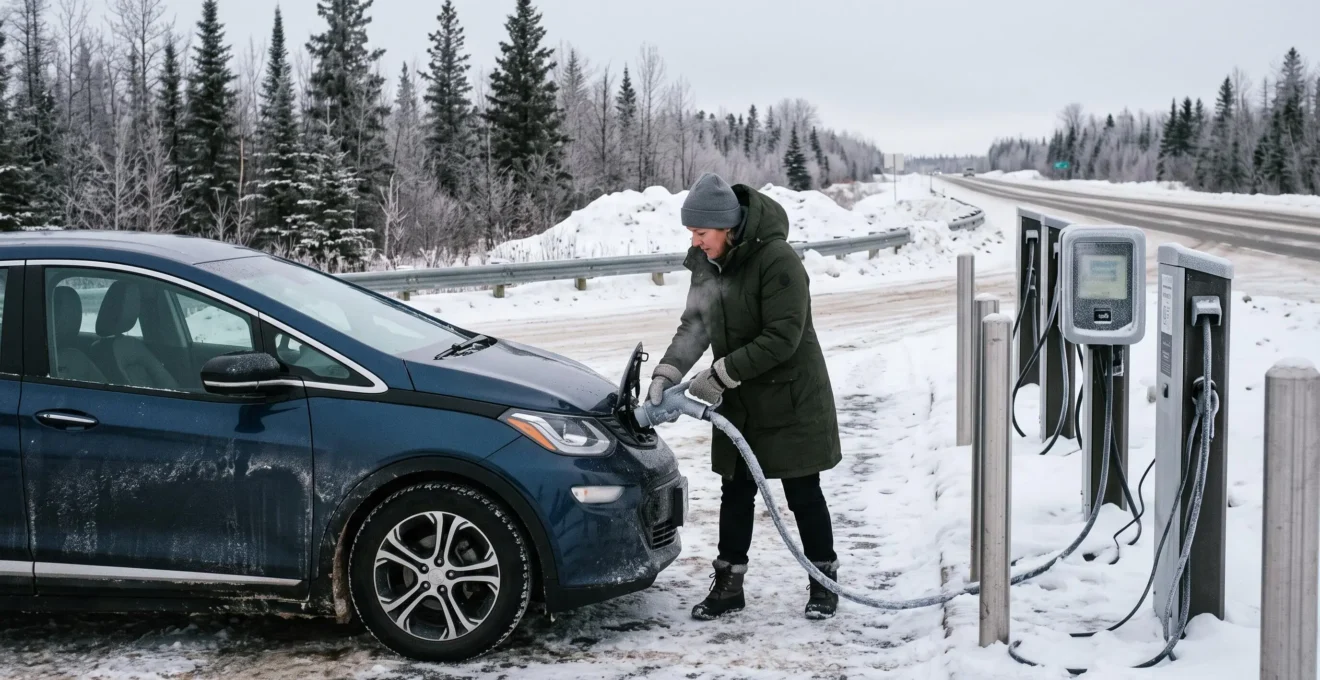
Canada’s electric vehicle charging infrastructure is increasingly capable of supporting everyday driving, but a reliable cross-country road trip still demands preparation. A charger shown on a map may be occupied, temporarily unavailable, incompatible with a vehicle or unable to deliver its advertised charging power. These differences matter most when temperatures fall and alternatives become scarce.
According to Transport Canada‘s September 2026 infrastructure update, Canada had 40,119 public light-duty EV chargers in Canada as of June 30, 2026. That total included 31,293 Level 2 chargers and 8,826 Level 3 chargers. Yet the number of connectors alone cannot establish whether a driver can find a working charger at a particular highway exit.
The practical question is therefore not simply whether Canada has enough charging equipment. It is whether drivers can depend on accessible, compatible and appropriately located chargers without turning ordinary travel into a complicated exercise. The answer depends on local infrastructure, charging habits, winter performance and the availability of alternatives.
EV charging in Canada: What drivers need to know
- Daily driving is generally easier to manage with dependable home, workplace or destination charging. Public fast charging becomes more important when those options are unavailable.
- Long-distance travel requires a verified backup plan. Winter consumption, charger availability and connector compatibility can determine whether an itinerary is realistic.
- Charging costs depend on more than electricity prices. Billing methods, charging speed, roaming charges and idle fees can substantially change the final bill.
- Why Do EV Drivers Encounter Unreliable Public Chargers on Canadian Highways?
- How to Plan Winter EV Charging Stops on Long Canadian Road Trips
- Level 2 or DC Fast Charging: Which Makes Sense During Different Stops?
- Charging Compatibility Mistakes That Can Leave EV Drivers Stranded
- How to Compare EV Charging Fees Based on Energy, Time and Idle Charges
- How to Coordinate Transit Connections When Commuting Across Municipal Boundaries
- Heat Pump or High-Efficiency Furnace: Which Suits a Cold-Climate Home?
- When Does Car-Sharing Make More Sense Than Owning a Vehicle in Canada?
Why Do EV Drivers Encounter Unreliable Public Chargers on Canadian Highways?
Canadian highway chargers can appear unreliable for three different reasons: equipment may be genuinely out of service, charging power may be restricted despite an operational connection, or a functioning station may be occupied without accurate availability information. Each problem requires a different response, making real-time verification and backup locations essential for dependable intercity travel.
A hardware failure prevents a charging session from starting or completing. The cause may involve the dispenser, connector, payment equipment or communication system. A charger delivering less power than expected presents a different problem: the session may succeed, but the stop lasts substantially longer than planned. Reduced power can result from charging equipment limitations, thermal protection or the vehicle’s own battery-management system.
Canadian weather introduces further uncertainty. Extreme cold can make cables difficult to handle and affect equipment operation, while high summer temperatures may trigger thermal management or power restrictions. These effects vary by charger design, maintenance and operating conditions. A network’s published availability figure should not automatically be interpreted as the probability of a successful, full-power charging session in severe weather.
40,119
Public light-duty EV chargers recorded across Canada as of June 30, 2026. This measures deployed infrastructure, not verified uptime, successful charging sessions or available highway charging sites.
Transport Canada’s electric vehicle dashboard, updated September 2026.
Geographic distribution also affects reliability from the driver’s perspective. Transport Canada’s figures show 13,694 public chargers in Ontario, 13,490 in Quebec, 8,027 in British Columbia and 2,121 in Alberta. These provincial totals are not equivalent to highway coverage, and they cannot establish that any province has a more reliable network. Population distribution, road geography and charger placement all matter.
Drivers may encounter equipment operated by Quebec’s Electric Circuit, BC Hydro, Petro-Canada, Tesla or other charging providers. Federal infrastructure funding has supported deployment, but additional charger installations do not eliminate equipment failures or localized congestion.
Before relying on a corridor charger, apply three checks:
- Confirm its latest operating status in the network operator’s application.
- Cross-check recent driver reports and connector details on PlugShare.
- Identify an alternative compatible charging site that remains reachable with the expected battery reserve.
If the charger is genuinely unavailable, use the backup. If power is reduced, reassess the remaining travel time and energy needs. If the site is occupied, compare the queue with the distance and available capacity at another location.
Reliability is ultimately a route-level question: a functioning station is useful only when it is available, compatible and capable of delivering enough energy before the next necessary stop. Winter conditions make that calculation more demanding.
How to Plan Winter EV Charging Stops on Long Canadian Road Trips
Winter EV road trips in Canada should be planned using actual cold-weather energy consumption rather than the manufacturer’s advertised driving range. Drivers need conservative distances between chargers, battery reserves, verified alternatives and sufficient time for slower charging. Battery preconditioning can improve fast-charging performance, but its effectiveness depends on the vehicle and prevailing conditions.
Cold weather affects an electric vehicle in several ways. Cabin heating consumes energy, battery chemistry becomes less efficient at low temperatures, and winter tires, snow-covered roads and denser cold air may increase energy demand. Highway speed and strong headwinds can further reduce achievable range.
The Canadian Automobile Association‘s February 2025 winter test offers a useful perspective. Fourteen EVs were driven between Ottawa and Mont-Tremblant at temperatures between -7°C and -15°C. Their measured winter driving ranges were 14% to 39% below official estimates, with considerable variation between vehicles.
Real-world evidence: Canadian winter EV performance
In its February 2025 winter EV performance test, CAA evaluated 14 electric vehicles under sub-zero Canadian driving conditions.
Actual range fell 14% to 39% below official estimates. During a 15-minute DC fast-charging session, the tested vehicles added an average of approximately 100 km of range and 28% battery charge. These are test averages, not guaranteed outcomes for individual vehicles or charging stations.
Rather than applying a universal winter-range discount, drivers should record their vehicle’s consumption under different conditions. A useful log includes outside temperature, speed, road conditions, heating use and energy consumption in kWh/100 km.
Consider an explicitly hypothetical EV with 60 kWh of usable energy and measured winter consumption of 25 kWh/100 km. Its calculated full-battery range under those assumed conditions is approximately 240 km. If the driver plans to use only 70% of that energy between stops to preserve reserves, the planning distance becomes roughly 168 km.
This calculation is a starting point, not a guarantee. Conditions can deteriorate, and usable energy or consumption may differ from the assumptions.
Extra caution is appropriate on northern Ontario routes, in northern Quebec and along remote British Columbia corridors, where charging alternatives may be separated by substantial distances or require detours.
Battery state of charge introduces another tradeoff. Arriving at a fast charger with a relatively low battery level can allow higher charging power when the battery is at a suitable temperature. However, arriving too low creates unnecessary risk if the charger is unavailable. Charging beyond 80% often becomes progressively slower, although additional energy may be justified when the next reliable charger is far away.
Where supported, battery preconditioning should be activated through the vehicle’s navigation or charging preparation functions before reaching a DC fast charger. A suitably warmed battery may accept power much faster than a cold one, sometimes making a major difference to stop duration. No fixed charging-time reduction should be assumed for every vehicle.
Five checks before a winter EV road trip
- Record measured winter consumption. Produce a reference figure in kWh/100 km from comparable cold-weather drives.
- Calculate a conservative leg distance. Write down the planned maximum kilometres between stops, including a battery reserve.
- Verify each primary station. Save the charger location, connector type and latest reported operating status.
- Identify a reachable alternative for every critical stop. Save the backup location and estimated arrival battery percentage.
- Prepare charging access before departure. Confirm required applications, payment methods, compatible adapters and battery-preconditioning settings.
A winter itinerary should protect the driver’s ability to reach the next functional charger, not simply minimize the number of stops. Choosing the right charging technology for each stop can make that itinerary more practical.
Level 2 or DC Fast Charging: Which Makes Sense During Different Stops?
Level 2 charging is generally best when a vehicle can remain parked for several hours, such as at home, work or overnight accommodation. DC fast charging is more suitable for shorter highway stops where rapid energy replenishment is necessary. The best choice depends on the available parking time, the vehicle’s charging capabilities and the next journey segment.
Charging speed matters only in relation to what the driver is doing. A fast charger offers limited practical value during an overnight hotel stay, while a Level 2 charger may provide insufficient energy during a brief roadside break.
The following comparison illustrates how these technologies serve different travel situations.
| Decision factor | Level 2 AC charging | DC fast charging |
|---|---|---|
| Typical stop | Overnight accommodation, workday or extended destination visit | Highway rest stop or shorter charging break |
| Time available | Several hours | Usually a shorter planned stop |
| Power limitation | Vehicle’s onboard AC charger and available station power | Battery temperature, state of charge and vehicle/station power limits |
| Main advantage | Energy can be replenished while the vehicle is already parked | Substantial energy can be added without an extended stay |
| Main constraint | Too slow for many short highway stops | Charging power may decline as the battery fills or when it is cold |
In winter, repeated DC fast-charging stops can become inefficient when the battery remains too cold to accept higher power. Charging overnight on Level 2 at a hotel, inn or ski destination avoids the need to rush and can allow the vehicle to start the next morning with a higher state of charge.
DC fast charging also deserves consideration from a battery-health perspective. Frequent high-power charging can contribute to battery wear under certain conditions, but long-term degradation depends on several factors, including temperature management, battery chemistry, charging power and how long the vehicle remains at high states of charge. Occasional highway fast charging is not automatically harmful, and a mixed charging strategy is usually more relevant than avoiding fast charging entirely.
Public Level 2 stations have an additional role in smaller Canadian municipalities. A charger at a community facility, municipal parking lot or accommodation property may provide a useful contingency when nearby DC equipment is occupied or unavailable.
However, an emergency Level 2 stop requires realistic expectations. The driver’s onboard AC charging limit and the actual station output determine how much energy can be recovered during the available time.
The most effective charging mix combines speed when necessary with convenience when time is available. That strategy works only when the vehicle can physically connect to and successfully activate the selected charger.
Charging Compatibility Mistakes That Can Leave EV Drivers Stranded
EV charging compatibility in Canada depends on the vehicle’s charging port, connector standard, approved adapters, station configuration and network authorization requirements. A connector that physically fits does not guarantee that charging will start. Before long-distance travel, drivers should confirm both hardware and software compatibility at every essential stop.
Several connector standards coexist in Canadian public infrastructure:
- J1772: A widely used connector for Level 1 and Level 2 AC charging on vehicles with the corresponding inlet.
- CCS1: A common North American DC fast-charging connector used by many vehicles.
- NACS: The North American Charging Standard, associated with Tesla vehicles and increasingly adopted by other manufacturers.
- CHAdeMO: A legacy DC fast-charging standard still relevant to certain existing vehicles, but less central to newer infrastructure deployment.
Adapters introduce another layer of complexity. Drivers must distinguish between AC and DC adapters, which are not necessarily interchangeable. A CCS1-equipped vehicle seeking access to a compatible NACS fast charger may require an approved NACS DC adapter. That requirement is different from using a Level 2 AC adapter.
Tesla‘s Supercharger network illustrates why connector shape alone is insufficient. The company distinguishes Tesla-only stations, Superchargers equipped with Magic Dock for broader vehicle access, and eligible NACS Superchargers supporting certain non-Tesla vehicles.
Access depends on the individual location, vehicle manufacturer and model eligibility. Vehicle production configuration and software support may also affect whether a particular vehicle can use the network.
According to Tesla’s official Supercharger compatibility information for other EVs, CCS1 vehicles using eligible NACS Superchargers require a supported DC adapter supplied or approved under the manufacturer’s stated requirements. Tesla prohibits third-party adapters under its published safety conditions.
Even with a compatible adapter, charging can fail if the station cannot authorize the session. Depending on the operator, access may require a configured mobile application, registered account, activated RFID card or valid payment method. Network roaming arrangements can introduce further restrictions.
Cable reach also matters. Some Superchargers were designed around Tesla charge-port positions. A non-Tesla vehicle with a differently positioned inlet may struggle to connect without occupying an unsuitable parking position. Cable length varies by site and equipment generation.
The safest preparation is a local compatibility test. Before departure, identify an eligible charging station, confirm the manufacturer’s approved equipment, initiate a short charging session and verify that electricity is actually being delivered.
This test should also confirm that payment succeeds and the charging session ends correctly. Testing locally is far less disruptive than discovering an authorization problem at a remote highway stop.
Compatibility checking belongs alongside battery-range planning. Once access is assured, the next consideration is whether the selected network’s billing structure makes the charging stop economical.
How to Compare EV Charging Fees Based on Energy, Time and Idle Charges
Canadian EV charging costs should be compared using the total amount paid for usable energy, not only the advertised station rate. Operators may charge per kilowatt-hour, per minute or through combined pricing structures. Idle fees, roaming charges, subscriptions and reduced charging power can make two apparently similar stops cost very different amounts.
Under energy-based billing, the main charge reflects the electricity delivered. Under time-based billing, the price depends on how long the vehicle remains connected or actively charging, according to the operator’s rules.
A vehicle accepting less power than the charger can deliver may therefore face a disadvantage under per-minute pricing. The station may advertise high power, while battery temperature, vehicle limitations or state of charge restrict actual energy transfer.
Consider two explicitly hypothetical charging sessions. Both deliver 30 kWh of energy:
| Billing factor | Energy-based station | Time-based station |
|---|---|---|
| Illustrative price | CAD 0.40/kWh | CAD 0.50/minute |
| Energy received | 30 kWh | 30 kWh |
| Session duration | 45 minutes | 45 minutes |
| Calculated charging cost | CAD 12.00 | CAD 22.50 |
These prices are invented solely to demonstrate the calculation; they are not published Canadian network tariffs. Actual charges may include taxes and other fees.
BC Hydro offers a documented example of energy-based public charging prices. Its published rates, effective April 1, 2026, are CAD 0.3083/kWh for Level 2 charging and CAD 0.3969/kWh for fast charging on equipment rated at 25 kW or higher, before tax. The applicable classification depends on the charger’s labelled capacity, not the power actually received by the vehicle.
CAD 0.40/minute
BC Hydro’s published fast-charging idle fee, effective April 1, 2026, after a five-minute grace period once charging stops. It does not apply to the utility’s Level 2 charging under the stated conditions.
BC Hydro public charging help centre, published charging rates and fee conditions.
The five-minute grace period matters because an idle fee can accumulate after the session finishes. At the stated rate, an additional 30 billable idle minutes would cost CAD 12.00. That amount is an arithmetic illustration of the published fee, not a prediction of a typical driver’s bill.
BC Hydro also publishes roaming charges of CAD 1.25 per fast-charging session and CAD 0.75 per Level 2 session under its stated roaming arrangements. Prices on partner networks can differ.
For a meaningful trip comparison, calculate charging expenditure per 100 km:
Cost per 100 km = energy consumption in kWh/100 km × effective charging price per kWh.
Where the operator bills by time, calculate the full session expenditure first, then divide by the energy delivered to obtain an effective per-kWh figure. Add applicable fixed charges and idle fees before comparing stops.
Home charging can be evaluated using the same approach, with the household electricity tariff and relevant charging losses considered. A paid network membership or financing arrangement should be included only after confirming its actual terms and whether the expected usage offsets any subscription cost.
Provincial differences also deserve attention. Quebec’s Electric Circuit and BC Hydro operate under different institutional and tariff arrangements, while private networks may apply their own pricing structures. Home electricity costs and public charging prices are not interchangeable, and neither should be assumed uniform within a province.
Charging economics become especially important for drivers who rely on public infrastructure regularly. For commuters, coordinating charging with public transit may reduce the need for expensive highway-style charging during the working week.
How to Coordinate Transit Connections When Commuting Across Municipal Boundaries
Intermunicipal EV commuters should coordinate charging around parking duration, transit connections and the availability of dependable infrastructure at both ends of the journey. Home charging may be sufficient for many trips, but workplace chargers and Level 2-equipped park-and-ride facilities can provide additional flexibility when daily travel crosses municipal boundaries.
Travel around Toronto, Vancouver and Montreal often involves different transit authorities, parking facilities and charging networks. A commuter may drive to a regional station, leave the vehicle for the day and continue by train or bus. When charging is available and permitted throughout the parking period, this arrangement can combine mobility needs with useful battery replenishment.
However, a park-and-ride facility should not be assumed to provide EV charging simply because it offers vehicle parking. Chargers may be absent, reserved, subject to time limits or managed by an operator separate from the transit authority.
Before building a routine around a particular facility, check the transit agency’s station information, municipal parking rules and the charger operator’s published conditions.
Payment coordination also requires attention. A regional transit fare card does not automatically provide access to EV charging, and charging membership typically does not include transit fares. Drivers may need separate accounts for transit, municipal parking and one or more charging networks.
A realistic commuter budget should therefore include parking, transit fares, electricity and any applicable charging-session fees. It should also account for whether charging is consistently available during the intended parking hours.
The situation becomes more demanding for apartment residents, condominium owners and households relying on street parking. Without dependable home charging, the commuter must establish whether public equipment near work, a transit station or the destination neighbourhood can cover weekly energy requirements.
For example, a driver unable to charge at home should compare the energy needed for a typical working week against the amount realistically obtainable during permitted parking periods. If access is unreliable, a nearby alternative and a separate charging schedule are necessary.
A charging-enabled commuter itinerary works best when the vehicle is already stationary for several hours. Requiring repeated special trips to charge can eliminate much of the arrangement’s convenience.
Integrating charging into existing travel patterns makes EV ownership easier, but electricity demand also extends to the household. In colder provinces, the interaction between vehicle charging and home heating deserves consideration before installing additional equipment.
Heat Pump or High-Efficiency Furnace: Which Suits a Cold-Climate Home?
A cold-climate heat pump may offer efficient electric heating, while a high-efficiency furnace may be attractive where natural gas is available and comparatively economical. For households adding an electric vehicle, the choice should also consider winter energy costs, building insulation and electrical service capacity. Neither heating technology is universally preferable across Canadian climates.
Air-source heat pumps move heat rather than generating it directly through electric resistance. Their efficiency and available heating capacity change with outdoor temperature. Equipment specifically designed for cold climates is engineered to operate more effectively under lower-temperature conditions, although its performance still depends on the model and installation.
A high-efficiency furnace typically burns a fuel such as natural gas to produce heat. Its operating economics depend on local fuel prices, equipment efficiency, maintenance, and the home’s heating load. Comparing furnace efficiency ratings directly with heat-pump efficiency figures can be misleading because they describe different operating principles.
For an EV-owning household, the combined winter energy budget is the practical starting point. Electric heating and vehicle charging can increase electricity consumption during the same season, although their actual power requirements and operating schedules vary.
Homeowners should evaluate the following factors before selecting equipment:
| Household condition | Cold-climate heat pump | High-efficiency furnace |
|---|---|---|
| Well-insulated home | Potentially favourable because heating demand is lower | Can still be appropriate depending on fuel availability and cost |
| Severe winter temperatures | Requires evaluation of low-temperature capacity and possible backup heating | Performance depends on correctly sized equipment and fuel supply |
| Electricity demand | Adds heating-related electrical load | Usually has a smaller direct electrical heating demand when fuel-fired |
| EV charger installation | Requires a combined electrical load assessment | Also requires verification of panel capacity for the charger |
| Operating cost | Depends on electricity tariff and seasonal equipment performance | Depends on delivered fuel price and system efficiency |
Regional differences are significant. Natural gas availability and pricing differ between Alberta, Quebec and other provinces, while electricity tariffs, rate structures and local climate conditions can substantially affect the financial comparison.
Electrical service is another important consideration. A home adding a 40 A or 48 A continuous-output Level 2 charging installation may require a substantial dedicated circuit. The specific branch-circuit requirements, panel capacity and overall electrical load must be assessed under applicable electrical codes by a qualified professional.
Load management can sometimes reduce the need for expensive electrical upgrades by coordinating vehicle charging with other household demand. Whether that solution is appropriate depends on the installation and approved equipment.
Incentive programs can change the financial outcome. Federal initiatives, including the former Canada Greener Homes Grant, and provincial or utility programs have operated under different eligibility conditions and application periods. The former grant should not be treated as an automatically available current incentive. Any replacement or existing programs offered through provincial governments, Hydro-Québec, Hydro One or other providers should be checked against their current official terms before making a purchase decision.
The correct comparison therefore includes installation cost, annual energy demand, maintenance, potential electrical upgrades and verified incentives, rather than equipment purchase price alone.
For some households, the total cost of home upgrades, parking and charging infrastructure can make personal vehicle ownership less compelling. That raises a broader question: whether owning an EV is the best transportation arrangement at all.
Key considerations before choosing EV ownership
- Compare the full cost of transportation, including parking, insurance, depreciation, charging access and occasional long-distance journeys.
- Consider whether a household actually needs a vehicle every day or could combine public transit with occasional access to a shared car.
- Check local vehicle availability and winter-trip suitability before treating car-sharing as a realistic alternative to ownership.
When Does Car-Sharing Make More Sense Than Owning a Vehicle in Canada?
Car-sharing can make more financial and practical sense than vehicle ownership for urban Canadians who drive infrequently, face high parking costs and have convenient access to shared vehicles. Ownership generally becomes more attractive as regular driving needs increase or shared-car availability decreases. Long-distance travel, winter conditions and access to charging should form part of the comparison.
Owning a vehicle involves substantial fixed costs even when it remains parked. Insurance, registration, depreciation, parking and financing or purchase costs continue regardless of weekly mileage. An electric vehicle may reduce some operating expenses, but it does not eliminate these ownership costs.
Car-sharing replaces many fixed expenses with usage-based charges. The precise pricing structure depends on the service and may include hourly, daily, distance-based or other fees.
Canadian urban services include Communauto, Evo, Modo and Zipcar, although availability differs by city and service area. Their fleets should not be assumed to consist mainly of battery-electric or plug-in hybrid vehicles: propulsion types vary by operator, location and fleet composition. Drivers specifically interested in testing EV technology should confirm the exact vehicle category before booking.
The financial comparison is most useful when based on an entire year of expected travel rather than the cost of a single outing.
Consider an explicitly hypothetical household that drives on occasional weekends, commutes mainly by transit and takes one or two longer journeys each year. Car-sharing may cover local errands while conventional rentals handle trips into areas with limited charging infrastructure. Under those conditions, the household could avoid ongoing ownership costs and the need to manage an EV’s public charging requirements.
A household driving daily, transporting equipment regularly or travelling frequently to remote destinations may reach a different conclusion. Availability, vehicle size, booking restrictions and unpredictable demand can reduce the practicality of car-sharing.
Winter travel adds another distinction. Access to a shared EV can provide useful experience with real-world cold-weather energy consumption, but only when the operator offers an appropriate electric model and its booking conditions permit the planned journey. Drivers should verify charging responsibilities, range expectations and return requirements.
Outside major urban service areas, car-sharing choices may be limited or absent. Rural households and residents of smaller municipalities cannot base their transportation strategy on a service that does not operate near their homes.
For occasional long-distance travel, a mixed approach can be attractive: public transit for commuting, car-sharing for urban errands and a suitable rental vehicle for infrequent remote trips. This arrangement avoids requiring one privately owned vehicle to satisfy every possible journey.
The next practical step is to calculate annual ownership costs, identify available local car-sharing options and map the journeys that genuinely require a private vehicle. Compare those findings with the reliability of charging access at home, work and along regularly travelled routes. Canada’s charging infrastructure may be sufficient for a particular lifestyle without being equally convenient for every driver.
Can an EV owner manage everyday driving in Canada without home charging?
Yes, depending on local public charger availability, workplace charging, driving distance and parking arrangements. Drivers without home charging should calculate their weekly energy requirements and identify dependable charging locations near places they already visit. A backup option is especially important during winter or when public stations are frequently occupied.
Does having more public chargers guarantee a more reliable charging network?
No. Charger totals measure infrastructure deployment, not successful sessions, equipment uptime, delivered power or geographical convenience. Transport Canada’s June 2026 infrastructure figures provide useful national and provincial counts, but they do not establish whether particular chargers will be available and operational when a driver arrives.
Should drivers always charge an EV to 100% before a winter highway trip?
Not necessarily. A higher departure charge may provide a useful reserve when charging opportunities are limited, but drivers should follow their vehicle manufacturer’s battery-care recommendations. The appropriate target depends on battery chemistry, available range, road conditions and the distance to the next dependable charging location.
What should drivers do if a planned highway fast charger is unavailable?
Check whether another compatible unit at the location is operating, then evaluate the nearest verified alternative against the vehicle’s remaining estimated range. Avoid proceeding to an uncertain or distant charger without sufficient reserve. If no fast-charging alternative is safely reachable, an accessible Level 2 station may offer a slower contingency, provided the vehicle has enough energy to get there.
Can drivers use the same charging application across every Canadian network?
No universal application guarantees access to every charging provider. Some networks support roaming, payment cards or other authorization options, but requirements differ by operator and site. Before travelling, confirm which applications, accounts, RFID cards or payment methods are accepted at the specific stations on the planned route.