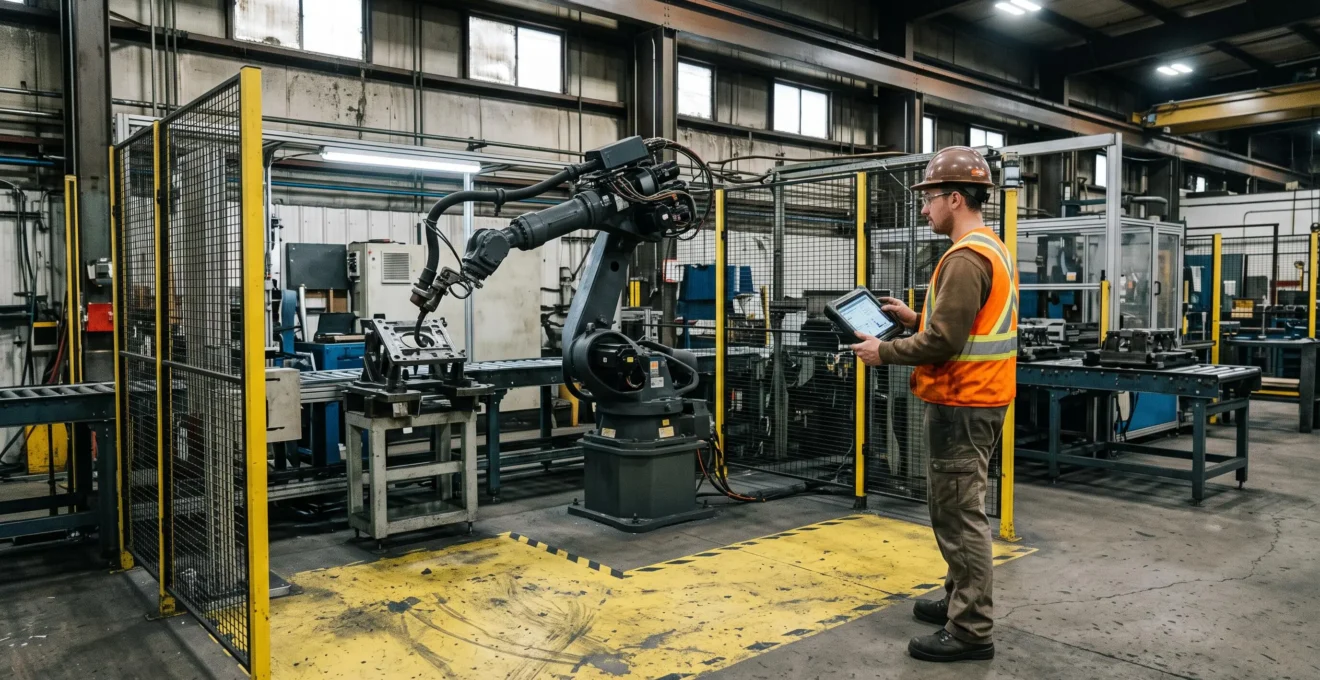
Robotics and automated systems can improve Canadian industrial operations where repetitive handling, hazardous movements, inconsistent processing or equipment stoppages constrain production. The strongest opportunities are not necessarily the most technologically sophisticated. They are the tasks where automation can deliver measurable improvements in throughput, worker safety, process consistency or equipment availability without creating larger problems elsewhere in the facility.
Canadian manufacturers face distinct implementation considerations. Smaller production batches, variable materials, geographically dispersed suppliers and limited access to specialized maintenance personnel can make standardized automation projects difficult to justify. A robot that performs well during commissioning may still fall short of expectations when production schedules, staffing and upstream processes are considered.
According to Statistics Canada‘s analysis of robotics adoption in Canadian businesses, 8.4 % of manufacturing businesses had adopted robotics technologies in 2022. The survey also identified integration challenges, recruitment difficulties and return-on-investment concerns among adopters. These findings make a practical point: successful automation depends as much on operational readiness as on equipment selection.
Industrial automation: the essential decisions
- Start with the production constraint. Measure cycle times, defects, ergonomic exposure and downstream capacity before selecting robotic equipment.
- Evaluate the complete robotic cell. Integration costs, safety controls, changeovers and maintenance capabilities can matter more than the robot’s purchase price.
- Build reliability into the project. Condition monitoring, operator training and transparent maintenance priorities help sustain performance after commissioning.
- Why Do Industrial Robots Fail to Deliver Expected Productivity Gains?
- How to Identify Repetitive Production Tasks Worth Automating
- Collaborative Robots or Traditional Industrial Robots: Which Fits Small Factories?
- Robot Integration Mistakes That Can Create Unexpected Workplace Hazards
- How Condition-Based Maintenance Can Reduce Industrial Robot Downtime
- How to Reduce Material Waste in Small Canadian Manufacturing Facilities
- How to Prioritize Competing Requests Without Damaging Colleague Relationships
- How Are Canada’s Manufacturing and Resource Sectors Adapting to New Production Demands?
Why Do Industrial Robots Fail to Deliver Expected Productivity Gains?
Industrial robots often miss productivity targets because installing a functioning machine is not the same as improving an entire production process. Upstream material shortages, downstream bottlenecks, lengthy changeovers and inadequate technical support can eliminate expected throughput gains. Productivity improves only when the robotic workstation, surrounding equipment and operating practices function as a coordinated system.
A robot may complete its programmed movement within the supplier’s specified cycle time while spending much of the shift waiting for parts or downstream capacity. For example, accelerating a welding station provides limited additional output if inspection or packaging cannot process the increased volume. The robot meets its technical specification, but the production line does not achieve the projected improvement.
Installation success measures whether the robot works; integration success measures whether the operation performs better. This distinction should guide acceptance testing. A facility needs evidence of completed good units per operating hour, not simply faster robotic motion.
Financial projections can also depend on utilization assumptions that do not reflect actual Canadian production conditions. Seasonal demand, frequent product changes, variable incoming material quality and smaller orders may reduce the number of productive hours available to recover an investment.
Consider a hypothetical facility where a supplier’s payback calculation assumes steady production of identical components. If the plant instead changes fixtures frequently and experiences inconsistent incoming part dimensions, additional programming and handling time can substantially change its business case. The appropriate response is to recalculate the expected utilization using observed production patterns, rather than treating the original quotation as a guaranteed result.
19.5%
Of Canadian businesses that had adopted robotics technologies in the 2022 Statistics Canada survey reported significant difficulties integrating advanced technologies with existing systems, standards and processes.
Statistics Canada, Survey of Advanced Technology, 2022; analysis published in 2024.
Technical capability creates another constraint. Without personnel trained to diagnose faults, adjust programs and manage changeovers, a relatively minor interruption can require external integrator assistance. Waiting for support can turn a short equipment fault into a much longer production stoppage. Statistics Canada’s survey also found that 25.2% of robotics adopters reported significant difficulties recruiting qualified personnel.
Before commissioning, facilities should establish production-level acceptance criteria covering throughput, first-pass quality, changeover duration, availability and recovery from common faults. Measuring these indicators across normal operating conditions is more informative than observing a demonstration cycle.
When those losses are documented, the next decision becomes clearer: which manual tasks are sufficiently repetitive, constrained or risky to justify automation in the first place?
How to Identify Repetitive Production Tasks Worth Automating
Production tasks are good automation candidates when they combine frequent repetition, consistent inputs, measurable quality requirements and meaningful operational costs or ergonomic risks. Managers should rank potential applications using observed cycle times, task variability, worker exposure and production constraints. A technically simple task is not automatically the most valuable one to automate.
Start by observing operations over a representative production period. Record how often each task occurs, the time required, the frequency of interruptions and the variation between incoming parts. Include rework and handling delays rather than measuring only the movement that would eventually be performed by a robot.
A practical screening exercise can use four dimensions:
- Repetition and volume: How many comparable cycles are performed, and how stable is demand across shifts and seasons?
- Ergonomic exposure: Does the task involve repetitive reaching, awkward postures, lifting or other hazards requiring assessment?
- Precision and quality: Can a defined motion, placement accuracy or process parameter reduce observed defects?
- Input variability: Are dimensions, orientations, materials and presentation consistent enough for reliable automated handling?
Variability deserves special attention. A palletizing operation may appear predictable until incoming pallets from multiple regional suppliers differ in dimensions or condition. A processing station may handle identical nominal products but encounter materially different surface characteristics. These variations can introduce additional sensing, fixturing and programming requirements after an initial equipment quotation.
Candidate selection should also distinguish between ease of automation and economic urgency. A repetitive task with adequate staffing may offer less immediate value than a more challenging process that repeatedly limits output because qualified operators are unavailable. Labour constraints should therefore be examined alongside technical feasibility, not used as a replacement for it.
Five practical steps to validate an automation candidate
- Observe the task across representative operating conditions and produce a dated cycle-time log.
- Record defects, rework, interruptions and incoming-part variations in a categorized exception register.
- Document repetitive movements, manual handling and relevant ergonomic concerns in a task-exposure assessment.
- Map upstream supply and downstream processing capacity in a workstation flow diagram.
- Compare the expected automated process with the measured baseline and produce a preliminary business-case worksheet covering integration, staffing, changeovers and maintenance.
These are screening steps, not a substitute for detailed engineering or a formal workplace risk assessment. A promising candidate still needs feasibility testing with representative parts and operating conditions.
Once the task is validated, robot selection should be based on its actual force, speed, space and safety requirements rather than assumptions about which technology is best for smaller factories.
Collaborative Robots or Traditional Industrial Robots: Which Fits Small Factories?
Collaborative robots can suit smaller factories with space constraints, frequent changeovers and appropriately designed human-machine interaction. Traditional industrial robots are often better suited to high-speed operations, heavier loads and applications requiring substantial separation from workers. The correct choice depends on total integration cost, production targets and a task-specific safety assessment, not robot purchase price alone.
A collaborative robot, commonly called a cobot, may reduce some space and guarding requirements when its complete application can operate safely under an appropriate collaborative mode. However, the tooling, workpiece, motion and surrounding equipment can introduce hazards that require additional protective measures.
Traditional industrial robots may offer greater speed, reach or payload for particular applications, but their complete installation can require substantial guarding, access controls and floor space. Conversely, a cobot operating under force-limiting requirements may have to move slowly enough that it cannot meet the required production cycle.
The comparison should therefore include equipment, fixtures, sensing, safety engineering, commissioning, operator training, maintenance and future product changes.
| Decision criterion | Collaborative robot | Traditional industrial robot |
|---|---|---|
| Production volume and speed | May suit moderate-speed work and frequent product changes | Often preferable for demanding cycle-time targets |
| Task force and payload | Collaborative operation can impose application-specific limitations | May accommodate higher forces and heavier loads with suitable safeguards |
| Floor space | Potentially smaller footprint, depending on required protection | Guarded work envelopes may require more space |
| Existing safety infrastructure | Requires risk assessment and appropriate protective functions | Can make use of existing safeguarded automation areas where suitable |
| Changeover requirements | Potential advantages for adaptable low-volume applications | Can support flexible applications but may require more specialized integration |
| Total integration cost | Dependent on tooling, safeguards and production requirements | Dependent on guarding, installation complexity and cell design |
The CCOHS guidance on industrial robot and cobot safety identifies different collaborative safety approaches, including speed and separation monitoring, hand guiding, power and force limiting, and safety-rated monitored stops. These approaches have different operational constraints and should not be treated as interchangeable.
A crucial distinction is that collaborative equipment is not inherently safe in every application. A low-force arm fitted with a sharp tool or handling a hazardous workpiece can still create unacceptable risks. The complete robotic application must be evaluated, including the interactions between personnel, tools and other machinery.
Small manufacturers with limited engineering resources should request competing integration proposals based on the same production and safety requirements. This allows the actual cost of delivering acceptable output to be compared rather than relying on equipment specifications alone.
After identifying a suitable robot type, the principal challenge is ensuring that the installed cell remains safe during both normal production and the interventions that workers must perform.
Robot Integration Mistakes That Can Create Unexpected Workplace Hazards
Robot integration can introduce unexpected hazards when work-cell layouts, access routes, maintenance procedures or modifications are designed without a complete risk assessment. Hazards often emerge during troubleshooting, changeovers and manual intervention rather than normal automatic cycles. Assessing the entire robotic application throughout its lifecycle is essential for preventing unsafe interactions between workers and moving equipment.
One common mistake is designing the layout around machine reach and production flow before examining worker movements. A robot installed beside a pedestrian route may create exposure when material handling or maintenance requires access near its operating envelope. Guarding that appears adequate during commissioning can become inconvenient or insufficient once the cell reaches full production.
Risk assessment should consider routine operation, material loading, programming, cleaning, fault recovery, maintenance and reasonably foreseeable abnormal conditions. Maintenance access and safe intervention modes deserve particular attention, especially in smaller plants where one employee may have several responsibilities.
Another problem arises when a cell changes after commissioning. Adding conveyors, fixtures, tooling or new product configurations can alter reachable hazards, stopping requirements, protective distances or access arrangements. A prior assessment should not automatically be assumed valid after such modifications.
Modifications should trigger a review whenever they affect the robot’s movement, tooling, payload, safeguarding, operating modes or interactions with adjacent equipment. Changes to pedestrian access, maintenance procedures or task assignments also warrant examination. The review should determine whether existing safety measures remain appropriate and whether additional validation is needed before restarting production.
Canadian facilities must consider applicable provincial or territorial occupational health and safety requirements alongside relevant technical standards. The CAN/CSA-Z434-14 industrial robot safety standard addresses industrial robot systems and associated integration activities, including programming, operation and maintenance. The referenced R2024 edition is identified as historical by the catalogue, so the edition currently applicable to a project must be verified rather than assumed.
Human factors are equally important. If personnel regularly bypass a cumbersome procedure to recover a minor fault, the issue requires investigation and redesign where appropriate, not simply another instruction to work carefully. Protective functions, training, access arrangements and operational procedures must be usable under real production conditions.
Acceptance testing should include foreseeable intervention scenarios and verification of safety functions, not only a successful automated production run. Documentation should be updated whenever significant changes affect the assessed application.
Safety also depends on equipment remaining reliable over time. Monitoring developing mechanical problems can reduce unplanned interventions that expose technicians to additional operational pressure.
How Condition-Based Maintenance Can Reduce Industrial Robot Downtime
Condition-based maintenance can reduce industrial robot downtime by identifying signs of deterioration before equipment reaches failure. Instead of relying exclusively on calendar-based servicing, maintenance teams monitor operating indicators such as motor current, axis torque and cycle-time changes. Effective monitoring requires comparable operating data, meaningful thresholds and a defined response before production is disrupted.
Fixed maintenance intervals remain useful for tasks specified by equipment manufacturers and for safety-critical inspections. However, operating hours and mechanical stress can vary considerably between robotic applications. An identical calendar interval may be too late for heavily loaded components and unnecessarily early for equipment operating under lighter conditions.
Condition monitoring adds information about equipment behaviour. Many industrial robot controllers can expose useful signals, although availability depends on the specific manufacturer, controller and communications architecture.
Potential indicators include:
- Axis torque or motor current: Changes under comparable movements and loads may indicate increased mechanical resistance or degradation.
- Cycle-time drift: Persistent differences from a stable operating baseline can prompt investigation, although they are not specific evidence of mechanical wear.
- Motor temperature: Abnormal readings may support diagnosis, but temperature can be a relatively late indicator and depends on operating conditions.
- Fault and alarm history: Recurring events can help identify equipment requiring investigation, even when individual stoppages are brief.
Siemens’ 2023 technical white paper, Best Practices in Condition Monitoring for Multi-Axis Equipment, recommends analyzing robot-axis data under consistent operating conditions. Its discussion of torque and motor-current monitoring explains why measurements taken during different payloads or program sequences can be misleading. As supplier technical documentation, it informs monitoring design but does not establish a universal downtime reduction rate.
A practical implementation begins by recording representative normal operating behaviour. The team can then investigate trends relative to that baseline, accounting for programs, loads and other relevant operating conditions. Initial alert thresholds should be reviewed against observed behaviour and maintenance findings rather than treated as universal limits.
The collected data must also lead to decisions. One useful approach is to classify detected conditions by operational consequence: immediate safety-related concerns require appropriate action, while noncritical deterioration may support a planned intervention before a demanding production period.
For facilities experiencing seasonal demand peaks, the maintenance calendar should include planned opportunities to investigate emerging faults before available production windows become constrained. Deferring every intervention until an unexpected stoppage defeats the purpose of monitoring.
Existing installations may require controller-data access, additional monitoring capability or integration work. A baseline period is necessary before anomaly detection becomes meaningful, particularly where product mixes change frequently.
The same principle applies beyond machine health: collecting operational evidence can reveal unnecessary material losses and help determine where automation will create further value.
How to Reduce Material Waste in Small Canadian Manufacturing Facilities
Small Canadian manufacturing facilities can reduce material waste by measuring losses at selected production points, distinguishing process defects from inventory and logistics losses, and correcting their underlying causes. Concentrating on high-volume or high-cost material streams makes improvement manageable. The resulting measurements also provide a useful baseline for evaluating whether automation could improve consistency and material utilization.
Material waste is not a single operational problem. Scrap, offcuts, rejected components and rework typically arise during processing. Overstocking, storage deterioration, expired materials and losses during handling involve purchasing and logistics decisions. Each category requires different measurement points and corrective actions.
Facilities should begin with a limited waste map. Select a few stations with substantial material consumption or visible losses, then record input quantities, accepted output, scrap and rework. Where practical, categorize losses by product, machine, operating condition and defect type.
For a hypothetical metal fabrication facility, recording offcut dimensions and rejected-part causes can reveal whether losses arise mainly from cutting layouts, inconsistent incoming stock or machine settings. These causes would justify different responses. Automated handling may improve repeatability, but it cannot necessarily correct unsuitable stock dimensions or poor production planning.
Waste data should inform automation decisions, not merely justify an already selected robot. If measurements show that incorrect fixture positioning accounts for a recurring defect pattern, the facility can evaluate whether better fixtures, process controls, operator training or automated positioning would provide the most appropriate correction.
Quality and material usage should be considered together. A higher production rate offers limited economic value if scrap increases at the same time. Evaluating acceptable output per unit of material can reveal performance changes that a cycle-time metric misses.
Waste reduction can also affect procurement. Lower scrap volumes may reduce purchasing requirements, change preferred delivery schedules or alter order quantities. Savings estimates should consider these adjustments, including supplier terms and storage requirements, rather than assuming that every avoided kilogram immediately translates into an equivalent cash saving.
For resource-linked manufacturing, variable raw materials can make a stable baseline difficult to establish. Comparing waste patterns within similar material categories helps avoid attributing inherent input differences to machine or operator performance.
These improvements frequently compete for the same technical resources as maintenance and production support. Transparent priority setting becomes essential when every department has a legitimate operational need.
How to Prioritize Competing Requests Without Damaging Colleague Relationships
Industrial teams can prioritize competing requests without damaging relationships by using shared decision criteria, visible scheduling and clear explanations of trade-offs. Safety concerns, equipment-failure risks, production commitments and resource availability should guide the ranking. When colleagues understand why a request is delayed and when it will be reconsidered, prioritization becomes a coordinated operational decision rather than a personal disagreement.
Production managers may need immediate machine recovery, while maintenance teams require planned downtime for inspections. Quality personnel may request process adjustments, and engineering staff may need access to the same equipment for an automation trial. In smaller Canadian facilities, these needs can converge on a limited number of technicians and production windows.
Escalating every disagreement to the most senior available manager may resolve a particular conflict without improving the underlying process. A more consistent approach is to maintain a shared queue that records each request, its operational consequence, the affected equipment, the proposed priority and the responsible decision-maker.
A practical ranking can consider the following factors:
- Immediate safety implications and the need for protective action.
- Likelihood and consequences of an equipment failure.
- Current production disruption and delivery commitments.
- Availability of qualified personnel, parts and machine access.
- Potential consequences of delaying the work.
Safety-related requirements must not be reduced to a negotiable production preference. Applicable procedures and obligations determine the necessary protective response. For other competing requests, the ranking can reflect evidence of operational risk and the availability of suitable work windows.
Condition-monitoring data can make these discussions more constructive. A maintenance request supported by a documented deterioration trend is easier to evaluate than a general concern that a machine might fail. Similarly, a production request supported by actual downtime records provides a clearer basis for deciding whether immediate action is justified.
Communication matters when a request cannot be accepted immediately. Instead of offering a vague refusal, the responsible person can explain which work has priority, the operational reason and the next available review or intervention window. If that window remains uncertain, identifying what will determine its availability is preferable to making an unsupported commitment.
Publishing these decisions also helps departments identify recurring resource conflicts. Repeated deferral of preventive maintenance may indicate a staffing or scheduling problem that requires management attention rather than another round of individual negotiation.
The wider implication is that industrial automation must be treated as part of workforce and production planning. That becomes especially important as Canadian manufacturing and resource operations respond to changing capacity requirements.
Key takeaways for Canadian industrial decision-makers
- Choose automation projects according to measured capacity, quality, safety and staffing constraints rather than technology availability alone.
- Match each project’s integration complexity to the facility’s engineering and maintenance capabilities, including external support requirements.
- Build a phased implementation roadmap that combines operational measurements, risk assessment, workforce development and reliability management.
How Are Canada’s Manufacturing and Resource Sectors Adapting to New Production Demands?
Canada’s manufacturing and resource sectors can respond to changing production demands by adopting automation selectively, strengthening technical capabilities and improving operational flexibility. Robotics can help address difficult-to-staff tasks, process variability and production constraints, but implementation strategies differ between large plants and smaller facilities. Effective adaptation depends on matching technology investments to actual operating conditions and available support.
Manufacturers producing standardized goods in large volumes may benefit from highly repeatable robotic processes. Resource-linked operations can face different challenges, including variable feedstock, complex handling requirements and facilities located far from specialized integration support. These conditions can increase the importance of adaptable equipment, robust sensing and local troubleshooting capability.
Labour availability is a significant consideration, particularly where operations depend on specialized technical personnel. Automation can support production capacity when repetitive or physically demanding tasks are difficult to staff. However, it may also increase the need for employees trained in programming, electrical systems, maintenance and safety management.
Statistics Canada’s 2022 survey illustrates the uneven adoption environment: 9.1 % of large businesses had adopted robotics technologies, compared with 5.3% of medium-sized businesses and 1.6% of small businesses, using the survey’s business-size definitions. These historical figures do not establish current adoption levels, but they demonstrate an important difference in the surveyed businesses’ technological starting points.
Large manufacturers may have dedicated engineering teams, established automation infrastructure and greater capacity to standardize equipment across multiple production lines. Smaller facilities often rely more heavily on external integrators and must evaluate investments against tighter staffing and production constraints.
Public technology-adoption support programs may be relevant to particular projects, but eligibility, availability and funding conditions vary. Managers should verify the current requirements of applicable federal, provincial or regional programs rather than including unconfirmed assistance in financial projections.
A practical adaptation strategy can be organized into successive decisions. First, identify the operational constraint through measured production, quality and downtime data. Next, screen potential automated tasks and compare alternative process improvements. Then establish the necessary safety measures, integration responsibilities and training capacity before commissioning.
After implementation, the facility should monitor throughput, quality, equipment condition and maintenance demands against its original baseline. These observations inform whether the project should be adjusted, extended or replicated elsewhere.
The objective is not to maximize the number of robots installed. It is to build dependable industrial capacity that can respond to changing materials, workforce availability and customer requirements. A modest, well-integrated automation project may provide more useful operational flexibility than a larger installation whose maintenance and changeover demands exceed available resources.
For the next investment decision, select one constrained production process, establish its current performance baseline and assign responsibility for a joint operations, maintenance and safety review. That provides a concrete starting point for deciding whether robotics, another form of automation or a simpler process improvement offers the strongest operational case.
What should a Canadian manufacturer measure before purchasing an industrial robot?
Measure completed good units per hour, cycle-time variation, rework, scrap, equipment downtime, changeover duration and relevant manual-handling exposure. Record representative production conditions and incoming-material differences. These measurements establish whether a robot could address the actual constraint and provide a baseline for evaluating performance after commissioning.
Does installing a collaborative robot eliminate the need for safety guarding?
No. A collaborative robot requires an application-specific risk assessment covering its tooling, workpieces, movement, operating modes and surrounding equipment. Depending on the hazards, additional protective measures or guarding may be necessary. Canadian facilities must evaluate the applicable occupational health and safety obligations and relevant technical standards.
Can smaller factories begin monitoring robot condition without a sophisticated analytics platform?
Potentially. If suitable controller data are available, a facility can begin by recording selected operating indicators under consistent conditions and investigating meaningful deviations. The approach requires a representative baseline, appropriate technical interpretation and clearly assigned maintenance responses. Available signals and integration requirements depend on the robot and control system.
How should seasonal production changes affect an automation business case?
Seasonal demand should be reflected in projected utilization, staffing, maintenance access and production schedules. A business case based on continuous high-volume operation may overstate the benefits achievable in a facility with long low-demand periods or frequent product changes. Financial assumptions should be checked against representative operating records and alternative production scenarios.
When should a manufacturer expand from one robotic cell to additional automation?
Expansion is easier to justify once the first application demonstrates sustained improvements under normal production conditions. Evaluate actual throughput, quality, maintenance requirements, worker safety and changeover performance against the initial baseline. Confirm that downstream capacity, staffing and technical support can accommodate further automation before replicating the installation.