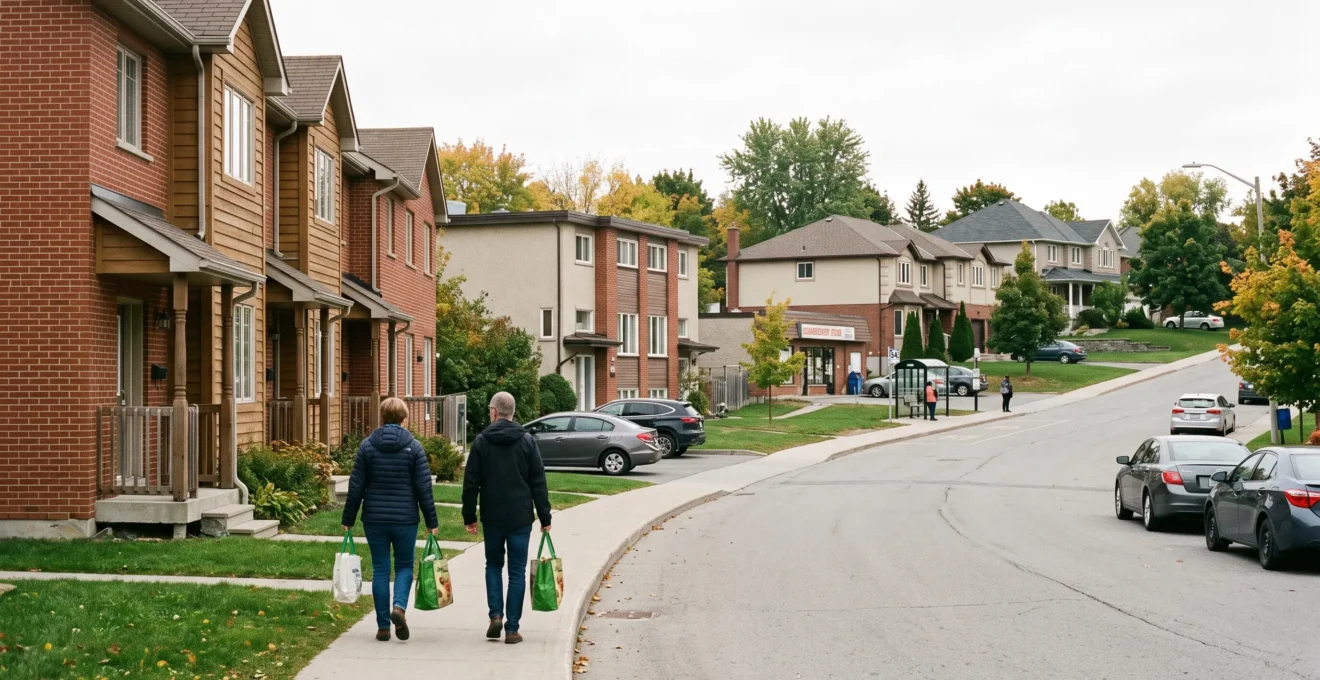
Choosing between urban and rural living in Canada is not simply a decision between a smaller home near amenities and a larger property surrounded by open space. Settlement location influences housing affordability, transportation needs, access to healthcare and schools, maintenance responsibilities and the reliability of essential infrastructure.
A detached home outside a regional centre may offer more land and privacy than an urban condominium. Yet that apparent advantage can diminish if the household needs another vehicle, faces longer medical trips or must maintain a private well and septic system. Conversely, a centrally located home may cost more to purchase while reducing everyday travel and property upkeep.
The most useful comparison is between specific properties and the daily routines they make possible. Canadian communities vary considerably in their proximity to employment, public services and reliable infrastructure. Understanding those differences helps prospective movers assess not only what they can afford today, but also how practical their housing choice may remain as their circumstances change.
Urban vs. rural living in Canada: the essentials
- Housing value extends beyond purchase price. Compare usable space, transportation costs, maintenance obligations and access to services together.
- Location matters more than a simple urban-rural label. A connected small town can offer a different experience from an isolated settlement, even when homes have similar asking prices.
- Long-term suitability requires property-specific checks. Verify healthcare, schools, internet service, infrastructure conditions and renovation needs before committing.
- Why Are Some Canadian Households Moving Toward Smaller Communities?
- How to Assess Healthcare, Schools and Internet Access Before Moving Rural
- Condo, Townhouse or Detached Home: Which Fits Different Canadian Locations?
- Rent, Groceries or Transportation: Which Costs Matter Most When Relocating?
- Hidden Property Maintenance Challenges for First-Time Rural Homeowners
- When Should You Inspect a Rural Property to Identify Seasonal Problems?
- How to Assess Attic Insulation Without Overlooking Moisture Problems
- Which Energy-Efficient Retrofits Deliver the Most Value in Canadian Homes?
Why Are Some Canadian Households Moving Toward Smaller Communities?
Some Canadian households are attracted to smaller communities because they may offer larger homes, more outdoor space, quieter surroundings and greater control over their property. Potential affordability and flexible working arrangements can strengthen that appeal. However, these advantages depend on the particular community, local housing supply and access to employment and essential services.
The difference in housing characteristics is measurable. According to Statistics Canada’s analysis of rural and urban housing in Canada, rural households had higher homeownership rates than urban households in the 2021 Census. Rural properties also had lower average owner-estimated values.
77.1% vs. 64.3%
The homeownership rate was 77.1% among rural Canadian households and 64.3% among urban households in the 2021 Census. These figures describe housing tenure, not the financial benefits of relocating.
Statistics Canada, 2021 Census of Population.
The same statistical analysis reported average owner-estimated home values of CAD 355,600 in rural areas and CAD 677,000 in urban areas in 2021. These were homeowner estimates, not transaction prices, and should not be interpreted as current market valuations.
A smaller community is not necessarily a remote community. A town within commuting distance of a metropolitan area may provide access to regional employment, hospitals and larger retail centres. A similarly priced property in an isolated settlement could require substantially longer journeys for the same services.
Statistics Canada’s Index of Remoteness for Canadian communities offers a useful distinction. It considers proximity to population centres and their population sizes, providing more geographic context than a basic urban-rural classification. It does not, however, confirm the availability of particular services at a residential address.
Personal circumstances also shape the appeal of relocation. Remote workers may value a dedicated office, while growing families may prioritize bedrooms and outdoor space. These advantages should be tested against possible changes in employment, commuting expectations, childcare requirements and household mobility.
Urban and rural housing are not the only alternatives. Established small towns, suburban neighbourhoods and regional centres can offer intermediate combinations of living space and convenience. Their suitability depends on the actual neighbourhood and available housing stock.
Once the preferred settlement type is clearer, the next question is whether its healthcare, education and communications infrastructure can support the household’s everyday needs.
How to Assess Healthcare, Schools and Internet Access Before Moving Rural
Before moving to a rural Canadian property, verify that essential healthcare, education and internet services are genuinely accessible from the exact address. Distance alone is insufficient: service capacity, appointment availability, school catchment rules, transportation routes and broadband installation conditions all matter. Assess these factors against the household’s present needs and foreseeable changes.
Start by separating essential services from occasional conveniences. A household might tolerate a longer journey to a major shopping centre but find frequent medical appointments or unreliable home internet considerably more disruptive.
Statistics Canada‘s rural community and proximity-to-services resources provide useful geographic context. However, proximity indicators cannot establish whether an individual clinic accepts new patients, a school serves a particular address or a telecommunications provider can complete an installation.
Healthcare access requires confirmation of actual services. Identify nearby family healthcare options, pharmacies, emergency departments and regional hospitals. Contact relevant providers to establish patient registration arrangements, services offered, referral pathways and where specialist appointments typically occur.
Consider travel frequency as well as travel distance. A hospital reached through a lengthy winter journey may be manageable for an occasional appointment but much less practical for ongoing treatment. Emergency transportation arrangements also deserve separate investigation because personal driving times do not establish ambulance response times.
School research should extend beyond the nearest building. Verify catchment boundaries with the relevant school board or authority, grade levels, transportation eligibility, bus-stop locations and extracurricular opportunities.
For example, in a hypothetical family relocation, a child might attend a nearby elementary school while the designated secondary school requires a substantially longer bus journey. The property could suit the family initially but create a significant scheduling challenge several years later.
Reliable connectivity is equally important for households depending on remote employment, online learning or virtual healthcare. Canada’s National Broadband Map can help identify potential service coverage, but advertised availability is only a starting point.
Request written serviceability confirmation for the exact civic address. Ask providers about installation requirements, available download and upload speeds, latency, data restrictions and known reliability limitations. Where possible, discuss actual performance with neighbouring residents.
Backup connectivity and electricity arrangements may be necessary when internet access is essential for income or household safety.
Five checks to complete before choosing a community
- Map essential destinations. Produce an address-specific route sheet showing healthcare facilities, schools, pharmacies and grocery options, including alternative winter routes where relevant.
- Confirm healthcare availability. Prepare a contact log recording clinic registration information, hospital services and specialist referral arrangements.
- Verify educational arrangements. Obtain a school-board confirmation of catchment boundaries, grade levels and transportation eligibility.
- Validate connectivity. Request a provider’s written confirmation of serviceability, installation conditions and available broadband plans for the property.
- Test a disruption scenario. Create a one-page contingency plan for loss of internet, an unavailable vehicle or a temporary road closure.
Once service access meets the household’s requirements, dwelling type becomes the next important consideration: different forms of ownership shift the balance between convenience, flexibility and maintenance responsibility.
Condo, Townhouse or Detached Home: Which Fits Different Canadian Locations?
The most suitable Canadian dwelling type depends on the household’s need for space, maintenance capacity, accessibility and proximity to daily destinations. Condominiums may offer convenient locations and shared property management, townhouses can balance density and private space, and detached homes generally provide greater physical independence. Ownership arrangements and neighbourhood characteristics can substantially change these advantages.
A centrally located condominium may allow residents to walk to shops, use public transit and reduce driving. A townhouse in a regional centre may combine a modest private outdoor area with practical access to schools and services. A detached rural property may provide room for hobbies, home offices or household expansion while increasing maintenance obligations.
The following comparison highlights typical possibilities rather than guarantees associated with a particular dwelling type.
| Criterion | Condo apartment | Townhouse | Detached home |
|---|---|---|---|
| Space and privacy | Often more compact, with shared building spaces | Potential balance of private and shared space | Often greater separation and outdoor flexibility |
| Maintenance | Some responsibilities handled collectively | Depends on ownership and condominium arrangements | Usually more direct homeowner responsibility |
| Service access | Depends on location; central sites may reduce driving | Varies across urban, suburban and regional settings | Can be convenient or vehicle-dependent |
| Future modifications | Subject to building systems and applicable rules | Depends on structure and ownership restrictions | Potentially more flexibility, subject to permits and site constraints |
Dwelling form and ownership structure are different questions. A townhouse can be held under condominium ownership, and some detached properties may also be part of condominium developments. Condominium fees, reserve-fund conditions, shared maintenance obligations and restrictions can materially change long-term costs.
Before purchasing a condominium property, review the applicable disclosure documents, financial information, governing rules and provincial requirements. An attractive asking price does not establish that future common-property expenses will be manageable.
Housing should also accommodate changing needs. An elevator-served apartment may be convenient for someone with reduced mobility, but an inaccessible unit layout can undermine that benefit. A detached home may allow modifications or expansion, yet stairs, structural limitations and renovation costs can create barriers.
Finally, consider what happens if the household needs to move again. Some smaller markets have fewer comparable rental or resale options, while other regional communities experience strong demand. The depth of the local buyer and tenant pool matters more than assumptions about rural marketability.
Even an appropriate dwelling can become financially burdensome when transportation, utilities and other recurring expenses are excluded from the initial comparison. A location-adjusted budget is therefore essential.
Rent, Groceries or Transportation: Which Costs Matter Most When Relocating?
Housing and transportation are often the most consequential expenses to evaluate together when relocating within Canada, but groceries, utilities, insurance and service-related travel can also change the result. The largest cost difference depends on the property, household size, vehicle needs and local infrastructure. Compare complete monthly budgets rather than advertised rents or mortgage payments alone.
Statistics Canada’s Housing and Transportation Cost Index research paper provides a framework for understanding affordability through combined housing and transportation expenses relative to income.
The research demonstrates the importance of examining these costs jointly. However, the index uses geographic aggregates rather than property-specific household budgets, excludes certain expenses and does not cover the territories or First Nations. Its methodology should not be mistaken for a calculation of an individual household’s disposable income.
For a household comparison, include rent or mortgage payments, applicable property taxes, insurance, utility costs, commuting expenses, vehicle ownership, groceries and recurring trips to essential services.
Transportation should be modelled as a dependency, not just a commute. A centrally located household might function with public transit and occasional vehicle use. A more distant property could require one car per working adult, depending on employment locations, schedules and available services.
Vehicle costs extend beyond fuel. Insurance, maintenance, depreciation, financing where applicable and unexpected repairs can reduce the savings associated with lower housing payments. A second vehicle can also introduce additional costs that are not obvious when comparing homes online.
Groceries deserve a consistent comparison. Build the same household shopping basket for each candidate location, check local retailer availability and consider how often a trip to a larger commercial centre would be necessary. Bulk purchasing may reduce some unit prices while increasing travel time, fuel use and storage requirements.
A simple decision framework can help establish a meaningful threshold:
| Budget component | Urban or connected location | Smaller or remote community |
|---|---|---|
| Housing | Rent or mortgage, taxes and applicable fees | Rent or mortgage, taxes and applicable fees |
| Utilities and insurance | Actual property and service quotations | Actual property and service quotations |
| Transportation | Transit, vehicle costs and routine travel | Vehicle costs, commuting and service-related travel |
| Groceries | Identical shopping basket and travel requirements | Identical shopping basket and travel requirements |
| Contingencies | Building and household-specific reserves | Infrastructure, vehicle and maintenance reserves |
Calculate how much housing expenditure would actually fall, then compare that saving with any increases in recurring expenses. Repeat the calculation under plausible changes in fuel prices, working arrangements and household needs.
Time also has value, but it should be assessed separately rather than assigned an arbitrary dollar amount. A household may decide that several additional hours of weekly travel are acceptable for more living space—or that the same arrangement would undermine family routines.
For prospective rural homeowners, this calculation is incomplete until the condition and ownership responsibilities of the property’s private infrastructure are understood.
Hidden Property Maintenance Challenges for First-Time Rural Homeowners
First-time rural homeowners may face maintenance responsibilities that are handled by municipalities, building managers or shared-property arrangements in other locations. Private wells, septic systems, drainage, access roads, heating equipment and extensive grounds can create additional work and expenses. Not every rural property has these systems, so buyers should identify responsibilities at the individual address.
Two detached homes on the outskirts of the same Canadian town may have substantially different infrastructure. One might be connected to municipal water and wastewater networks, while another relies on a private well and septic system.
These distinctions affect ongoing upkeep, repair planning, inspections and potential replacement costs. A property’s purchase price rarely explains the condition of every system serving it.
Develop an infrastructure-responsibility inventory before making a purchase decision. For each system, establish who maintains it, which records are available and whether local contractors can service it.
- Water supply: Identify municipal or private supply, relevant equipment, treatment arrangements and available testing records.
- Wastewater: Establish whether the property uses municipal sewers or a private septic system, and review available maintenance information.
- Heating: Record fuel type, equipment condition, servicing requirements and supply arrangements.
- Access: Determine who maintains driveways and private roads, including snow clearing and repairs.
- Waste and power: Confirm collection arrangements, electricity infrastructure and any emergency power requirements.
Contractor availability can materially change the financial picture. A specialized repair may involve travel charges, longer scheduling delays or limited provider choice. Buyers should ask qualified tradespeople whether they serve the exact location and obtain estimates where substantial work appears necessary.
Maintenance also reflects local exposure. Wooded lots may require vegetation management, extensive driveways can increase snow-clearing obligations, and drainage conditions may affect foundations and landscaping. Flooding and wildfire exposure should be evaluated using property-specific information rather than broad assumptions about rural living.
Insurance deserves early attention. Ask insurers about applicable coverage conditions, relevant property systems, access arrangements and identified hazards before relying on an estimated premium.
A lower purchase price can still represent a reasonable choice when responsibilities are known and reserves are adequate. The concern is not rural ownership itself, but unbudgeted infrastructure risk.
Records and professional inspections can reduce uncertainty, but some property defects are much easier to recognize during particular seasons.
When Should You Inspect a Rural Property to Identify Seasonal Problems?
A rural Canadian property should ideally be assessed during the season most likely to reveal its specific vulnerabilities. Spring thaw can expose drainage problems, summer may highlight water-supply concerns, autumn can reveal roof and gutter issues, and winter tests road access and heating performance. When repeat visits are impossible, targeted inspections and dated maintenance evidence become particularly important.
A dry summer viewing may make a low-lying yard appear trouble-free even if spring runoff regularly collects near the foundation. Similarly, a driveway that is convenient in warm weather may become difficult to navigate during freezing conditions.
Inspection timing should follow the property’s exposure. Buyers should identify the most consequential risks and seek evidence from the conditions in which those risks are most visible.
| Season | Potential problems | Useful evidence |
|---|---|---|
| Spring | Runoff, drainage, standing water and foundation moisture | Site observations, dated photographs and drainage assessments |
| Summer | Water availability, vegetation and grounds maintenance | Well records, relevant testing and property maintenance history |
| Autumn | Roof drainage, gutters and preparation for freezing temperatures | Roof condition reports and drainage maintenance records |
| Winter | Heating reliability, snow removal, ice and driveway access | Service records, winter photographs and access arrangements |
Some visible conditions are useful warning signs without proving a particular defect. Water staining near a foundation, for example, warrants further investigation but cannot by itself establish the cause or severity of moisture entry.
Private wells deserve particular attention because water conditions can change with rainfall, drought and surrounding land use. Review well construction and maintenance records, arrange appropriate laboratory testing and investigate whether water availability has been problematic in previous seasons.
Health Canada‘s private-well guidance recommends attention to water testing and circumstances that warrant additional checks. A satisfactory sample represents the conditions tested; it does not guarantee that water quality will remain unchanged.
If the purchase timeline prevents seasonal visits, request dated photographs, previous inspection reports, maintenance invoices and relevant records from the seller. Qualified inspectors or specialists can investigate specific concerns, although they cannot eliminate all uncertainty about future conditions.
The findings should lead to a practical classification: manageable routine maintenance, significant repairs requiring quotations, or potentially unacceptable access and infrastructure risks.
Depending on provincial rules and the purchase agreement, inspection findings may inform offer conditions, negotiations, repair budgeting or a decision not to proceed.
Seasonal conditions also affect the building envelope. In colder weather, attic condensation and heat-loss problems may become especially visible, making roof-space assessment an important part of evaluating an older home.
How to Assess Attic Insulation Without Overlooking Moisture Problems
Assessing attic insulation requires more than checking its thickness. Buyers should examine insulation coverage, gaps, compression, signs of air leakage, moisture damage and the condition of accessible roof-space surfaces. Roof leaks and condensation can produce similar warning signs, so the source of moisture must be identified before adding insulation or planning other energy-efficiency improvements.
An attic can contain substantial insulation while still losing heat through gaps around penetrations, poorly sealed openings or compressed material. Appropriate insulation levels depend on the building’s construction, climate and existing thermal performance.
Moisture assessment is equally important. Water entering through damaged roofing or flashing differs from condensation caused by warm, humid indoor air reaching a cold attic. Both may leave staining or damp materials, but they require different corrective measures.
Visible frost, wet insulation, mould-like growth and obstructed ventilation pathways warrant investigation. None of these observations should be treated as a complete diagnosis without considering the building’s structure and operating conditions.
Adding insulation before resolving moisture problems can conceal damage and leave the underlying cause untreated. A more reliable assessment follows an ordered sequence:
- Identify potential roof leaks, water entry and structural deterioration.
- Assess accessible air-leakage pathways between conditioned rooms and the attic.
- Review ventilation arrangements and possible obstructions.
- Determine whether existing insulation materials may require special handling.
- Evaluate the suitability of additional insulation after underlying defects have been addressed.
Older attic materials can present hazards if disturbed. Suspected asbestos-containing insulation, including some vermiculite installations, should be assessed by appropriately qualified professionals rather than moved during an informal viewing. Unsafe access and uncertain structural conditions are additional reasons to avoid entering an attic.
For a prospective homeowner, remediation costs depend on the actual defect. A relatively accessible attic requiring targeted air sealing and insulation may present a different project from a roof space with extensive moisture damage, difficult access or structural concerns.
Local contractor availability can add further variation, particularly where specialized services require long-distance travel. However, rural location alone does not establish that a home has poor insulation or lower energy performance.
Once the building envelope has been assessed, energy upgrades can be considered in the context of the property’s heating system, ownership restrictions and likely operating costs.
Key considerations before choosing a home
- Separate necessary repairs from optional upgrades. Moisture damage, unsafe systems and infrastructure defects may require attention before improvements intended primarily to reduce energy use.
- Compare total ownership scenarios. A property’s upfront cost becomes more meaningful when future repairs, energy bills and service dependencies are included.
- Plan for changing conditions. Heating reliability, access during severe weather and the availability of qualified contractors can matter as much as projected efficiency gains.
Which Energy-Efficient Retrofits Deliver the Most Value in Canadian Homes?
The most valuable energy-efficient retrofits in Canadian homes depend on existing deficiencies, regional climate, heating fuel, energy prices and expected ownership duration. Air sealing, insulation improvements, heating-system upgrades and window replacement can all be worthwhile, but no single measure offers the best financial return for every property. A building-specific assessment should guide the order of improvements.
Natural Resources Canada’s Keeping the heat in guide emphasizes the role of air-leakage control and a coordinated approach to insulation, ventilation and moisture management.
This matters because the building envelope and mechanical systems interact. Uncontrolled air leakage can increase heating demand, while insulation improvements may reduce heat loss. Ventilation and moisture control still need to be considered when tightening a building.
Retrofit sequencing can affect both performance and cost. For example, evaluating air sealing and insulation before selecting replacement heating equipment may provide a more accurate picture of the building’s heating requirements. Existing equipment condition, safety and replacement urgency must also inform that decision.
The economics differ among housing types and locations:
| Improvement | Potential benefit | Key limitations |
|---|---|---|
| Air sealing | Reduces uncontrolled air movement and associated heat loss | Requires attention to ventilation, moisture and relevant combustion-safety concerns |
| Attic or wall insulation | Improves thermal performance where insulation is deficient | Access, existing materials and moisture conditions affect suitability |
| Heating-system upgrade | May improve operating efficiency and comfort | Depends on climate, fuel costs, equipment suitability and service availability |
| Window replacement | May improve comfort and reduce heat loss | Upfront costs and savings depend on existing window performance |
An urban condominium owner may have limited authority to modify shared walls, exterior windows or centralized mechanical systems. A suburban townhouse may offer more opportunities but still face condominium or structural restrictions. A detached rural homeowner may have greater control over improvements while facing higher travel charges or fewer specialized contractors.
Local electricity and heating-fuel costs also matter. An upgrade that is technically effective may not deliver an attractive financial payback under every tariff, fuel arrangement or usage pattern. Retrofitting equipment that still functions adequately requires a different economic assessment from replacing a failed or unsafe system.
Before prioritizing renovations, obtain a qualified home energy assessment, property-specific quotations and an estimate of operating costs based on the household’s expected occupancy. Current federal, provincial and utility incentive eligibility should be verified directly before including financial assistance in the budget.
The final comparison should be whole-home rather than retrofit-only. Combine acquisition costs, necessary repairs, projected energy expenses, property maintenance, access to essential services and resilience during outages or extreme weather.
Before making a final housing decision, prepare a side-by-side comparison of the strongest candidate properties using inspection findings, verified service access, realistic operating budgets and qualified repair estimates. Choose the scenario that remains manageable under foreseeable changes in finances, employment and household needs—not simply the one with the lowest asking price.
Is a rural home always cheaper than an urban home in Canada?
No. Historical national housing data show lower average owner-estimated values in rural areas, but individual markets vary. Transportation, maintenance, insurance, utilities and access to services can offset purchase-price savings. Current listings and property-specific expenses are necessary for a meaningful comparison.
Can a household live in rural Canada without owning a car?
It may be practical in some connected smaller communities, particularly where essential destinations are walkable or dependable transportation alternatives exist. More remote properties can be difficult to manage without a vehicle. Verify actual transit routes, schedules, delivery availability and backup travel arrangements before relocating.
What should buyers verify when a rural property has a private road?
Confirm the legal access arrangements, maintenance responsibilities, snow-clearing provisions, shared costs where applicable and any relevant restrictions. Have an appropriate legal professional review title and access documentation under the rules of the province where the property is located.
Does high-speed internet coverage guarantee reliable service at a rural address?
No. Published coverage information does not necessarily establish installation feasibility or actual performance. Ask providers to confirm serviceability at the exact address and investigate upload speed, latency, reliability, installation requirements and backup options.
Should first-time buyers renovate an older rural home immediately after purchase?
Not necessarily. Prioritize urgent safety concerns, active water damage and critical infrastructure defects before discretionary improvements. A qualified inspection and energy assessment can help distinguish necessary work from upgrades that may be scheduled later according to the budget and expected ownership period.