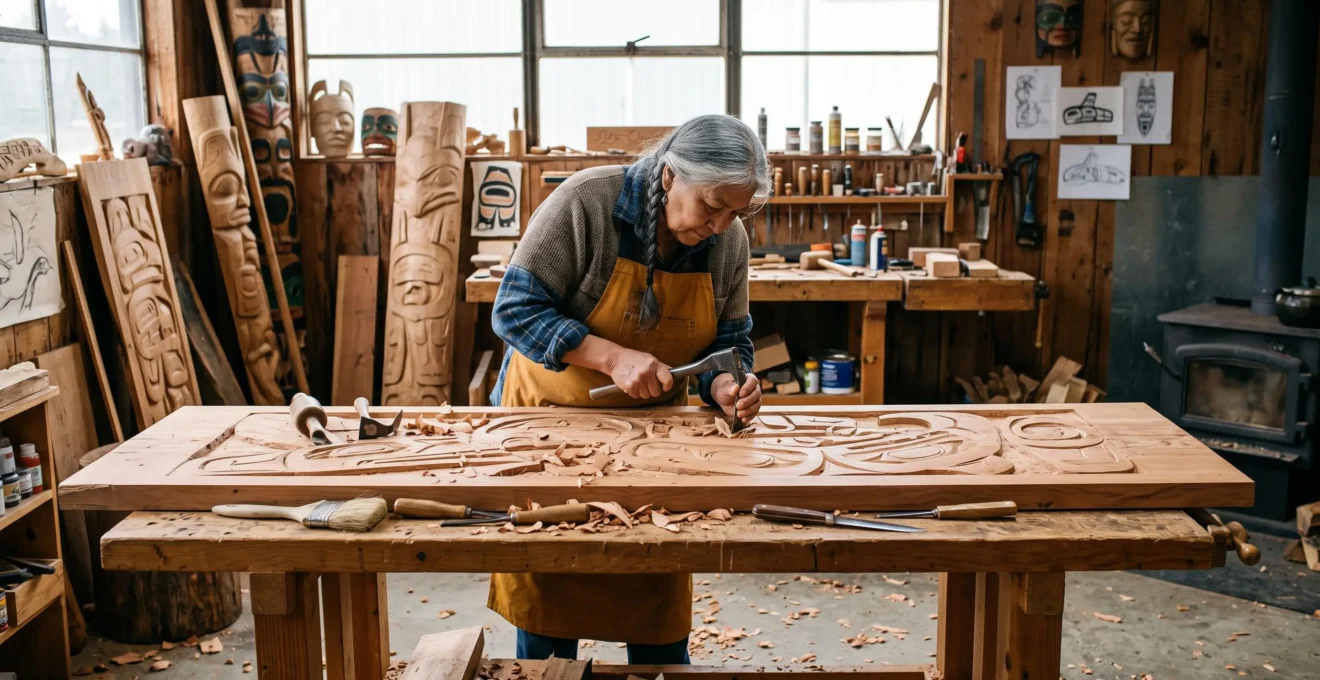
Indigenous artistic expression connects tradition and contemporary Canada through living relationships among artists, communities, territories, languages and cultural knowledge. First Nations, Inuit and Métis creators work across carving, textiles, painting, performance, film, animation and emerging technologies, bringing inherited practices into conversation with present-day experiences.
These expressions cannot be reduced to familiar decorative motifs or a single national identity. Some artworks carry community responsibilities or cultural permissions; others explore contemporary life without using recognizable traditional forms. Both may be meaningful expressions of Indigenous identity, although their significance must be understood on the artist’s own terms.
For Canadian audiences, appreciating these works involves more than identifying their visual qualities. It means recognizing distinct Nations, learning from Indigenous-led sources, understanding the effects of colonial policies and respecting the boundaries around cultural knowledge. Ethical purchasing, thoughtful interpretation and community-led preservation can all strengthen that engagement.
The central connection between tradition and contemporary art is therefore not stylistic uniformity. It is the continuing ability of Indigenous artists and communities to shape how their cultures are created, understood and shared.
Understanding Indigenous Artistic Expression in Canada
- Indigenous art represents distinct First Nations, Inuit and Métis histories and practices, not one recognizable Canadian style.
- Respectful engagement begins with artist attribution, cultural context, appropriate permissions and fair compensation.
- Contemporary media and community-led heritage initiatives can support cultural continuity while respecting Indigenous control over knowledge and storytelling.
- Why Indigenous Art Should Not Be Treated as a Single Canadian Style
- How to Research an Indigenous Artist and the Context Behind an Artwork
- Authentic Indigenous Artwork or Mass-Produced Imitation: What Should Buyers Check?
- Why Copying Sacred Indigenous Designs Can Cause Cultural Harm
- How Indigenous Artists Use Animation and Digital Media to Share Stories
- Why Some Public Sculptures Spark Debate in Canadian Communities
- Common Interpretation Mistakes That Can Distort Local Heritage Stories
- How Can Canadian Communities Preserve Cultural Heritage as Their Populations Change?
Why Indigenous Art Should Not Be Treated as a Single Canadian Style
Indigenous art should not be treated as a single Canadian style because First Nations, Inuit and Métis peoples have distinct histories, territories, artistic practices and cultural protocols. Their work may connect generations through particular materials, techniques or stories, but no shared aesthetic defines every Indigenous artist. Contemporary experimentation is as legitimate as customary practice.
Consider the differences among Inuit stone sculpture, Haida carving traditions, Mi’kmaq quillwork and artistic practices associated with Cree or Anishinaabe communities. Each emerges from particular histories, environments and knowledge systems. Even these examples represent broad traditions rather than uniform styles shared by every artist within a Nation.
The Canada Council for the Arts‘ briefing on Indigenous arts and cultures emphasizes the distinctions among Indigenous peoples and describes artistic expression across sacred, ceremonial, customary and contemporary practices.
Tradition and contemporary experimentation are not opposing categories. An artist may learn through community mentorship, formal artistic education or both. Their work might combine inherited techniques with photography, abstraction, installation or digital production. Another Indigenous artist may choose subjects unrelated to recognizable cultural motifs without becoming less authentic.
Commercial categories such as « Canadiana » can obscure these distinctions. When a gallery or souvenir shop groups unrelated objects under one national label, viewers may overlook who created them, where their practices originate and what responsibilities govern their use.
A more useful approach considers four questions:
- Nation: How does the artist identify their cultural or community affiliation?
- Territory: What place or relationship to land is relevant to the work?
- Medium: Which techniques and materials has the artist chosen?
- Function: Is the work intended for public display, personal expression, community use or another purpose?
Colonial history also shapes the relationship between inherited and contemporary practices. The Indian Act and associated policies restricted important cultural activities, including ceremonies such as the potlatch. Residential schools and other assimilation policies disrupted language and intergenerational knowledge transmission. Cultural practices nevertheless continued, adapted and experienced renewal through the efforts of Indigenous communities.
Present-day artistic expression must be understood against this history without defining Indigenous cultures solely through colonial harm.
Recognizing diversity is only the beginning. Understanding an individual work requires attention to the creator’s own account, which makes informed research an essential part of respectful cultural engagement.
How to Research an Indigenous Artist and the Context Behind an Artwork
Researching an Indigenous artist begins with identifying the artist’s Nation or community, reviewing their own description of the work and consulting reliable Indigenous-led sources. Cultural context matters because a design, material or narrative may involve histories and responsibilities that its appearance alone cannot reveal. Information that is not publicly shared should remain respected rather than reconstructed through speculation.
Start with the artist’s official biography, exhibition statements, interviews or published writing. Look for their preferred identification, which may include a specific Nation, community or territory rather than only the broad designation « Indigenous Canadian. »
Next, consult information published by Indigenous cultural centres, artist-run organizations, Indigenous curators or community institutions. Museum records and academic publications can provide additional perspectives, but their interpretations should be considered alongside what artists and relevant cultural knowledge holders choose to communicate.
Research should also distinguish what an artwork depicts from what it is authorized to communicate.
For example, imagine a hypothetical exhibition visitor identifying a carved figure as a purely decorative animal representation. If the work actually involves a hereditary crest or a culturally specific narrative, that aesthetic description may overlook questions of ownership, permission and cultural significance. The correct interpretation cannot be supplied merely by matching the figure with an online catalogue of symbols.
Canadian Heritage’s guidance on Indigenous creative industries recommends identifying creators accurately, respecting community protocols and seeking appropriate authorization before using sensitive cultural material.
A practical research record should distinguish verified information from interpretation. A curator’s description, an artist’s statement and a viewer’s personal response are not interchangeable forms of evidence.
Five Steps to Research an Indigenous Artwork Respectfully
- Record the artist’s full name and preferred Nation or community identification in a short attribution note.
- Locate an artist-authored biography, interview or statement and save its publication details.
- Identify the artwork’s title, date, medium and publicly documented context in a reference record.
- Cross-check significant cultural interpretations against an appropriate Indigenous-led source and note what remains unverified.
- Prepare a short description separating confirmed facts, personal interpretation and information that should not be reproduced without permission.
Not every question will have a public answer. Some teachings, practices, names or stories may be restricted to particular people or settings. A refusal to disclose information is not necessarily a research obstacle; it may express an important cultural boundary.
Good research therefore requires intellectual restraint as well as curiosity. Respecting an artist’s authority includes accepting what they choose not to share.
Once an artwork’s authorship and context are better understood, similar questions arise when someone considers purchasing it. Documentation can help buyers distinguish meaningful provenance from commercial claims that merely imitate Indigenous identity.
Authentic Indigenous Artwork or Mass-Produced Imitation: What Should Buyers Check?
Buyers should verify the artist’s identity, cultural attribution, seller’s relationship with the creator and the origin of an artwork before purchasing it. Authenticity is not established by a familiar motif, a high price or a generic certificate alone. Reliable provenance and transparent compensation are more useful than marketing language suggesting an object merely looks Indigenous.
Mass-produced products featuring Indigenous-looking designs can be sold without the involvement of Indigenous artists. Some are manufactured outside Canada, although manufacturing location alone does not determine authenticity: an Indigenous creator may legitimately license designs for production elsewhere.
The central issue is whether the product’s representation, authorship and commercial arrangements are truthful and respectful.
Unauthorized imitations can compete with Indigenous-made work at lower prices, redirect potential revenue and weaken the connection between cultural designs and the people entitled to use them. Canadian Heritage identifies these concerns in Canadian Heritage’s guide to working with Indigenous creative industries.
In Canada, certain marks help establish the origin of specific products. Examples include the Igloo Tag associated with Inuit art and the Genuine Cowichan mark. These are specific identification mechanisms, not a universal certification system for every First Nations, Inuit or Métis artwork.
Buyers should not assume that a generic Indigenous Art Code certificate or an Indigenous-made label represents a single nationwide official accreditation. Certification claims need to be checked against the actual issuing organization and the scope of the mark.
Before purchasing, ask the seller for the artist’s name and publicly available Nation or community identification. Request an explanation of whether the item is an original, a limited edition, a reproduction or a licensed manufactured product. Clarify whether the artist receives payment through the transaction or an agreed licensing arrangement.
A signature can support attribution but is not universal proof of authenticity. Some legitimate artworks are unsigned, while signatures and certificates can themselves be misrepresented.
The following comparison helps distinguish meaningful verification from weak sales claims.
| Criterion | Useful Evidence | Potential Warning Sign |
|---|---|---|
| Artist identity | Named creator and verifiable attribution | Only a generic Indigenous-inspired description |
| Origin | Transparent account of creation or licensed production | Unexplained or contradictory manufacturing claims |
| Documentation | Relevant provenance or a verifiable product-specific mark | Vague claims of official certification |
| Compensation | Clear information about the artist’s commercial involvement | No identifiable creator or licensing relationship |
An original handmade work may cost more because it reflects artistic labour, specialized materials, cultural learning and sometimes additional permissions or consultation. These factors are not universal pricing rules, however. An affordable, authorized reproduction can also be a legitimate way to support an Indigenous artist.
The most important distinction is not handmade versus manufactured. It is whether the artist’s contribution and the terms of production are accurately represented.
Respectful buying also involves recognizing that some designs cannot be freely reproduced even when their imagery is familiar. The question of cultural permission extends beyond consumer authenticity into ownership and collective rights.
Why Copying Sacred Indigenous Designs Can Cause Cultural Harm
Copying sacred or culturally restricted Indigenous designs can cause harm because some images, stories and symbols carry responsibilities held by particular families, clans, communities or Nations. Unauthorized reproduction may misrepresent those relationships, remove cultural material from its proper setting and divert commercial benefits from legitimate rights holders. Public visibility does not automatically mean permission to reuse.
A common misunderstanding treats all recognizable cultural imagery as freely available artistic inspiration. Yet the significance of a design may depend on who created it, who has authority to display it and the circumstances in which it can be shared.
Not every Indigenous motif is sacred or restricted. Artists also create original imagery for public circulation and may welcome collaboration, reproduction or licensing. Determining which situation applies requires specific information rather than assumptions based on visual appearance.
Appropriation involves more than aesthetic resemblance. A commercial reproduction becomes especially problematic when culturally distinct material is taken without appropriate authorization or attribution.
The consequences can be both cultural and economic. A copied design may be marketed without acknowledging the relevant community, while revenue flows to an unrelated manufacturer. Even when a product generates little direct income, its circulation can establish misleading expectations about who controls the imagery.
Canadian intellectual property law offers certain protections to individual artistic works. However, collectively held or intergenerational cultural expressions may not fit neatly within conventional requirements concerning authorship, originality or protected expression.
Innovation, Science and Economic Development Canada‘s briefing on Indigenous intellectual property explains these challenges and discusses complementary mechanisms, including trademarks, contractual arrangements and community-level protections. The briefing is an institutional overview, not a complete statement of current Canadian law.
Legal permission and cultural authorization are not necessarily equivalent. An image might fall outside a particular copyright claim while its reproduction still conflicts with the protocols of the community associated with it.
A respectful collaboration therefore begins by identifying the relevant decision-makers. Depending on the material, authorization could involve the individual artist, a family, community representatives or another recognized rights holder.
For example, a hypothetical design company considering the use of an inherited crest should not assume that permission from a graphic designer who can redraw it is sufficient. It would first need to establish the crest’s cultural authority and whether commercial use is appropriate. If authorization cannot be established, the company should select a different approach.
Good collaboration also makes attribution, compensation, permitted uses and future reproduction rights explicit. Where cultural material is sensitive, confidentiality and restrictions on redistribution may be appropriate.
These principles remain relevant when artistic material moves online. Digital technologies can create valuable opportunities for Indigenous storytelling, but they also make copying, redistribution and loss of context easier.
How Indigenous Artists Use Animation and Digital Media to Share Stories
Indigenous artists use animation, games, immersive media and other digital formats to express contemporary experiences and share culturally grounded stories. These tools can support language use, creative experimentation and intergenerational learning. Digital storytelling does not automatically replace oral traditions or community protocols; its value depends partly on who creates, controls and authorizes the narratives being shared.
Animation allows artists to develop visual worlds through movement, sound, dialogue and character design. Digital production can bring together illustrators, language speakers, performers, composers and cultural advisers while giving creators considerable freedom over how stories are presented.
Games and interactive media introduce additional possibilities. Rather than simply watching a narrative unfold, audiences may engage with choices, environments and sequences designed by the creators. Virtual and augmented reality offer other ways to explore experiences involving place, memory or cultural knowledge.
These formats are not inherently more effective than customary storytelling. They are additional media whose cultural significance depends on their content, creators and intended audiences.
Canada’s Indigenous Screen Office provides a concrete example of Indigenous-led support for audiovisual storytelling. Its funding environment encompasses established screen formats alongside gaming, immersive media and podcasts.
34%
Of projects supported by the Indigenous Screen Office Program during fiscal years 2021–22 through 2024–25 included Indigenous languages. This represents a specific funded group of projects, not all Indigenous audiovisual production in Canada.
Canadian Heritage’s evaluation of the Indigenous Screen Office Program, published June 22, 2026.
The evaluation also reported annual averages of 53 Indigenous audiovisual stories supported in development and 35 in production during the assessment period. These figures demonstrate activity within the program, not national production totals.
Language-related production may involve translation, dubbing, subtitles and contributions from Elders or knowledge keepers. Such work can create recordings and creative materials through which languages remain audible to new audiences. Whether it produces lasting language revitalization depends on sustained community use and other conditions beyond any single production.
Animation and related screen media can also provide creative approaches to difficult subjects, including residential schools, displacement and reconciliation. Visual abstraction, pacing and sound may allow artists to communicate experiences in ways that differ from documentary interviews or conventional historical narration. Audience responses vary, and no single format should be assumed to have a superior impact.
Digital distribution creates a further challenge: material shared outside its original setting can be copied, edited or redistributed without appropriate context. Technologies such as generative artificial intelligence introduce additional concerns involving cultural representation, consent and Indigenous-language content.
Indigenous narrative sovereignty means that creators retain meaningful authority over their stories. That principle remains important regardless of whether an artist works with a carving tool, a camera or an animation platform.
When these artistic expressions enter shared civic spaces, questions of representation become more public. Sculptures and monuments can bring contrasting accounts of Canadian history into direct conversation.
Why Some Public Sculptures Spark Debate in Canadian Communities
Public sculptures can spark debate when the histories they celebrate conflict with the experiences of communities represented, excluded or harmed by those histories. In Canada, disputes may involve colonial figures, absent Indigenous consultation or competing interpretations of public memory. The central question is often not whether history should be remembered, but whose perspectives shape its public presentation.
A monument occupies a different position from an artwork displayed in a private gallery. Installed in a civic square, park or government setting, it can appear to carry institutional endorsement. Its location, inscription and commissioning history influence how people interpret it.
For Indigenous communities, a colonial-era monument may represent more than a historical figure’s individual biography. It can also evoke policies of dispossession, cultural suppression or institutional exclusion. Other residents may view the same monument as a longstanding local landmark or a record of an earlier period.
These viewpoints cannot be resolved simply by treating every historical interpretation as equally complete. Evidence matters, as does the participation of people whose histories are being represented.
Communities considering a contested sculpture have several possible responses:
| Approach | Potential Contribution | Important Limitation |
|---|---|---|
| Removal or relocation | Changes what a civic space publicly honours | Requires decisions about storage, access and historical documentation |
| Contextual interpretation | Adds historical perspectives and acknowledges contested meanings | May leave the monument’s prominent position unchanged |
| Community-led reinterpretation | Allows affected communities to shape public understanding | Requires meaningful authority, resources and continued collaboration |
| New public art commissions | Creates space for contemporary Indigenous artistic voices | Does not automatically resolve concerns about existing monuments |
Contemporary Indigenous public artworks can also reshape civic environments through installations, sculpture and other commissioned forms. Their significance is not limited to providing a counterpoint to colonial monuments; they may affirm relationships with territory, contemporary identity, language or community life on their own terms.
When evaluating a local dispute, residents can ask who selected the original subject, who was consulted, how historical claims are supported and what decision-making power affected communities now possess.
Consultation should influence decisions rather than merely document objections. Meaningful engagement makes room for different community perspectives while respecting Indigenous rights and responsibilities.
These debates also reveal how easily public interpretations become accepted knowledge. The words used on plaques, museum labels and heritage displays can influence cultural understanding long after their original authors are gone.
Common Interpretation Mistakes That Can Distort Local Heritage Stories
Local heritage stories become distorted when interpreters apply generalized cultural meanings, overlook Indigenous knowledge holders or treat incomplete accounts as settled history. Common errors include interpreting Indigenous artwork exclusively through Western aesthetic categories, dismissing oral histories and assuming a symbol has the same meaning across Nations. Respectful interpretation requires evidence, cultural context and a willingness to revise previous explanations.
One frequent error is describing an artwork entirely through form, colour or technique while excluding its relationships with community knowledge. Formal analysis can be useful, but it may be insufficient where cultural responsibilities affect the work’s meaning.
Another mistake is treating oral traditions as automatically less credible because they do not resemble written archival documents. Oral histories can carry historical knowledge, relationships and understandings of place. Their appropriate interpretation requires attention to the traditions and knowledge holders involved, rather than imposing a single standard of documentary presentation.
A third problem arises when a design’s meaning is generalized across unrelated communities. Similar-looking forms do not establish shared symbolism, and the significance of an image cannot always be determined outside its original context.
Interpretation errors can spread through repeated publication. An unsupported claim introduced in a museum label may be copied into a tourism guide, classroom resource or digital article. Later authors may mistake repetition for independent confirmation.
Consider a hypothetical local exhibition that describes an object using a symbolic meaning found in an unrelated regional source. If subsequent educational materials repeat that explanation, visitors may encounter an apparently established interpretation that no appropriate community knowledge holder has confirmed.
A responsible correction process would identify the original claim, trace its supporting evidence and consult the relevant artist, cultural organization or authorized knowledge holders. The exhibition could then revise its explanation, attribute the interpretation appropriately and record what remains uncertain.
Community involvement must extend beyond a one-time request for approval. Effective heritage interpretation benefits from agreed responsibilities for reviewing language, authorizing sensitive content and responding to corrections.
Good intentions do not eliminate the need for these safeguards. An institution may genuinely wish to celebrate Indigenous culture while still creating misleading materials if it selects information without meaningful collaboration.
It is equally important not to demand that every detail become public. Some cultural knowledge is not intended for general distribution. An accurate interpretation may acknowledge that limits exist without disclosing the restricted material itself.
These principles become particularly important as Canadian communities change. Preservation efforts must respond to mobility, demographic change and shifting opportunities for cultural transmission without assuming that heritage can be preserved simply by collecting objects or recording stories.
Key Takeaways for Community Heritage Decisions
- Identify who has cultural authority to guide interpretation, preservation and access before designing a heritage initiative.
- Distinguish publicly shareable cultural materials from knowledge requiring restricted or community-controlled access.
- Assess whether proposed preservation activities support ongoing cultural practice, not only the creation of permanent records.
How Can Canadian Communities Preserve Cultural Heritage as Their Populations Change?
Canadian communities can preserve cultural heritage through Indigenous-led cultural centres, language initiatives, community archives and living artistic practices. As populations move or change, effective preservation depends on maintaining relationships among knowledge holders, younger generations and their communities. Digital documentation can support these efforts, but it cannot replace cultural authority, direct participation or ongoing opportunities to practise traditions.
Population change creates several different challenges. In smaller communities, outmigration may reduce opportunities for regular gatherings and in-person learning. In growing urban areas, people from different Nations may need culturally appropriate spaces to maintain distinct connections and practices.
Language transmission can face additional pressures when speakers and learners are separated by distance, limited resources or changing community circumstances. These pressures vary substantially among First Nations, Inuit and Métis communities and should not be understood as one uniform Canadian experience.
Community governance is central to effective preservation. Indigenous-led initiatives can determine which materials are collected, who may access them, how they are interpreted and whether particular knowledge should be recorded at all.
Cultural centres may support exhibitions, workshops, artistic mentorship and local education. Language programs can connect learners with fluent speakers and culturally grounded instruction. Community archives can preserve selected documents, recordings and photographs under locally determined access rules.
Digital tools provide further options, including audio documentation, digitized collections and virtual exhibitions. These formats may help people engage with materials across geographic distances, but technological access alone does not ensure language use or cultural continuity.
Imagine a hypothetical community archive developing a collection of recorded interviews. The project might involve Elders, younger archivists and language learners, but its success would depend on more than producing audio files. Participants would need to decide which recordings can be shared, how contributors are credited, what permissions are required and who manages future access.
Some materials could be publicly available for education. Others might be accessible only to designated community members. Certain teachings might be better preserved through direct relationships rather than permanent recordings.
This distinction suggests three practical preservation categories:
- Preserve as a record: Materials approved for documentation, archiving and appropriate future access.
- Support as a living practice: Language use, artistic teaching, ceremonies or creative activities sustained through community participation.
- Protect through cultural authority: Knowledge whose access, transmission or use belongs to designated holders rather than the general public.
The categories may overlap, and decisions must remain open to revision by the relevant community authorities. An archival record can support living practice, but it does not automatically confer permission to reproduce its contents.
Heritage preservation should also leave room for innovation. Contemporary artists may adapt techniques, explore unfamiliar materials or address new community experiences. A culture is not preserved more faithfully simply by preventing its members from creating new expressions.
For Canadian audiences and cultural organizations, the practical objective is to support Indigenous peoples’ continuing ability to define, practise and transmit their own heritage.
A useful next step is to choose one Indigenous-led cultural organization, exhibition or artist project relevant to the community being explored. Review how it identifies its cultural context, presents permissions and involves knowledge holders. Then consider what support or participation is appropriate on the terms established by those responsible for the work.
Can non-Indigenous people collect and display Indigenous artwork?
Yes, when the artwork is legitimately offered for sale or display and the relevant permissions are respected. Buyers should verify attribution, provenance and authorized reproduction rights. Owning a physical artwork does not necessarily grant permission to reproduce its images commercially or disclose culturally restricted knowledge.
Does Indigenous artwork need traditional motifs to be authentic?
No. Indigenous artists may work through customary techniques, contemporary methods or combinations of both. Artistic authenticity should not be judged solely through recognizable motifs. The artist’s identity, creative authority and the accurate representation of their work matter more than conformity to a familiar aesthetic.
Is it appropriate to photograph Indigenous artwork in a museum or gallery?
Follow the venue’s photography policies and any restrictions identified by the artist or relevant community. Permission to view an artwork does not necessarily authorize photography, online publication or commercial reuse. Where restrictions are unclear, ask staff or the appropriate rights holder before recording or sharing images.
Can digital archives make all Indigenous cultural knowledge publicly accessible?
No. Some cultural materials are appropriate for public access, while others are subject to community, family or ceremonial restrictions. Digital preservation should follow the decisions of appropriate knowledge holders and provide access controls where needed. Making a record technically available does not automatically make its unrestricted distribution culturally appropriate.
How can visitors support Indigenous artists without purchasing artwork?
Visitors can attend Indigenous-led exhibitions and cultural events, engage with artist-authored publications, pay appropriate admission or event fees and share authorized information with accurate attribution. Supporting Indigenous cultural organizations and respecting the creators’ stated boundaries are meaningful forms of engagement beyond purchasing objects.