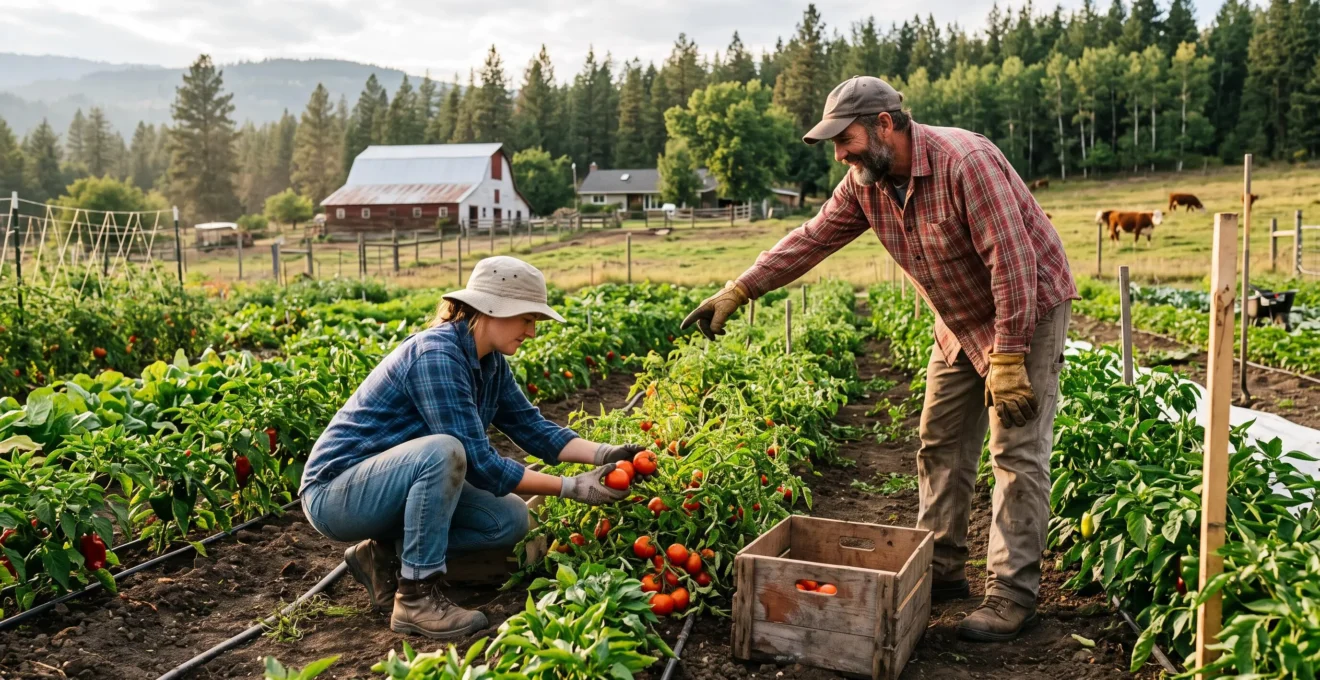
A Canadian farm stay can turn a familiar countryside getaway into a closer encounter with the people, seasons and daily decisions behind regional food production. Rather than spending an afternoon picking fruit or browsing a roadside stall, travellers can spend several days observing how a farm operates, participating in suitable activities and discovering where its products are sold.
The experience depends on more than the accommodation. A vegetable grower preparing for harvest, a livestock farm caring for animals and an orchard between picking seasons have different routines. The most rewarding visits begin with understanding what the farm actually produces, which activities guests can join and how those activities fit the time of year.
Families can build their trip around supervised agricultural experiences, while food-focused travellers can connect farm visits with farmers’ markets, restaurants and regional producers. With a suitable base and realistic expectations, even less-visited agricultural regions become manageable destinations for a longer rural holiday.
Canadian farm stays: the essentials
- Choose your travel dates according to the farm’s crops, livestock and seasonal activities rather than a general Canadian travel calendar.
- Confirm supervised activities, family safety arrangements and daily routines directly with the host before booking.
- Combine an overnight farm experience with nearby farmers’ markets and regional food producers to understand the journey from production to purchase.
- Why Do Farm Stay Experiences Change Throughout the Growing Season?
- How to Plan a Family Farm Stay with Young Children Safely
- Working Farm Stay or Pick-Your-Own Visit: Which Fits Your Travel Goals?
- Farm Visitor Safety Mistakes Around Animals and Agricultural Equipment
- When to Visit Canadian Farmers’ Markets for Regional Harvest Variety
- How to Cut Weekly Grocery Spending Through Seasonal Meal Planning
- How to Create Tourism Partnerships Between Restaurants, Guides and Accommodations
- How to Explore Lesser-Known Canadian Regions Without Complicated Travel Planning
Why Do Farm Stay Experiences Change Throughout the Growing Season?
Canadian farm stay experiences change because agricultural work follows crop development, animal care requirements, weather and regional growing conditions. Spring may involve planting and newborn livestock, summer brings field maintenance and harvesting, autumn concentrates on gathering and storing produce, and winter often emphasizes animal care or protected cultivation. The same property can therefore offer remarkably different guest activities throughout the year.
Consider a hypothetical mixed farm welcoming guests in May and September. May visitors might observe seedling preparation, help with an approved planting activity or learn about the care of young animals. September visitors could instead assist with suitable harvesting tasks, sort produce or discover how crops are prepared for local market sales. Although the accommodation remains unchanged, the agricultural experience is fundamentally different.
Seasonal patterns also depend on location and crop type. Prairie grain producers, Okanagan fruit growers and Atlantic Canadian vegetable farms do not share a single harvest schedule. Even within one region, temperature, rainfall, crop varieties and growing methods can shift the timing of activities.
In winter, certain livestock operations continue caring for animals daily, while some greenhouse businesses maintain production. Maple-related activities belong to their own seasonal cycle and should not be assumed to be available during every winter stay.
When researching a property, distinguish between its year-round description and the activities available during your actual booking dates. A website featuring summer harvest photographs may be describing experiences that are unavailable during a spring visit.
- Spring: Ask about planting, seedlings, livestock care and seasonal access restrictions.
- Summer: Check which crops are ready and whether guests may participate in harvesting.
- Autumn: Explore harvesting, storage, food preparation and market-related activities.
- Winter: Confirm whether the property accepts visitors and which indoor or outdoor experiences remain available.
A practical approach is to contact hosts three to six weeks before the intended stay and ask what guests are expected to experience during that particular week. Request examples of actual activities rather than relying on promotional descriptions.
Once the timing is suitable, the next consideration is whether the working environment can safely accommodate everyone travelling, particularly younger children.
How to Plan a Family Farm Stay with Young Children Safely
A safe family farm stay starts with selecting an operation that welcomes children, clearly separates visitor activities from agricultural hazards and offers supervision appropriate to each child’s age. Parents should verify access to machinery, livestock areas and water features before booking. Young visitors benefit most from a small number of structured, hands-on activities rather than unrestricted exploration of a working property.
Not every farm offering accommodation is designed for children. A small hobby farm may have visitor-friendly animal areas and flexible activity schedules, while a commercial operation may have moving equipment, production buildings and time-sensitive work. Neither environment should be assumed safe simply because the property advertises family accommodation.
Ask whether livestock pens, ponds, workshops and machinery storage areas are secured or clearly separated from guest spaces. Confirm who supervises agricultural activities and whether the host has experience welcoming children of similar ages.
For hygiene and animal contact, Nova Scotia‘s animal exhibit safety recommendations emphasize supervision, handwashing and separation between animal areas and places where visitors eat. These provincial recommendations offer useful precautions for families, although individual farms may apply additional requirements.
A manageable daily routine might include collecting eggs with permission in the morning, relaxing after lunch and taking part in a short garden activity later in the day. One or two meaningful experiences usually leave more room for questions, rest and unexpected changes than a continuous programme of farm tasks.
Pack closed-toe footwear suited to uneven or muddy ground, weather-appropriate layers, spare clothing and supplies for personal hygiene. Washing hands with soap and running water after animal contact is important; hand sanitizer can be useful when appropriate but should not replace required handwashing facilities.
Before arrival, explain to children that animals must not be fed or touched without permission, gates are not toys and equipment is never a play area. Parents remain responsible for supervising their children even when a farm host leads an activity.
Five checks before confirming a family farm stay
- Ask which activities are suitable for each child’s age and obtain a written list of available supervised experiences.
- Confirm how machinery, livestock enclosures and water hazards are separated from guests, and record the host’s explanation of restricted areas.
- Request a sample daily schedule and identify one or two realistic activities for each day of the stay.
- Check footwear, clothing and hygiene requirements, then prepare a family packing checklist.
- Confirm check-in instructions, emergency contact arrangements and any child-specific restrictions, keeping the details in your booking notes.
Choosing a suitable environment makes the experience more comfortable, but families should also consider whether a full overnight stay is necessary for the type of agricultural involvement they want.
Working Farm Stay or Pick-Your-Own Visit: Which Fits Your Travel Goals?
A working farm stay is better suited to travellers seeking sustained contact with agricultural routines, while a pick-your-own visit offers a shorter, more flexible introduction to local food production. Farm stays involve accommodation and potentially supervised activities over several days. Pick-your-own experiences typically focus on harvesting a specific crop during an available picking window, making them easier to combine with other travel plans.
The distinction is not simply about how much produce visitors take home. A farm stay can reveal the work surrounding food production, including animal care, crop planning, harvesting and preparation for sale. A pick-your-own visit concentrates on one accessible part of that process.
However, staying on a farm does not automatically grant permission to perform agricultural work. Some properties provide accommodation and demonstrations without offering direct participation, while others arrange clearly defined guest activities.
In British Columbia’s Agricultural Land Reserve, the Provincial Agricultural Land Commission‘s farm diversification rules distinguish agricultural activities, agritourism and accommodation, with conditions applying to farm-related visitor experiences. These rules concern a specific provincial land-use framework and should not be treated as national requirements.
The comparison below helps determine which arrangement matches your expectations.
| Travel consideration | Working farm stay | Pick-your-own visit |
|---|---|---|
| Typical commitment | One or more nights | Usually a few hours |
| Primary experience | Extended exposure to farm life | Harvesting an available crop |
| Guest participation | Depends on activities approved by the host | Usually limited to designated picking areas |
| Planning requirements | Accommodation booking and activity confirmation | Checking picking dates, hours and availability |
| Cost considerations | Accommodation, travel, meals and possible activity fees | Potential admission and produce charges |
| Flexibility | Must fit the farm’s schedule | Often easier to include in a day itinerary |
Neither option guarantees a particular harvest or activity. Rain, crop maturity and operational priorities can change what visitors are allowed to do, sometimes at short notice.
For a longer Canadian road trip, the strongest approach may be to combine both formats. Use a farm stay as the main agricultural experience, then explore pick-your-own locations or farmers’ markets between destinations. This creates a progression from seeing produce in the field to understanding how it reaches local buyers.
Whichever format you choose, direct contact with agricultural production comes with responsibilities that differ from those encountered at conventional tourist attractions.
Farm Visitor Safety Mistakes Around Animals and Agricultural Equipment
The most common farm visitor safety mistakes involve approaching animals without permission, entering restricted buildings or fields, allowing children near machinery and overlooking hygiene requirements. Visitors may also underestimate electrical fencing, irrigation installations and working dogs. A safe visit requires following the host’s designated routes, respecting farm boundaries and treating operational areas as workplaces rather than recreational spaces.
Farms continue operating while guests are present. Equipment may move between fields, animals may react unpredictably and production areas may contain hazards that are not obvious to people unfamiliar with agriculture.
The Canadian Food Inspection Agency‘s guide to visiting farms explains that diseases and pests can move through contact with animals and plants, but also through contaminated footwear, clothing, soil and equipment. Its visitor guidance includes obtaining permission, respecting biosecurity procedures and avoiding unauthorized exploration or contact with machinery.
These precautions protect agricultural operations as well as visitors. A guest who enters an animal enclosure or walks through a production area without approval may create risks even when nothing appears visibly dangerous.
- Livestock: Never enter an enclosure or approach, feed or handle an animal unless the host explicitly permits it.
- Machinery and ATVs: Keep children away from agricultural vehicles, attachments and operational equipment. Do not touch or operate them.
- Working dogs: Ask before approaching or touching any farm dog. Its responsibilities and behaviour may differ from those of a household pet.
- Fences and irrigation: Treat electrical fencing, pumps, hoses and irrigation systems as potentially hazardous, and request instructions before entering nearby areas.
- Gates and pathways: Remain on approved routes, follow the host’s instructions about gates and report damaged barriers or other hazards promptly.
Hygiene deserves particular attention after animal contact. Wash hands thoroughly with soap and running water after leaving animal areas and before eating. Keep food, drinks and children’s mouth-contact items away from livestock spaces, and follow any footwear-cleaning requirements.
Biosecurity also matters when visiting multiple farms. The CFIA guidance includes precautions concerning visits to other agricultural premises and recent contact with animals. Travellers planning several farm visits should disclose relevant recent exposure and follow each host’s current instructions rather than assuming one property’s rules apply everywhere.
On arrival, request a brief walk-through identifying approved areas, off-limits buildings, animal-contact procedures and emergency arrangements. This is especially important where visitor accommodation shares space with ongoing farm operations.
With operational boundaries understood, travellers can explore another side of the rural food system: the markets where producers connect directly with customers.
When to Visit Canadian Farmers’ Markets for Regional Harvest Variety
The best time to visit Canadian farmers’ markets for fresh local variety depends on the growing season and agricultural identity of the region. Summer typically brings a broad selection of berries, vegetables and seasonal fruit, while autumn emphasizes apples, squash and storage crops. Some markets continue through winter with preserved foods, greenhouse products and other regional specialties, but availability varies considerably between communities.
For a documented provincial example, Farmers’ Markets Ontario‘s seasonal produce calendar identifies asparagus among earlier-season offerings, cherries and peaches among summer products, and apples and squash among autumn produce. The calendar covers Ontario and explicitly recognizes variation related to weather, location, crop varieties and growing methods.
It should not be used as a fixed national harvest calendar. Different Canadian growing regions offer different combinations of products, while the actual timing of harvesting changes from year to year.
Regional food identities provide a useful starting point for planning:
- Okanagan, British Columbia: Explore orchard fruit and regional produce, with specific availability depending on crop and season.
- Prairie provinces: Look for grain- and pulse-related foods alongside seasonal vegetables and products from local livestock operations.
- Atlantic Canada: Discover regional berries, vegetables and, at markets carrying them, seafood from coastal producers.
- Quebec: Explore maple products, cheeses and seasonal produce while recognizing that fresh maple sap production has its own seasonal window.
When staying on a farm, ask the host which markets nearby producers attend, whether the property sells directly to visitors and which market days fit your itinerary. A visit becomes particularly informative when you can observe a crop being grown, meet its producer at a stall and later prepare a meal using the same ingredient.
Market arrival time also shapes the experience. Visiting early may provide a wider selection before popular items sell out. Arriving near closing might reveal discounted produce from some vendors, although reductions are never guaranteed and certain stalls may already be packed away.
Ask producers what is currently being harvested, how their products are grown or raised and what they recommend cooking with them. These conversations can reveal seasonal conditions, local varieties and food traditions that are difficult to understand from product labels alone.
Confirm operating days and whether a market continues indoors during colder months. Some seasonal markets close entirely, while year-round operations may change venue, vendor numbers and product selection.
The same attention to seasonal availability can remain useful after the trip, particularly when travellers want to apply what they learned to everyday food shopping.
How to Cut Weekly Grocery Spending Through Seasonal Meal Planning
Seasonal meal planning can help reduce grocery spending by building meals around produce that is abundant, reasonably priced and suitable for several recipes. The method works best when shoppers compare actual prices rather than assuming seasonal or local food is always cheaper. Flexible menus, pantry staples and careful storage can reduce unnecessary purchases and limit food waste over the week.
Farm stays offer a practical introduction to this approach. Watching crops reach maturity makes it easier to understand why certain ingredients appear in large quantities at particular times. Market visits then provide opportunities to compare varieties, quantities and prices directly.
However, peak-season availability does not guarantee the lowest retail price. Growing methods, transportation, labour, market location and individual vendor pricing can all influence what shoppers pay. A locally grown seasonal product may still cost more than an imported alternative.
A useful weekly method is to reverse the usual shopping process:
- Check which vegetables and fruits are available and compare their current prices.
- Choose two or three ingredients that offer good value and can be used in multiple meals.
- Build a flexible meal plan around those ingredients.
- Add pantry staples such as rice, pasta, dried pulses or other foods already available at home.
- Purchase only the additional ingredients required, then plan how to use or store leftovers.
For example, a hypothetical autumn shopping basket containing squash, carrots and apples could support roasted vegetables, a soup and simple fruit-based snacks. The savings would depend on actual quantities, prices and what the household would otherwise purchase.
Preservation can extend the usefulness of seasonal abundance. Freezing appropriate produce may be a manageable starting point. Canning requires tested, food-safe procedures suited to the product, while root-cellar storage depends on suitable temperature and humidity conditions. Travellers should not assume every preservation technique is appropriate for every food.
The most sustainable habit is often a modest one: replace two or three familiar meals each week with recipes based on current seasonal availability. This allows households to develop cooking confidence without discarding the convenience of their existing routines.
Beyond individual food choices, farm stays can also introduce travellers to the relationships among growers, restaurants, accommodation providers and local guides.
How to Create Tourism Partnerships Between Restaurants, Guides and Accommodations
Effective agritourism partnerships connect farms, accommodation providers, restaurants and local guides through clearly defined experiences and transparent producer relationships. Accommodation hosts can introduce visitors to nearby agricultural activities, restaurants can identify the farms supplying their ingredients, and guides can explain how local products are grown, processed and sold. Travellers benefit when these connections simplify planning and preserve authentic contact with producers.
For guests, the value of these partnerships is practical. Rather than independently arranging accommodation, an agricultural visit, a market stop and a regional meal, they may discover a compatible set of experiences through one knowledgeable host.
Consider a hypothetical arrangement involving a vegetable farm, a nearby restaurant and a local guide. The farm hosts overnight guests and provides an approved garden demonstration. The restaurant serves a dish using ingredients purchased from that producer, while the guide explains the region’s agricultural history and introduces other food businesses.
This example illustrates how collaboration could work; it is not a documented partnership or evidence of a specific economic result.
A functioning network requires more than mutual recommendations. Each participant needs to understand what is available, how reservations are handled, which activities are accessible to visitors and what happens when agricultural conditions change.
Useful partnership arrangements may include:
- Accommodation and farms: Verified visitor activities, practical directions and realistic seasonal availability.
- Restaurants and producers: Transparent ingredient sourcing and menus that reflect what participating farms can actually supply.
- Guides and agricultural businesses: Prearranged access, clear safety responsibilities and explanations grounded in real production practices.
- Markets and hosts: Accurate market-day information and opportunities for guests to meet participating producers directly.
Travellers can evaluate the authenticity of a farm-to-table claim by asking straightforward questions: Which farm supplied the ingredients? What is produced locally at this time of year? Can guests visit or meet the producer?
Specific answers are more informative than broad marketing language. A restaurant might use regional ingredients for only part of its menu, and a host may recommend businesses without maintaining a formal commercial partnership. Both distinctions are worth understanding.
Local connections can also provide alternatives when rain, harvesting delays or operational restrictions disrupt plans. A host familiar with nearby food businesses may suggest a market, producer shop or indoor experience instead, subject to availability.
These relationships become especially useful in rural destinations where attractions are spread out and visitors would otherwise spend considerable time coordinating individual stops.
Key takeaways for planning a rural food journey
- Choose a destination for its agricultural identity and accessible experiences, rather than trying to cover the largest possible geographic area.
- Use one well-located farm accommodation as a practical base for nearby markets, producers and countryside activities.
- Confirm transport, essential services and seasonal access before arrival so rural distances do not undermine the experience.
How to Explore Lesser-Known Canadian Regions Without Complicated Travel Planning
Travellers can explore lesser-known Canadian agricultural regions more simply by choosing one farm stay as their base and building short excursions around it. Selecting a region for its food production, confirming local market days and keeping most visits within a manageable driving distance reduces the need for complicated daily arrangements. Hosts can provide valuable local guidance, although transportation and seasonal accessibility still require advance planning.
Instead of assembling a route around major cities, begin with the kind of agricultural experience you want. Orchard landscapes, dairy production, vegetable farms and mixed farming communities create different opportunities for visitors interested in regional food culture.
Several Canadian regions provide useful starting points for further research:
- Prince Edward County, Ontario: Consider agricultural producers, farm-based food experiences and regional markets while checking which activities welcome overnight visitors.
- Eastern Townships, Quebec: Explore the region’s dairy and rural food traditions, including producer visits available during your travel dates.
- Annapolis Valley, Nova Scotia: Investigate orchards, seasonal produce and local markets within a landscape shaped by agricultural production.
- Kootenays, British Columbia: Look for smaller agricultural communities and locally organized food experiences suited to your preferred travel season.
These are destination ideas rather than verified accommodation recommendations. Specific farm stays, visitor programmes and market schedules should be confirmed independently before making reservations.
A manageable itinerary begins by selecting a region and booking a suitable farm stay. From there, identify a few potential excursions within approximately 45 to 60 minutes’ driving distance, adjusting for road conditions and the actual location of services.
For a hypothetical three-night stay, the first day could focus on arrival and an orientation with the host. The second might include a supervised farm activity followed by a local meal, while the third could centre on a farmers’ market and an additional producer visit. This leaves flexibility for weather changes and the farm’s operational priorities.
Rural travel does require preparation. A car is often useful or necessary, mobile coverage can be inconsistent, and grocery shops, fuel stations and restaurants may be separated by considerable distances. Download relevant maps, confirm arrival directions and bring essential supplies. Winter travel can introduce additional road and weather considerations.
For a longer journey, consider connecting two or three agricultural regions rather than changing accommodation every night. A stay in each region provides time to understand local food production and experience how agricultural traditions vary across Canada.
Start by identifying one region and contacting a suitable farm host about accommodation, seasonal activities and nearby market days. Build the remaining itinerary around those confirmed details, leaving space for the everyday discoveries that make rural food travel distinctive.
Do all Canadian farm stays allow guests to participate in agricultural work?
No. Some farm accommodations provide opportunities to observe agricultural operations, while others offer supervised activities or demonstrations. Guest participation depends on the property, season, available equipment, insurance arrangements and host permissions. Confirm exactly what participation involves before booking, particularly if hands-on activities are a main reason for your trip.
Can visitors bring their own pets to a working farm stay?
Pet policies depend on the individual property. Working farms may restrict visiting animals to protect livestock, working dogs and farm biosecurity. Ask for explicit permission before bringing a pet, and clarify where it may go. An accommodation advertised as pet-friendly should not be interpreted as permitting pets inside livestock or production areas.
What should travellers ask before booking a winter farm stay in Canada?
Confirm that the accommodation operates during winter, which activities remain accessible and whether visitors can safely observe or join any agricultural routines. Ask about road access, snow clearing, suitable footwear, heating and nearby essential services. Greenhouse and livestock operations may offer experiences outside the main growing season, but these opportunities must be verified with the host.
How can travellers tell whether farmers’ market products are actually local?
Ask vendors where an item was grown, raised or produced and whether they are selling their own products or goods from another supplier. Market policies and vendor arrangements differ, so the presence of a product at a farmers’ market does not independently establish its origin. Specific information about the producer and production location is more useful than a general local-food claim.
Is it possible to plan a Canadian agritourism trip without renting a car?
It may be possible in selected locations, but transport options require careful checking. Many agricultural properties are outside areas served by frequent public transit, and taxis or arranged transfers may be limited. Travellers without a car should confirm how to reach the accommodation, markets and booked experiences before paying for a stay. Hosts may be able to suggest transport options, but transfers should never be assumed to be included.