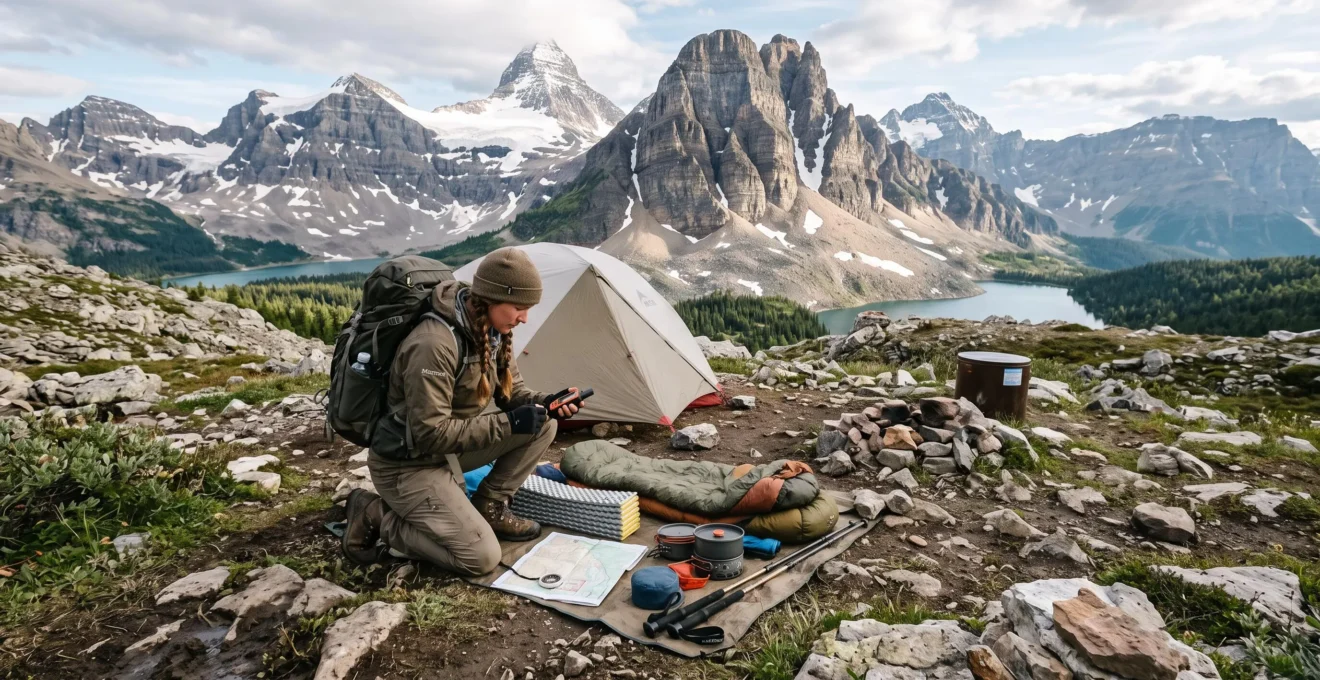
Backcountry camping in Canada’s mountain regions demands a different approach from staying at a developed campground. In the Canadian Rockies, Selkirks and Coast Mountains, changing weather, difficult terrain, wildlife activity and limited communications can turn a manageable inconvenience into a serious problem. Safe travel depends on preparing for those conditions before leaving the trailhead.
A reliable plan starts with choosing a route that matches the group’s experience, confirming where overnight camping is permitted, identifying suitable campsites and carrying equipment for unexpected delays. It also requires understanding how to retreat when circumstances change. Even a well-equipped camper can become vulnerable if a river rises, a mountain pass becomes impassable or an injured companion cannot continue.
The objective is not to eliminate every wilderness risk. It is to make informed decisions, preserve options for getting home and avoid depending on services that may not exist. For outdoor enthusiasts moving beyond established campgrounds, the most important skill is recognizing when self-sufficiency must take priority over completing the original itinerary.
Backcountry camping safety essentials
- Assess mountain weather, campsite hazards and exit routes together rather than treating them as separate planning tasks.
- Confirm camping permits and food-storage requirements with the responsible land manager before departure.
- Carry independent navigation and emergency communication equipment, leave a detailed trip plan and establish clear turnaround conditions.
- Why Mountain Weather Can Turn Dangerous Even on Summer Camping Trips
- How to Evaluate a Backcountry Campsite Before Setting Up Your Tent
- Designated Backcountry Sites or Dispersed Camping: Which Fits Your Trip?
- Food Storage Mistakes That Increase Wildlife Encounters at Remote Campsites
- When to Cancel or Turn Back: Reading Changing Conditions Before They Become Emergencies
- Navigating Boreal and Mountain Trails When Your Phone Has No Signal
- Planning Mistakes That Disrupt Trips to Remote Canadian Destinations
- How to Explore Canada’s Mountain Backcountry Trails Safely and Responsibly
Why Mountain Weather Can Turn Dangerous Even on Summer Camping Trips
Mountain weather can become dangerous during summer because elevation, changing airflows and passing weather systems produce conditions very different from those in nearby valleys. A warm morning can give way to thunderstorms, freezing temperatures or snow at higher elevations. Campers must monitor conditions throughout their trip and consider whether weather could prevent a safe return.
Elevation influences temperature and exposure, while mountain ridges and valleys redirect winds and create localized weather patterns. Cold air may settle into valleys overnight, making sheltered campsites unexpectedly chilly. Storm systems can also produce sharp differences between conditions at a trailhead and those encountered on an exposed pass.
In the Rockies, Selkirks and Coast Mountains, conditions should be reassessed whenever the route gains elevation or crosses exposed terrain. A regional forecast describes the broader weather pattern but cannot fully capture the conditions at every campsite, ridge or crossing.
Start with Environment and Climate Change Canada‘s regional forecasts, then compare them with available mountain-specific forecasts, elevation information and park advisories. Before departure, record the expected temperature range, precipitation, wind and thunderstorm potential. During the trip, compare those expectations with observed conditions.
Useful warning signs include:
- Rapidly building clouds, especially when accompanied by thunder or increasing wind.
- Sudden wind-direction changes or a noticeable deterioration in visibility.
- Falling atmospheric pressure combined with other signs of an approaching weather system.
- Unexpected snowfall, freezing precipitation or accumulating snow on exposed terrain.
- Rainfall that could affect streams, drainage channels or river crossings.
These observations are reasons to reassess conditions, not reliable standalone predictions. Pressure changes or developing clouds do not establish a universal deadline for retreat.
Distinguish uncomfortable conditions from those that compromise safety. A cold, rainy night may be manageable with adequate shelter and insulation. Lightning above treeline, rising water at a necessary crossing or accumulating snow on a pass can instead eliminate the route needed to leave.
Parks Canada’s Jasper backcountry safety guidance warns that mountain weather can change rapidly, snow and freezing temperatures are possible throughout the year, and high-elevation trails may remain snow-covered or icy into mid-summer.
The less obvious hazard is that the route home may become more dangerous than the campsite. A sheltered tent offers little protection against the consequences of a flooded crossing or inaccessible pass the following morning.
Weather planning should therefore include an exit strategy, not simply a clothing and shelter checklist. Once changing conditions threaten movement, the decision becomes whether the trip can continue safely at all.
How to Evaluate a Backcountry Campsite Before Setting Up Your Tent
A safe backcountry campsite should be assessed for falling trees, flooding, slope hazards, cold-air accumulation and wind exposure before a tent is unpacked. The most sheltered-looking location is not necessarily the safest. Campers must also check wildlife activity and follow the campsite restrictions established by the responsible park or public-land authority.
Begin by examining the surrounding terrain rather than focusing only on whether the ground is flat. Consider what could happen overnight if wind strengthens, heavy rain begins or nearby slopes become unstable.
- Check overhead hazards. Look for dead standing trees, broken branches, unstable trunks and leaning trees that could fall onto the sleeping area. Avoid positioning a tent beneath suspected widowmakers.
- Identify flood and debris-flow exposure. Avoid dry streambeds, drainage channels, creek banks vulnerable to rapid water-level changes and terrain directly exposed to material moving down steep slopes.
- Consider cold-air pooling. Depressions and low valley bottoms may collect cold air overnight. A slightly more elevated location may offer better thermal conditions without requiring an exposed ridgeline.
- Assess wind exposure. Ridges, open shorelines and exposed saddles can experience stronger winds. Choose natural shelter only after checking that surrounding trees and terrain are safe.
Site selection involves balancing competing hazards. Dense trees may reduce wind exposure but increase the risk of falling branches. A creek offers convenient water access but may expose tents to flooding and wildlife travel corridors. An exposed ridge might avoid pooling water while creating unacceptable wind or lightning exposure.
Before committing to a location, look for animal tracks, droppings, damaged vegetation, heavily used wildlife trails and signs that previous campers left food or garbage. These indicators warrant closer assessment because animals may continue to use the area. An existing fire ring or flattened tent space does not prove a location is safe or legally authorized.
Camping regulations override general campsite preferences. Some protected areas restrict visitors to designated campsites or established tent pads. Where random camping is authorized, minimum distances from trails, water and other facilities may apply.
For example, Parks Canada’s Banff backcountry rules specify additional conditions for authorized random camping areas. Campers cannot assume that distances permitted on provincial public land are acceptable inside a national park.
A final assessment should also consider whether the tent location interferes with drainage or damages fragile vegetation. When an authorized durable surface is available, use it rather than creating another disturbed area.
Once a location passes the terrain and legal checks, evaluate how cooking, water collection and food storage will work without introducing new risks. That decision is closely connected to whether the trip uses established campsites or dispersed camping.
Designated Backcountry Sites or Dispersed Camping: Which Fits Your Trip?
Designated backcountry campsites are generally more appropriate for beginners and travellers seeking established locations with possible food-storage facilities. Dispersed camping offers greater flexibility where it is legally permitted, but demands stronger navigation, campsite selection and self-sufficiency skills. The correct choice depends on local regulations, the group’s experience and the consequences of an unexpected delay.
In Canada, dispersed camping is not governed by one nationwide rule. National parks, provincial parks and provincial public lands can have substantially different requirements. Some locations prohibit camping outside approved sites, while others authorize random camping under specific conditions.
The comparison below illustrates the main planning differences, subject to destination-specific rules.
| Planning factor | Designated backcountry site | Dispersed or random camping |
|---|---|---|
| Legal access | Camping at authorized locations, subject to park conditions | Allowed only where the land manager permits it |
| Permits and reservations | May require a campsite reservation and backcountry permit | May require a separate permit, authorization or public-land access pass |
| Food storage | May provide lockers or bear poles | Campers often provide their own compliant storage system |
| Navigation | Usually follows identified camping locations | Requires independent identification of legal, suitable locations |
| Safety support | May provide established facilities and more predictable itineraries | Greater reliance on personal equipment and evacuation planning |
| Best suited to | Beginners and groups building backcountry experience | Experienced campers prepared for remote self-sufficiency |
Banff National Park provides a useful example of why legal distinctions matter. According to Parks Canada’s Banff backcountry camping regulations, overnight backcountry trips require a permit. Random camping is authorized only in specified areas and requires its own permit.
In those authorized Banff areas, random campsites must be at least 5 kilometres from a trailhead or designated campground, 50 metres from trails and 70 metres from water sources. Campfires are not permitted in the random camping areas covered by these rules.
By contrast, Alberta’s public land camping rules permit random camping unless signs, notices or departmental publications prohibit it. The provincial guidance includes a 30-metre setback from lakes and streams and a general maximum stay of 14 days, subject to additional applicable restrictions.
These are different regulatory settings. Neither set of distances should be applied automatically to British Columbia, another national park or a different public-land zone.
Reservation timelines also affect the decision. Popular designated campsites around Banff, Jasper and the Lake Louise area may require advance planning according to their booking windows. Confirm the applicable release dates and availability before fixing transportation or committing to a demanding itinerary.
Camping outside the locations authorized by a permit can result in enforcement consequences. It can also undermine a trip plan shared with a trusted contact, who may search the wrong area if the group unexpectedly camps elsewhere.
For a first remote mountain trip, a designated campsite with clearly understood regulations often provides a useful starting point. More remote camping becomes appropriate when the group can manage the responsibilities that established facilities would otherwise reduce.
Food Storage Mistakes That Increase Wildlife Encounters at Remote Campsites
Food-storage mistakes increase wildlife encounter risks when animals can access food, garbage or other attractants near campers. Common errors include keeping snacks inside tents, cooking beside sleeping areas and leaving toiletries or dirty cooking equipment unsecured. Effective storage means managing every relevant attractant using the method required for the specific camping location.
The problem extends beyond whether a bear can reach a food bag. Wildlife can become conditioned to associate campsites and people with food when previous encounters provide a reward. That increases risks for later visitors and can create serious consequences for the animals involved.
Frequent errors include:
- Eating or preparing meals in the tent or immediately beside the sleeping area.
- Storing toothpaste, scented toiletries or food packaging separately from other secured attractants.
- Leaving dirty pots, cooking utensils or food scraps accessible overnight.
- Keeping snacks in sleeping bags or jacket pockets inside the tent.
- Using an improvised bear hang where a specific approved container is mandatory.
- Assuming an established campsite is safe because previous visitors did not report wildlife problems.
Storage methods vary with the destination. Designated campsites may provide bear-resistant lockers or bear poles. Where permitted, some campers use properly constructed bear hangs, while other locations require approved bear-resistant containers. An improvised hang is not interchangeable with a required certified container.
Banff illustrates the distinction. Its designated backcountry campgrounds require attractants such as food, garbage, toiletries and cooking equipment to be secured using the designated food-storage infrastructure. In its authorized random camping areas, Interagency Grizzly Bear Committee-approved bear-resistant food containers are required from April 1 through November 15.
These requirements are specific to the locations and season identified in the Banff regulations, not a universal Canadian rule.
Food storage must be planned before selecting the camping style. A designated campsite with storage infrastructure reduces the burden of providing a separate system, although the camper remains responsible for using it correctly. Dispersed camping shifts more responsibility onto equipment selection, storage discipline and local compliance.
Cooking procedures should also keep attractants away from the sleeping area wherever site regulations and terrain allow. Avoid choosing a cooking location that places campers directly on a wildlife travel route or creates additional exposure to cliffs, unstable ground or water hazards.
Fuel and other potentially hazardous items require special attention: follow both the land manager’s attractant-storage instructions and the equipment manufacturer’s safety requirements. Do not place hazardous materials in a container or locker contrary to its permitted use.
The final evening check should account for every relevant item rather than only the main food supply. A clean campsite protects both the current group and future visitors.
Even careful storage cannot eliminate wildlife encounters. Campers still need appropriate wildlife-response knowledge, awareness of current advisories and the willingness to change plans when animal activity makes an area unsuitable.
When to Cancel or Turn Back: Reading Changing Conditions Before They Become Emergencies
A backcountry trip should be cancelled, postponed or shortened when changing conditions undermine the group’s ability to travel, camp or return safely. Rising rivers, deteriorating forecasts, nearby wildfire activity, injuries and excessive fatigue are legitimate reasons to stop. The strongest decisions come from establishing retreat criteria before departure rather than negotiating them during an emergency.
The main challenge is often psychological rather than technical. After travelling a long distance, paying for permits or reaching a nearly completed objective, groups may continue because turning back feels like losing the investment. This sunk-cost pressure becomes especially dangerous when combined with summit fever: prioritizing the destination over changing evidence.
Reduce this pressure by agreeing on a decision framework before leaving:
- Water conditions: do not enter a crossing when its depth, current, debris or visibility makes safe passage uncertain.
- Weather: retreat or shelter when conditions create unacceptable lightning, cold, visibility or route-access risks.
- Fire and smoke: reassess immediately when wildfire conditions, closures or smoke exposure threaten safe travel.
- Group condition: shorten the route when injury, illness or accumulated fatigue reduces the ability to reach a safe destination.
- Time: establish a turnaround time that preserves enough daylight and travel capacity for a safe return.
The group should agree that any member can raise a safety concern and that a designated decision-maker can call for retreat. Avoid making that person responsible for persuading everyone that a hazardous situation is already an emergency.
A turnaround deadline should be based on available travel time rather than distance remaining to the destination. If a group agrees to begin retreating by an established time, being close to the objective does not automatically justify extending it.
Consider a hypothetical trip that includes a creek crossing on the way to a reserved campsite. Heavy rain begins, and the creek becomes visibly stronger. Continuing may mean facing an even more difficult crossing on the return. The safer decision may be to retreat before the crossing becomes impassable rather than relying on the original reservation.
Cancellation planning begins several days before departure. Check destination-specific trail conditions, closures, wildlife alerts, wildfire notices and restrictions. Where practical, include a weather buffer day and select reservations or transportation arrangements with cancellation conditions the group understands.
Financial losses are real: permits, transport and other bookings may not be fully refundable. Policies vary, so check the actual reservation terms. Flexible planning helps prevent already-spent money from influencing safety decisions.
Turning back is a successful use of the safety plan, not evidence that preparation failed. Its effectiveness, however, depends on knowing where the group is and how to communicate if an ordinary retreat becomes impossible.
Navigating Boreal and Mountain Trails When Your Phone Has No Signal
Backcountry navigation without cellular service requires two separate systems: tools for determining location and equipment for requesting assistance. Offline maps and downloaded routes can support navigation without a mobile network, but they do not guarantee emergency communication. Campers should carry independent map-and-compass skills and establish a realistic emergency contact method before travelling remotely.
Mobile applications can remain useful when coverage disappears, provided the necessary mapping data has already been downloaded and the device can determine its position. However, an offline map does not resolve a depleted battery, damaged phone or incorrect route interpretation.
Prepare the navigation system in stages:
- Download relevant offline maps covering the intended route, potential alternatives and surrounding terrain.
- Save available GPX tracks and verify that they match the selected trail rather than assuming an online route is accurate.
- Carry an appropriate paper topographic map and working compass, with the skills required to use both.
- Test the offline navigation application before departure, including its behaviour with mobile data disabled.
- Plan battery management using airplane mode where appropriate, spare power and a power bank matched to the trip’s expected demands.
Practice locating trail junctions, interpreting contours and matching visible terrain to map features before attempting a remote journey. Paper navigation tools remove dependence on an electronic battery but are only useful when the person carrying them understands their limitations.
Emergency communication requires separate preparation. Parks Canada’s emergency guidance notes that cellular coverage is not always reliable in remote areas and that satellite communication devices can help initiate an emergency response. Satellite equipment is not infallible, however, and terrain or operating conditions may interfere with its performance.
A personal locator beacon (PLB) can provide an emergency distress-alert capability, while supported satellite messengers may offer additional messaging functions. Actual capabilities, coverage, subscription requirements and emergency procedures vary by device. Campers should understand their chosen equipment and test permitted non-emergency functions before departure.
Calling 911 remains an appropriate emergency action where a connection is available, but a remote campsite should not rely on cellular 911 access as its only rescue plan.
Navigation also becomes safer when progress is checked regularly. Identify major junctions, river crossings, elevation changes and expected travel-time checkpoints before leaving. If the terrain no longer matches the intended route, stop and establish the group’s location before continuing.
Early recognition of a navigation error can prevent a minor wrong turn from developing into an exhausting detour or an unplanned overnight stay.
The most dependable route is not necessarily the one with the shortest mapped distance. It is the one that the group can follow, recognize and safely leave using the resources available.
Planning Mistakes That Disrupt Trips to Remote Canadian Destinations
Remote mountain trips are frequently disrupted by underestimated travel times, incomplete permit arrangements, missing services and unrealistic hiking schedules. Problems become more serious when several occur together, because remote trailheads may offer little opportunity to obtain fuel, food, replacement equipment or assistance. Effective planning builds buffers around both the journey to the trailhead and the wilderness itinerary.
Driving to a remote access point can be a substantial part of the expedition. Unpaved roads, poor surface conditions, seasonal restrictions and changing road accessibility may extend travel times. A late arrival can leave the group starting an already demanding route with insufficient daylight.
Before departure, confirm access-road conditions, fuel availability, parking restrictions and whether the vehicle is suitable for the route. Do not assume that a nearby community, seasonal business or trailhead has fuel, food, rentals or other essential supplies.
Another common mistake is transferring hiking speeds from maintained urban or frontcountry trails to steep, uneven mountain terrain. A distance that seems straightforward on a map may take substantially longer when carrying overnight equipment or navigating rough ground.
River crossings, residual snow, route-finding delays and fatigue can reduce progress further. On a multi-day itinerary, one late arrival may affect subsequent reserved campsites or transport arrangements.
Campers should also verify permits, reservation conditions, trail access and any applicable orientation requirements before travelling. High-elevation snow may persist into summer; choosing a departure date from the calendar alone does not establish that a route is accessible.
A particularly important safeguard is a detailed trip plan held by a reliable contact. The person should know the intended route, overnight locations, vehicle details, expected return and the agreed time at which an overdue return should trigger follow-up action.
Five checks to complete before leaving for the trailhead
- Verify land access and camping authorization: save the applicable permit or authorization details and record the approved overnight locations.
- Check transportation and resupply: create a written list of confirmed road-access considerations, fuel stops and essential supplies to carry.
- Test navigation and communication: confirm offline map availability, inspect the paper map and compass, and record the emergency device operating procedure.
- Build a realistic route schedule: produce a day-by-day itinerary showing distances, expected travel windows, alternative routes and turnaround decisions.
- Share the emergency trip plan: provide a trusted contact with the route, campsites, vehicle information, expected return and a specific overdue-response arrangement.
Small planning errors often compound. For example, an unexpectedly slow access-road drive can create a late start. The late start increases fatigue, fatigue reduces walking speed, and reduced speed can put the next campsite beyond a safe day’s travel.
A workable itinerary therefore includes extra food, appropriate shelter and enough schedule flexibility to respond to delays without rushing into hazardous terrain.
Good preparation does more than reduce inconvenience. It preserves alternatives when transportation, weather or route conditions develop differently from the original plan, creating the foundation for responsible wilderness travel.
Key takeaways before your first remote mountain trip
- Choose the itinerary around the least experienced group member’s abilities, not the strongest hiker’s ambitions.
- Make every essential safety function independent where practical: navigation, shelter, food management and emergency communication should not depend on one device or facility.
- Build experience progressively, and select environments where an early retreat remains manageable before attempting more isolated routes.
How to Explore Canada’s Mountain Backcountry Trails Safely and Responsibly
Safe and responsible exploration of Canada’s mountain backcountry requires combining realistic route selection, self-sufficient equipment, sound judgment and minimal environmental impact. Campers should match their objectives to the group’s weakest skills, respect local regulations and prepare to retreat when conditions change. Progressively more demanding trips help develop experience without taking unnecessary risks.
The foundation is a pre-departure assessment covering three connected areas: what the group can do, what the equipment can support and what the selected environment demands.
Start by reviewing navigation ability, first-aid knowledge, wildlife-response skills, experience in poor weather and the group’s ability to make decisions under pressure. An experienced leader cannot automatically compensate for companions who are unprepared for the terrain or unable to sustain the expected pace.
Next, confirm that equipment supports genuine self-sufficiency. Essential categories include shelter appropriate to anticipated conditions, insulation, weather protection, water treatment, food reserves, lighting, first-aid supplies, repair materials, navigation tools and emergency communication equipment.
Equipment should be selected for the actual route and forecast conditions, not merely because it appears on a generic camping checklist. Group members also need to know how to use it.
Responsible camping protects the ecosystems that make these destinations valuable. Alpine vegetation, sensitive soils and boreal habitats can recover slowly from repeated trampling and disturbance. Staying on established routes where required, respecting closures and avoiding damage to vegetation help limit cumulative impacts.
Apply Leave No Trace principles in practical ways:
- Use established campsites and durable surfaces where legally permitted and appropriate.
- Respect wildlife distances and never approach or feed animals.
- Keep food, garbage and other attractants secured according to local requirements.
- Pack out garbage and manage human waste according to the destination’s rules.
- Respect seasonal closures, fire restrictions and designated travel routes.
- Avoid creating new trails, campsites or unnecessary disturbance in fragile terrain.
Responsible recreation and personal safety reinforce each other. Protecting wildlife from food rewards reduces future encounter risks, while keeping established trails and authorized camping locations can help prevent avoidable navigation and land-use problems.
A gradual progression provides a practical learning path. Begin with a manageable overnight trip at an authorized designated campsite, where logistics and route complexity are relatively predictable. Move to longer multi-day journeys after demonstrating competence with navigation, food storage and changing weather. Reserve genuinely remote dispersed trips for situations where the entire group can manage those demands independently.
Each trip should strengthen a specific ability rather than merely increase distance or isolation. Practising map navigation on a familiar trail, testing shelter during manageable bad weather and rehearsing turnaround decisions can be more valuable than attempting an ambitious route prematurely.
Ultimately, backcountry safety operates as a chain. Weather assessment informs route choice; route choice determines campsite and permit needs; campsite location shapes wildlife precautions; and navigation, communication and scheduling determine how reliably the group can respond when circumstances change.
For the next trip, select a realistic destination, verify its current access and camping requirements, complete the pre-departure checklist and share the resulting plan with a trusted contact. A successful backcountry adventure is one that preserves the ability to make safe decisions from departure to the return home.
Do beginners need a guide for backcountry camping in Canada’s mountains?
A guide is not universally required, but beginners should avoid routes that exceed their navigation, first-aid and wilderness experience. An introductory trip with experienced companions or a qualified guide can help develop essential skills. Whether independent travel is appropriate depends on the route, conditions, group abilities and any specific destination requirements.
Can you camp anywhere on Crown land in Canada?
No. Crown land camping permissions depend on the province, land designation and applicable restrictions. Alberta permits random camping on public land subject to conditions and local prohibitions, but those rules do not automatically apply elsewhere. Confirm the relevant land authority, applicable access requirements and current restrictions before selecting a campsite.
What should campers do if an emergency communication device fails?
Focus first on immediate safety, first aid and avoiding further exposure. Use any alternative communication method available without creating additional danger. A shared trip plan and agreed overdue-response procedure provide an important backup if communication fails. Do not assume another device or cellular network will work in remote mountain terrain.
How much extra food should be carried on a multi-day mountain trip?
Carry additional food appropriate to plausible route delays, the group’s needs and the difficulty of reaching an exit. There is no single quantity suitable for every Canadian mountain itinerary. Jasper National Park’s backcountry guidance specifically recommends extra food because travel may take longer than planned. The reserve should be incorporated into pack-weight planning and secured using the required wildlife-safe storage method.
Is summer the safest season for high-elevation backcountry camping?
Summer can offer more accessible conditions on some routes, but the calendar alone does not establish safety. Snow and ice may remain on high-elevation trails into mid-summer, and freezing temperatures or storms remain possible. Evaluate the actual trail, elevation, forecast, water conditions and current advisories rather than assuming that summer eliminates mountain hazards.